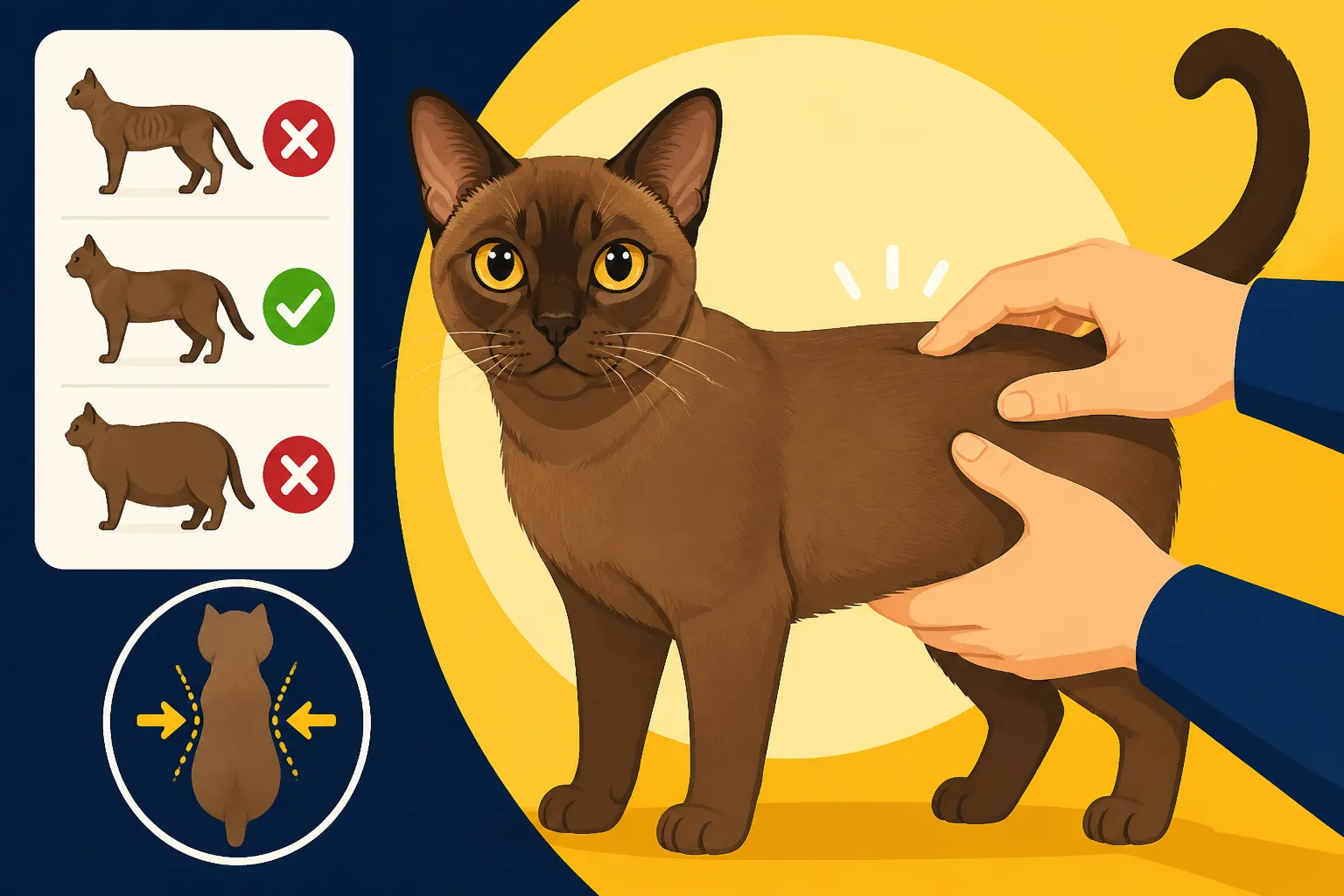
How to Score a Burmese’s Body Condition
It's a common dilemma for Burmese owners: how do you truly know if your wonderfully dense, 'brick wrapped in silk' companion is at a healthy weight? Their compact, muscular build can make it incredibly tricky to gauge their body condition accurately, often leading to worries about overfeeding or missing early signs of health issues. This comprehensive guide will walk you through exactly how to score your Burmese's body condition, empowering you to confidently assess their physique and maintain their optimal health throughout their lively lives.
Why Traditional Weight Checks Fall Short for Burmese
When it comes to our beloved Burmese cats, relying solely on the number on the scale can be incredibly misleading. Unlike many other breeds that might show weight fluctuations more obviously, the Burmese has a unique body composition that can trick even the most observant owner. Their substantial muscle mass means they naturally weigh more than their sleek appearance might suggest, making a direct weight comparison to other cat breeds almost irrelevant.
The Deceptive 'Brick Wrapped in Silk' Physique
The term "brick wrapped in silk" is often used to describe the Burmese, and it's spot-on. These cats are surprisingly heavy for their size, boasting a compact, muscular build that's dense and firm to the touch. This isn't fluff or fat; it's pure muscle. When you pick up a healthy Burmese, you'll immediately notice their unexpected heft. This density means that a weight that might be considered healthy for a less muscular cat could actually indicate an underweight Burmese, and conversely, a slight increase in weight could mean a much more significant accumulation of fat than initially perceived. You really have to get your hands on them to understand their true form.
For instance, you might have a friend with a Siamese or a Domestic Shorthair of similar stature who weighs a couple of pounds less, and it's easy to start wondering if your Burmese is overweight. However, comparing these breeds is like comparing apples and oranges because their genetic blueprints for muscle and bone density are completely different. The Burmese evolved with a specific robust structure, and this is entirely normal and healthy for them. Understanding this fundamental difference is the first step toward accurately assessing their condition. Why a Muscular Burmese Is Mistaken for a Fat One delves deeper into this common misconception.
Why the Scales Aren't Enough on Their Own
While regular weighing is absolutely a crucial part of monitoring your Burmese's health, it should never be the only tool in your arsenal. A fluctuation of half a pound might not look significant on the scale, but for a Burmese, it can represent a meaningful change in their body fat percentage, especially if they are already prone to certain health conditions. The scales give you a quantitative measurement, which is excellent for tracking trends, but they don't tell you where that weight is distributed – is it healthy muscle, or is it excess fat?
Think of it like this: two people can weigh the exact same amount, but one might be a bodybuilder with very little body fat, and the other might have a much higher fat-to-muscle ratio. The scales show identical numbers, but their body compositions are vastly different. The same principle applies to your Burmese. You need to combine the numerical data from the scales with a physical assessment to get the full picture. This is where body condition scoring (BCS) becomes an indispensable tool, offering a qualitative assessment that complements your regular weigh-ins. How to Weigh a Burmese Accurately at Home provides tips for consistent measurements.
Understanding the Burmese Body Condition Scoring System
Since the scales alone aren't sufficient, the veterinary community developed Body Condition Scoring (BCS) systems. These systems provide a standardized, visual, and tactile method to assess a pet's body fat reserves. While there are typically 5-point and 9-point scales, the 9-point scale offers a more nuanced assessment, which can be particularly helpful for a breed like the Burmese.
The Standard BCS Scale
The most commonly used BCS scale ranges from 1 to 9, where 1 is emaciated, 9 is morbidly obese, and 5 is considered ideal. Each number corresponds to a specific physical description, guiding you through a systematic evaluation of your cat's ribs, spine, waistline, and abdominal tuck. The beauty of this system is that it's not about a specific weight number, but rather about the feel and appearance of the cat's body structure. It forces you to look beyond the fur and consider what's underneath.
For example, a cat scoring a '1' would have ribs, spine, and pelvic bones easily visible from a distance, with no palpable fat and severe abdominal tuck. On the other end, a '9' would feature massive fat deposits over the chest, spine, and tail base, with no discernible waist and obvious abdominal distention. The goal is always to aim for that sweet spot of a '5', where the cat is well-proportioned, with a slight abdominal tuck and palpable but not visible ribs. This methodical approach removes much of the guesswork inherent in simply looking at your cat.
Adapting BCS for the Burmese's Unique Build
While the general principles of the BCS scale apply to all cats, you need to make slight allowances for the Burmese's muscularity. Their 'brick' like structure means they will naturally feel denser and more solid than many other breeds. When you're feeling for ribs, for example, you might have to apply slightly more pressure than you would on a slender Siamese. The key is to feel for the individual ribs, not just a general hardness. If you can feel them distinctly, but they aren't jutting out, you're likely in a good zone.
It's also important to remember that a Burmese's waistline, while present, may not be as dramatically tucked as in some more svelte breeds. A healthy Burmese will still have a discernible waist when viewed from above, and an abdominal tuck when viewed from the side, but it won't be as extreme as a cat with a very fine bone structure. The trick is to compare your Burmese to a mentally ideal Burmese, not to the picture of a generic ideal cat in a BCS chart. Understanding Why a Burmese Is Heavier Than It Looks is crucial here.
Here's a simplified version of the 9-point Body Condition Score (BCS) system, adapted with special considerations for your muscular Burmese:
| BCS Score | General Description | Burmese Specific Considerations | Key Physical Indicators |
|---|---|---|---|
| 1: Emaciated | Severe malnutrition; bones prominent. | Extremely rare in a well-cared-for Burmese. | Ribs, spine, pelvic bones very visible; no fat; severe abdominal tuck; sunken eyes. |
| 2: Very Thin | Ribs, spine, pelvic bones easily seen; no fat. | Still very thin for a Burmese; muscle loss evident. | Ribs easily visible, individual vertebrae palpable; severe abdominal tuck. |
| 3: Thin | Ribs easily felt, minimal fat; distinct waist. | On the leaner side for a Burmese; slight muscle definition. | Ribs easily palpable with minimal fat covering; definite waist; moderate abdominal tuck. |
| 4: Underweight | Ribs palpable, small amount of fat; noticeable waist. | Acceptable if active, but ideally aiming for 5. | Ribs easily palpable with thin fat covering; easily visible waist; good abdominal tuck. |
| 5: Ideal | Well-proportioned; ribs palpable, minimal fat. | The target score for a healthy, muscular Burmese. | Ribs easily palpable with slight fat covering; visible waist and abdominal tuck. |
| 6: Overweight | Ribs palpable with slight difficulty; fat over lumbar area. | Early signs of excess weight for a Burmese. | Ribs palpable with slight excess fat; waist less distinct; minimal abdominal tuck. |
| 7: Heavy | Ribs difficult to feel; obvious fat over back, abdomen. | Clearly carrying too much weight for optimal health. | Ribs difficult to feel; moderate fat deposits over back/abdomen; no abdominal tuck. |
| 8: Obese | Ribs not palpable; extensive fat deposits. | Significant health risk, needs immediate intervention. | Ribs not palpable; extensive fat deposits on chest, back, abdomen; pendulous belly. |
| 9: Severely Obese | Massive fat deposits; no waist; abdominal distention. | Morbidly obese, serious health emergency. | Massive fat deposits; no waist; distended abdomen; difficulty moving. |
Remember, the goal is to consistently assess your cat using these guidelines and consult your vet for a professional assessment, especially if you're unsure or see significant changes.
How to Physically Assess Your Burmese's Body Condition
The best way to score your Burmese's body condition is through a hands-on approach. This isn't just a quick glance; it involves gently feeling specific areas of their body. Your Burmese, being the affectionate little shadow they are, will likely enjoy the attention, making this assessment a purr-fect bonding opportunity!
Feeling for Ribs and Spine
Start by gently running your open palms along your Burmese's sides, just behind their front legs. You should be able to feel their ribs with a slight, gentle pressure, much like feeling the knuckles on your hand when your palm is flat. If the ribs are sharp and immediately obvious without any pressure, your Burmese is likely too thin. If you have to press firmly to feel them, or can't feel them at all, they're probably carrying too much weight. A healthy Burmese will have a thin layer of muscle and fat over the ribs, making them discernible but not prominent.
Next, move your hands along their spine. You should be able to feel the individual bumps of the vertebrae, but they shouldn't feel like sharp, pointy protrusions. Again, a slight cushion over them is ideal. If the spine feels like a series of sharp peaks, it's a sign of a low body condition score. If it feels like a smooth, indistinct ridge, there's too much fat covering it. This tactile examination is incredibly important because their dense coat, while short, can sometimes mask a subtle dip or rise in their body contours. How to Feel a Burmese's Ribs Under a Satin Coat goes into more detail on this technique.
Checking the Tummy Tuck and Waistline
Once you've felt their ribs and spine, take a step back and observe your Burmese from above and from the side. From above, look down at their back while they're standing. You should see a distinct 'waist' or hourglass shape behind their ribs, before their hips. This indentation shouldn't be extreme, but it should be noticeable. If their sides look straight, like a cylinder, or even bulge out, they are likely overweight. If the indentation is severely pronounced, they might be underweight.
From the side, observe their abdomen. A healthy Burmese should have an 'abdominal tuck,' meaning their belly gently slopes upwards from their ribcage to their hind legs, rather than hanging low or parallel to the ground. If their belly appears distended, sags, or looks like a continuous straight line from chest to hind legs, it indicates excess fat. Conversely, if the tuck is very sharp and angular, they might be too lean. Remember, this is about a subtle, graceful curve, not a dramatic change in shape.
Observing from Above and the Side
Beyond the hands-on feel, visual assessment is your complementary tool. When you stand above your Burmese and look down, pay attention to their overall shape. An ideal Burmese will have a clear, but not exaggerated, waistline. The body should flow smoothly. If you see their body widening significantly after the ribs, that’s a red flag for weight gain.
Similarly, when looking at your Burmese from the side, observe their profile. A healthy, fit Burmese will show that subtle upward curve in their abdomen. If their belly hangs low, like a hammock, or is round and distended, this indicates an accumulation of fat. You should also watch their movement. Are they agile? Do they jump and play easily? Or do they seem a little slower, perhaps struggling with jumps they used to make effortlessly? These subtle behavioral changes can also hint at their body condition.
Recognizing the Signs of Underweight or Overweight Burmese
Your Burmese's body condition isn't just about aesthetics; it's a direct indicator of their overall health. Both being underweight and overweight can lead to significant health problems, some of which are particularly prevalent in the Burmese breed. Knowing what to look for can help you intervene early.
Subtle Clues of Weight Gain
Burmese cats are notoriously food-motivated, which makes them susceptible to gaining weight if their diet isn't carefully managed. One of the earliest subtle clues might not even be visual, but behavioral. You might notice them begging more intensely than usual, or perhaps becoming more adept at counter-surfing. They might also become slightly less active, preferring longer naps over vigorous play sessions. While a Burmese is still playing at fifteen, a subtle decrease in energy in a younger cat can be a sign.
Visually, beyond the less defined waist and abdominal tuck, you might observe a slight rounding of their face, making their distinctive Burmese features seem a bit softer. You might also notice their satin coat looking a little less sleek, perhaps because the underlying fat is altering the way the fur lies. The increased weight puts extra strain on their joints, and critically for Burmese, it significantly increases their risk of developing diabetes. Why a Burmese Is Four Times More Likely to Become Diabetic explains this inherited predisposition in detail. A sustained calorie surplus, even small, can add up quickly in this dense breed.
Red Flags for Being Underweight
While less common than overweight issues in pet Burmese, being underweight can be a serious concern and usually points to an underlying health problem. Red flags include a very visible spine and ribs, prominent hip bones, and a very sharp abdominal tuck. Their coat might also appear duller or even sparse, as their body prioritizes vital functions over coat health. Behaviorally, an underweight Burmese might show decreased energy, lethargy, or a noticeable lack of interest in food, despite being food-driven by nature.
If your Burmese is losing weight without any dietary changes, or if they appear ravenously hungry but still losing weight, this warrants immediate veterinary attention. These could be signs of serious conditions such as hyperthyroidism, gastrointestinal issues, or even parasites. For a breed that often hides illness behind its affection, a noticeable change in body condition is a strong signal that something is amiss. Why a Burmese Hides Illness Behind Its Affection reminds us to be vigilant and never ignore changes in their physique or routine.
Maintaining an Ideal Body Condition for Your Burmese
Keeping your Burmese at an ideal body condition is one of the most proactive things you can do for their long-term health and happiness. It requires a consistent approach to diet, exercise, and regular monitoring. It's a journey, not a destination, especially with a breed prone to weight gain and diabetes.
Dietary Considerations for Burmese
The cornerstone of maintaining an ideal body condition for your Burmese is a carefully controlled, species-appropriate diet. Given their strong predisposition to diabetes, a diet low in carbohydrates is paramount. This means focusing on high-quality wet food with meat as the primary ingredient and avoiding dry kibble, which often contains too many carbohydrates. Feeding a Burmese Is a Medical Decision, Not a Preference is a strong statement for a reason.
Portion control is absolutely critical. Burmese are famous for their endless appetites, and if given the chance, they will overeat. You must weigh their food portions accurately using a kitchen scale, rather than relying on scoops, and feed them two distinct meals a day. Free feeding, where food is left out all day, is a recipe for disaster for a Burmese. Many owners find great low-carb wet food options online, and some explore brands that focus on high-quality, whole ingredients, though it's always wise to check their specific carb content for your Burmese.
The Role of Regular Play and Exercise
Even though Burmese cats are incredibly affectionate and love their lap time, they are also highly playful and energetic, even into their senior years. Regular, interactive play sessions are vital for burning calories, maintaining muscle mass, and keeping their minds stimulated. Think wand toys, laser pointers (used responsibly to avoid frustration), and even games of fetch – yes, many Burmese love to retrieve!
Aim for at least two to three dedicated play sessions of 10-15 minutes each day. This isn't just about keeping them slim; it's about enriching their lives and preventing boredom, which can sometimes manifest as overeating or destructive behaviors. Providing tall cat trees and scratching posts also encourages vertical exploration and activity. Even an old Burmese still wants to play, so adapt the intensity but keep them moving! A Burmese Is Still Playing at Fifteen highlights their enduring kittenish nature.
Consistent Monitoring at Home
Regular home monitoring is your secret weapon. This means monthly weigh-ins using a reliable pet scale (or holding them and weighing yourself, then subtracting your weight) and, crucially, a weekly body condition score assessment. Get into the habit of feeling your Burmese's ribs and checking their waistline every week. This consistency allows you to spot subtle changes early, before they become significant issues.
Keep a journal or use a simple app to track their weight and your BCS assessments. This data can be incredibly valuable for your veterinarian during their annual check-ups. Remember, even small changes can signal a need for dietary adjustments or a vet visit. Your vigilance now can prevent bigger problems down the line, ensuring your Burmese stays in that ideal BCS '5' range for as long as possible. Why a Burmese's Weight Should Be Recorded Monthly emphasizes the importance of this routine.
When to Seek Veterinary Advice
While home monitoring and a keen eye are essential, there will be times when professional veterinary advice is indispensable. Never hesitate to reach out to your vet if you have any concerns about your Burmese's body condition.
When Your Burmese is Off the Chart
If your home body condition scoring consistently places your Burmese outside the ideal 4-6 range – especially if they are scoring a 2-3 (underweight) or 7-9 (overweight/obese) – it's definitely time for a vet visit. Significant deviations from the ideal indicate a potential health problem or a diet plan that needs urgent adjustment. Being severely underweight could point to underlying illnesses that require diagnosis and treatment, while being significantly overweight puts them at a much higher risk for conditions like diabetes, arthritis, and heart disease.
Your vet can conduct a thorough physical examination, run blood tests (especially important for checking glucose levels in a diabetes-prone breed), and help you formulate a safe and effective weight management plan. They can also rule out any medical reasons for weight gain or loss, ensuring you're not just treating symptoms. Remember, professional eyes and diagnostic tools offer a level of insight that we can't achieve at home.
The Importance of Vet-Guided Weight Management
Attempting drastic weight changes for your Burmese without veterinary guidance can be dangerous. Rapid weight loss, especially in overweight cats, can lead to hepatic lipidosis (fatty liver disease), a life-threatening condition. Your vet will help you set realistic weight loss goals (typically 1-2% of body weight per week) and prescribe an appropriate caloric intake and diet, perhaps even a prescription diet if necessary.
They can also advise on safe ways to increase activity, taking into account your cat's age and any existing health conditions. For a breed like the Burmese, whose diabetes risk is so high, a vet-guided approach to weight management is not just recommended, it's essential. This proactive partnership with your veterinarian is key to ensuring your beloved Burmese lives a long, healthy, and wonderfully active life. Why a Burmese's Glucose Should Be Checked From Seven outlines an important health milestone that vets will monitor closely.
Disclaimer
This article is for general informational purposes only and does not constitute professional advice. Laws, prices and regulations vary by location and change over time. Consult a qualified professional for guidance on your specific situation.