Whether Any Siamese Blood Remains in the Burmese
A Burmese cat may look nothing like a Siamese, but the breeds are connected by their early history. Siamese cats played a part in establishing the Burmese breed, which raises a fair question: does Siamese ancestry remain in Burmese cats today? The answer depends on whether you mean historical ancestry, a recent Siamese cross, or the genes that shape a cat’s appearance.
The Burmese and Siamese share an early breeding history
Wong Mau was central to the Burmese origin story
The modern Burmese breed traces its registered history to Wong Mau, a brown cat brought to the United States in 1930. Her appearance did not fit neatly into the categories familiar to breeders at the time. She had a dark brown coat, but her body and color pattern also suggested a relationship to Siamese-type cats.
Dr. Joseph Thompson and other breeders studied Wong Mau and bred her with Siamese cats as part of their effort to understand and establish the new type. Those early matings helped create the foundation from which breeders developed the Burmese breed. For more background, see The Burmese Began With One Cat Called Wong Mau and Dr Joseph Thompson and the Burmese He Bought in 1930.
This history means Siamese cats were involved in the Burmese’s beginnings. It does not mean that a modern Burmese is simply a Siamese in a brown coat, or that every Burmese today has a recent Siamese parent or grandparent. The breed’s origins and an individual cat’s immediate pedigree are different questions.
Early Siamese matings helped breeders define the Burmese
The early crosses were part of a developing breeding program, not a description of how registered Burmese are ordinarily bred today. By selecting cats with the desired Burmese appearance and breeding them onward, early breeders began to establish a recognizable, repeatable breed type. Why the First Burmese Was Bred to a Siamese explains that formative stage in more detail.
It is also useful to remember that cat breeds are shaped by populations over generations. A breed does not become genetically unrelated to every cat involved in its foundation simply because breeders later maintain separate pedigrees. At the same time, a shared founding history does not make two breeds interchangeable or mean they are routinely crossed now.
The most accurate short answer is therefore: Siamese cats contributed to the Burmese breed’s early development, but that fact alone does not establish recent Siamese ancestry in any particular Burmese. To understand an individual cat’s lineage, you need its pedigree rather than a general breed history.
What “Siamese blood” can mean
Historical ancestry is not the same as a recent cross
People use “Siamese blood” in several ways. They may mean that Siamese cats appear somewhere in a breed’s distant origin story, that a particular cat has a Siamese parent or ancestor in its documented pedigree, or that a cat carries a genetic variant associated with Siamese color. Those are related ideas, but they are not identical.
For Burmese cats, the historical connection is clear: Siamese cats were used in the breed’s early development. A modern, registered Burmese, however, is expected to come from a Burmese pedigree maintained under the rules of its registry. That pedigree is the relevant record when asking whether a particular cat has a recent Siamese cross in its documented lineage.
A pedigree cannot answer every question about a cat’s distant ancestry, especially when the family tree reaches back to the breed’s foundation. But it can help distinguish a documented, recent cross from the broad historical fact that Siamese cats contributed to the breed’s development.
A brown Burmese is not simply a pointed Siamese
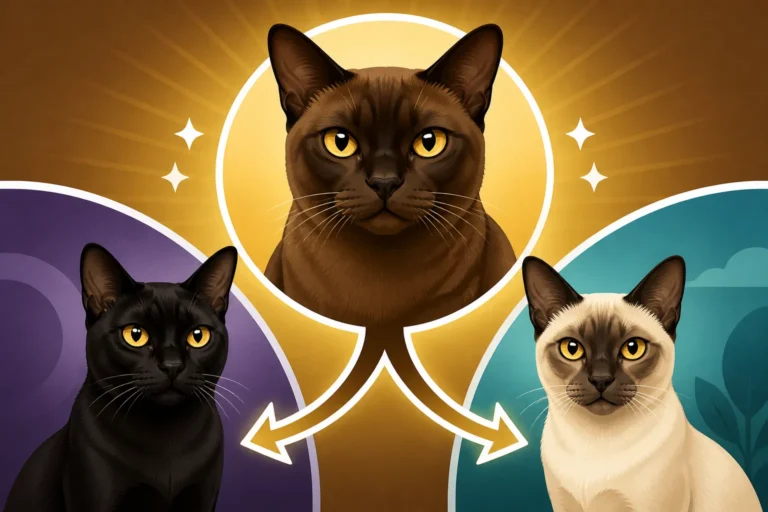
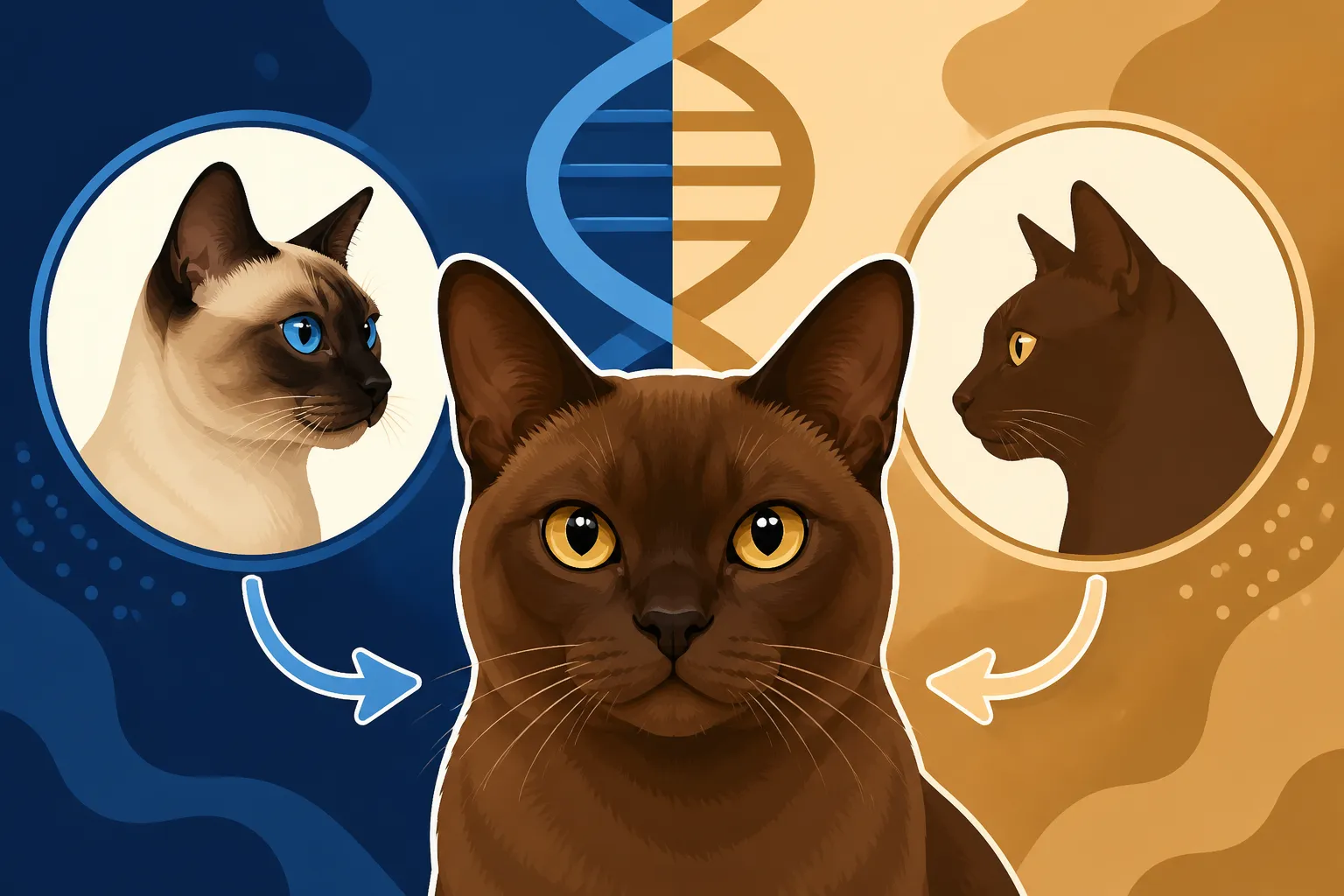
The Burmese and Siamese are also associated with different versions of a temperature-sensitive coat-color pattern. In simplified terms, a Siamese’s familiar pointed pattern has darker color on cooler areas such as the face, ears, paws, and tail, while the Burmese pattern generally produces a more even, shaded coat with darker extremities.
These differences involve variants affecting pigmentation, but coat color alone cannot reveal an entire family tree. A cat’s appearance is not a substitute for its pedigree, and a brown coat does not prove that there is no Siamese ancestry far back in the breed’s history. Nor does a Siamese-like feature by itself prove that a cat is a Siamese cross.
When Burmese and Siamese color variants occur together, the appearance can differ from either typical breed pattern. The interaction helps explain why early breeders could observe intermediate-looking cats and why the Burmese’s origins were a subject of investigation. For a closer look at the color inheritance, see What Happens When Burmese and Siamese Genes Meet.
Why registered Burmese lines are considered separate today
Breed registration helped establish boundaries
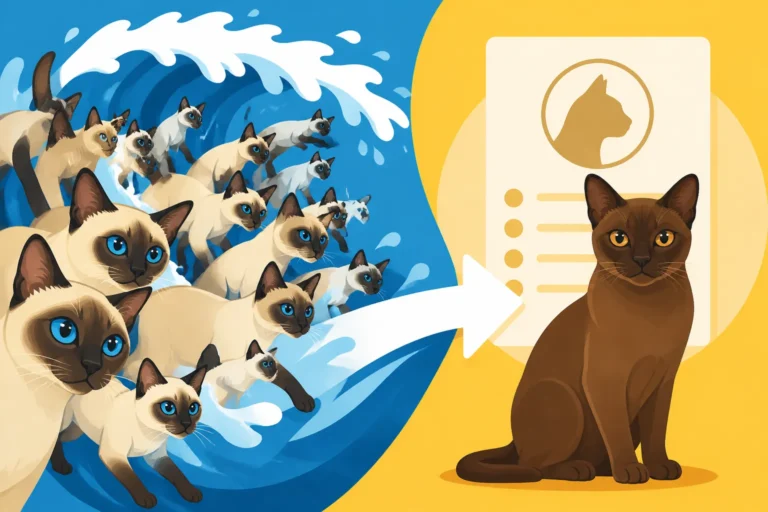
As interest in Burmese cats grew, breeders had to show that they were developing a consistent breed rather than registering Siamese crosses as Burmese. The Cat Fanciers’ Association suspended Burmese registration in the 1940s amid concerns about pedigrees that included Siamese ancestry too close to the cats being registered. Why CFA Suspended Burmese Registration describes the dispute.
Registration resumed after breeders demonstrated a qualifying line of Burmese-to-Burmese breeding across multiple generations. That step helped establish a clearer boundary between the Burmese and Siamese in the registry’s records. It did not erase the Siamese contribution from the Burmese’s early history; it set requirements for which cats could be registered as Burmese going forward. See What CFA Required Before Reinstating the Burmese.
Registry rules matter because “purebred” is a pedigree and registration category, not a guarantee that a breed has never shared ancestry with another breed. Breed histories often include foundation cats, selective breeding, and changing rules. The Burmese is a good example of why a distant origin story should not be confused with a present-day breeding practice.
The American and European Burmese are not Siamese crosses
The American and European Burmese types developed along different breeding and show-standard paths, but that distinction does not mean one type is a Siamese cross and the other is not. Both are Burmese varieties with their own histories and standards. Their differences are better understood through breed development and registration than by assuming Siamese ancestry is present in only one type. See Whether the Two Burmese Types Are Separate Breeds.
| Question | What the distinction means |
|---|---|
| Did Siamese cats contribute to Burmese beginnings? | Yes. Siamese cats were involved in early Burmese breeding. |
| Does that prove a particular cat has a recent Siamese ancestor? | No. An individual pedigree is needed to assess documented recent ancestry. |
| Does a Burmese-looking coat prove a cat has no Siamese ancestry? | No. Appearance alone cannot establish a complete pedigree. |
| Are modern registered Burmese ordinarily described as Siamese crosses? | No. Registered Burmese are bred and recorded as Burmese under registry rules. |
| Are American and European Burmese defined as Siamese crosses? | No. They are Burmese types with differing histories and standards. |
How to check the ancestry of an individual Burmese
Start with the pedigree and registration details
If you are considering a Burmese kitten or already live with one, ask for the pedigree and registration information from the breeder or relevant registry. Check that the cat’s parents are identified and that the breed designation is consistent through the documented generations. If something is unclear, ask the breeder to explain the specific entry rather than relying on a verbal assurance that the cat is “pure Burmese.”
A registry pedigree is the most useful starting point for documented ancestry, but it does not provide an unlimited genetic history. Its records cover the generations represented in the pedigree and the rules of that registry. If the question is whether there is a recent Siamese cross, those records are more relevant than the general fact of Siamese involvement in Burmese origins.
Retail breed descriptions are a different kind of information. A Chewy listing or breed guide may offer broad background for shoppers, but it is not an individual cat’s pedigree. The same applies to breeder advertisements, social media posts, and casual descriptions such as “Siamese-looking Burmese.” Treat those as descriptions, not proof of ancestry.
Use DNA testing cautiously
A DNA test may offer information about particular genetic variants or estimated breed ancestry, depending on the test and the reference data it uses. It should not automatically be treated as a definitive replacement for a well-documented pedigree. Results can be difficult to interpret when a breed has a complex foundation or when a company’s comparison database has limited representation of that breed.
If a test reports Siamese-related ancestry, ask what the result actually measures. Does it identify a particular pigmentation variant? Does it estimate similarity to a reference population? Does it claim to identify recent crossbreeding? Those are different claims, and they should not be collapsed into a single conclusion about a cat’s family tree.
Chewy and other retailers may help owners find general breed information or cat-care supplies, but purchasing a DNA kit through a retailer would not by itself make its interpretation conclusive. For a question about registration, consult the registry; for a health or genetic result, discuss the report with a veterinarian or a qualified genetics professional.
Be careful with appearance-based claims
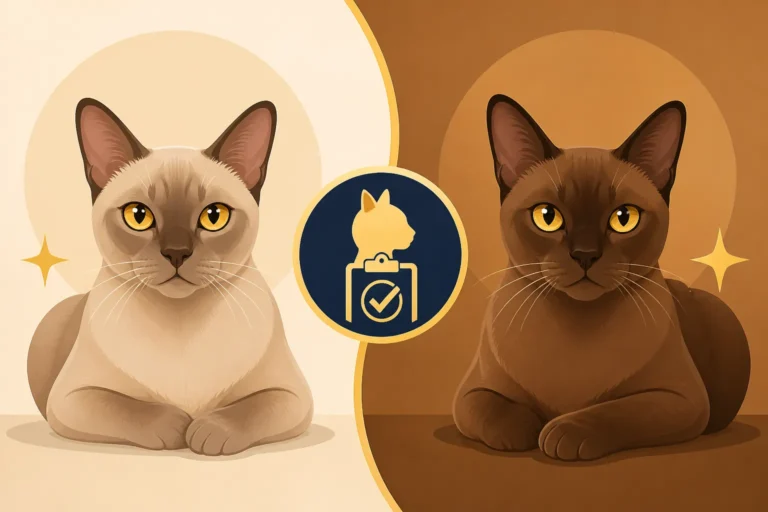
A Burmese can have a warm, brown coat, round eyes, and a compact, muscular body without looking like the stereotype of a Siamese. Conversely, a cat with a longer face, lighter coat, or more visible color contrast is not automatically a Siamese cross. Individual variation, age, lighting, and the way a photograph is taken can all affect how a cat appears.
A seller who uses “Siamese blood” as a selling point should be able to explain precisely what they mean and show supporting records if they are making a claim about a specific pedigree. A seller who uses the phrase to suggest a special look or rare lineage without documentation is offering an impression, not evidence. A general breed profile from Chewy or any other retailer cannot verify that claim for an individual kitten.
The practical takeaway is straightforward: Siamese cats helped shape the Burmese in its early history, but that does not mean modern registered Burmese are simply Siamese crosses. For an individual cat, separate breed history from documented lineage, and use the pedigree or registry records to assess any claim of recent ancestry.
Disclaimer
This article is for general informational purposes only and does not constitute professional advice. Laws, prices and regulations vary by location and change over time. Consult a qualified professional for guidance on your specific situation.