Where the Burmese Color Gene Sits
A Burmese kitten may be born pale, darken as it grows, and still carry the same inherited color pattern throughout life. That can make the breed’s coat genetics seem confusing, especially when Burmese, Siamese, and Tonkinese colors look related. This guide explains where the Burmese color gene is located, what it does, and how its variants affect coat color.
Where the Burmese color gene is located
The gene sits at the TYR locus
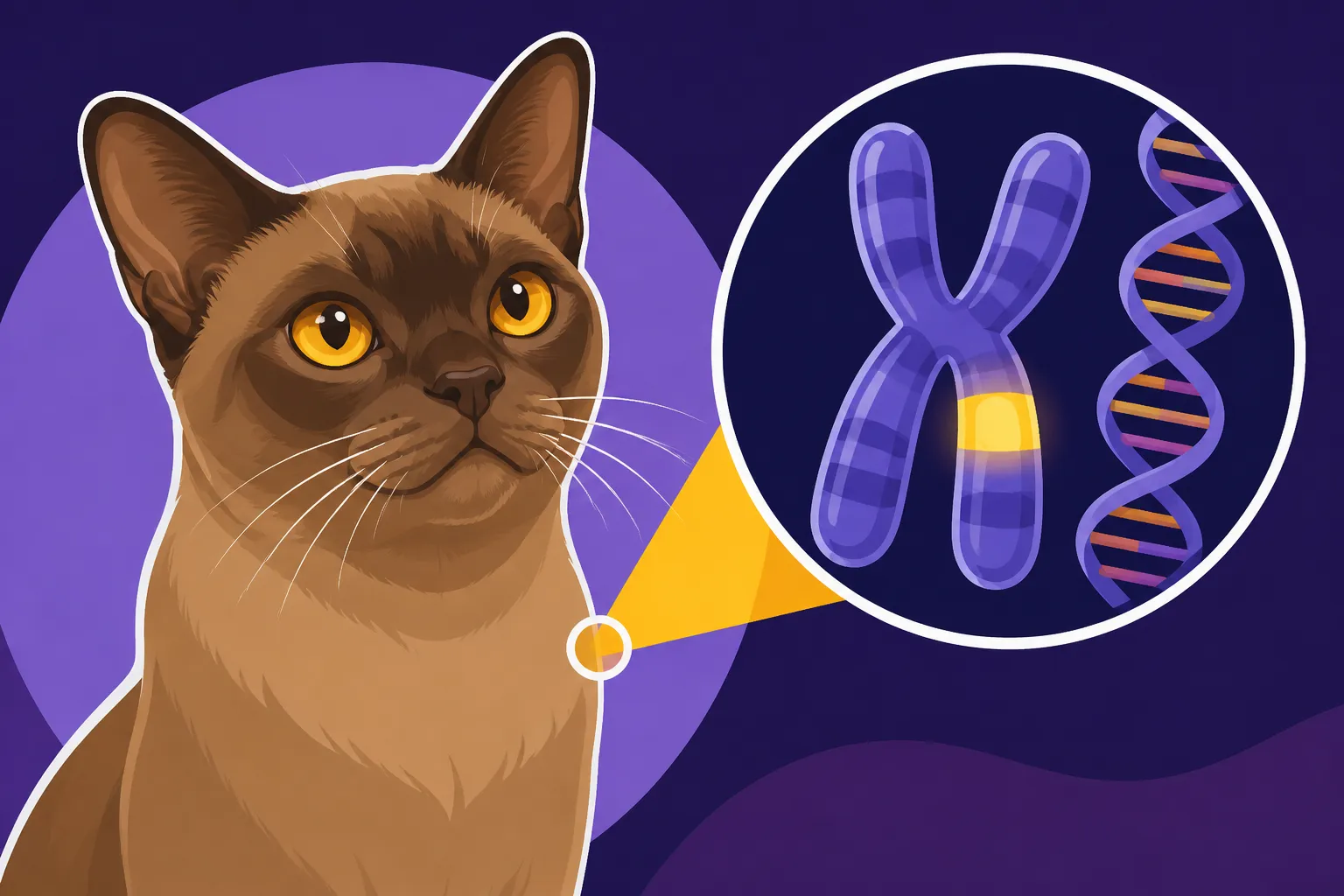
The Burmese color pattern is associated with the TYR gene, which provides instructions for making tyrosinase, an enzyme involved in producing pigment. In cats, this gene is located on chromosome D1. The position of a gene on a chromosome is called its locus—so when people ask where the Burmese color gene “sits,” they are asking about the gene’s location in the cat’s genetic material.
That location is different from the specific genetic variant responsible for a particular coat pattern. The TYR gene can have different versions, called alleles, and those versions affect how pigment is made. A Burmese’s characteristic coat is associated with the Burmese allele, commonly written as cb. The allele is a version of the gene, not a separate gene in another part of the cat’s DNA.
This distinction helps explain why a cat can inherit TYR variants associated with different color patterns. The gene’s location remains the same, while the alleles inherited from the parents can vary. For a broader look at the Burmese variant itself, see What the cb Allele Does to a Burmese's Color.
The Burmese allele affects pigment production
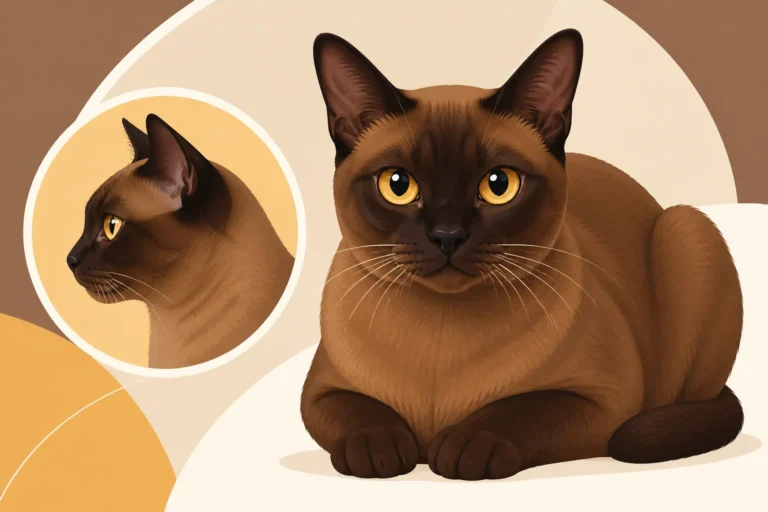
The TYR gene matters because pigment production helps determine how dark or light a cat’s coat appears. The Burmese allele changes how tyrosinase functions. Its effect is temperature-sensitive: pigment tends to develop more strongly in cooler parts of the body than in warmer areas, though the Burmese pattern is generally more even and sepia-toned than the sharply contrasting points of a Siamese.
This is why the Burmese color gene is sometimes described as a temperature-sensitive color gene. It does not mean the cat changes color whenever the room temperature changes. Rather, the enzyme’s activity during coat growth is influenced by temperature, contributing to differences in pigment across the body.
The gene does not work in isolation from every other factor. A cat’s visible coat color reflects inherited variants and how pigment is produced across the body. Age and coat growth also affect what an owner sees. The genetic instructions do not change when a kitten’s coat darkens; the appearance develops as the coat matures.
How TYR variants create related cat colors
Burmese, Siamese, and Tonkinese patterns are connected
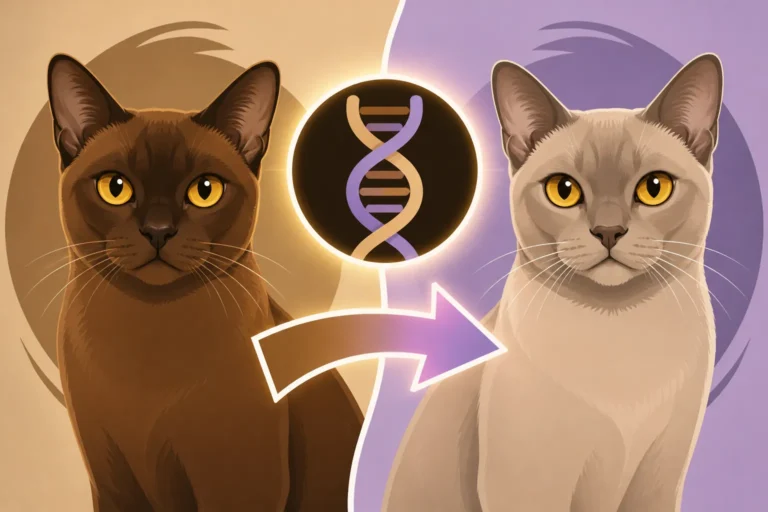
The Burmese, Siamese, and Tonkinese color patterns are related through variants of the same TYR gene. A Burmese typically carries two copies of the Burmese allele, written cb/cb. A Siamese carries two copies of the colorpoint allele, often written cs/cs. A cat with one of each, cb/cs, can show the Tonkinese mink pattern.
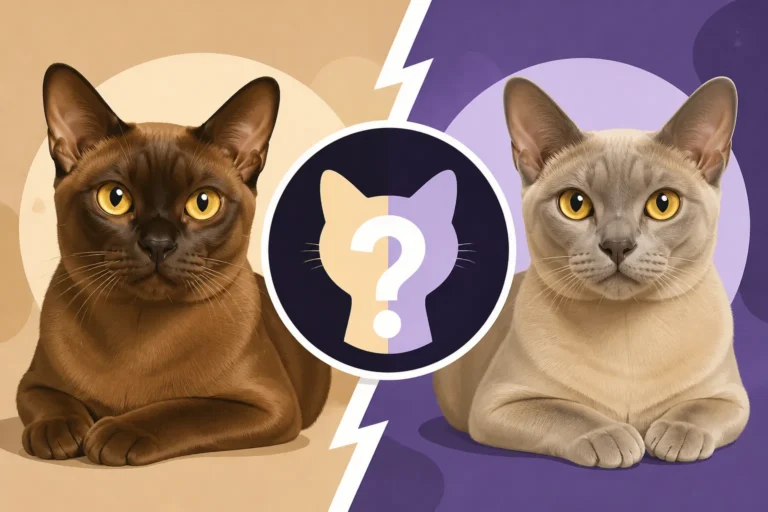
These combinations help explain why the breeds can have related but distinct appearances. Burmese coats generally show a comparatively even, warm-toned body color. Siamese cats have stronger contrast between a lighter body and darker points, such as the face, ears, legs, and tail. Tonkinese cats with one Burmese and one Siamese allele often fall between those patterns in appearance.
| TYR allele combination | Common associated pattern | General appearance |
|---|---|---|
| cb/cb | Burmese | Relatively even, sepia-toned coat |
| cs/cs | Siamese colorpoint | Pale body with darker points |
| cb/cs | Tonkinese mink | Intermediate shading and contrast |
This table describes common associations, not a complete guide to every possible coat-color gene or every individual cat’s appearance. Other inherited traits can affect the final color and pattern. For more on how the two familiar patterns differ, see Why a Burmese Is Brown and a Siamese Is Pointed and What Happens When Burmese and Siamese Genes Meet.
Inheritance explains why parents matter
A kitten receives one copy of the TYR gene from each parent. If both parents pass on a Burmese allele, the kitten can inherit cb/cb and express the Burmese pattern. If the kitten inherits one Burmese allele and one Siamese allele, it may have the combination associated with the Tonkinese mink pattern. The exact outcomes in a litter depend on the parents’ genotypes, not just on what their coats look like.
That is why appearance alone may not tell you every allele a cat carries. A cat can carry a variant that is not obvious in its own coat, then pass it to a kitten. Breeders who need to understand likely coat-color outcomes may use pedigrees or genetic testing alongside visual identification. A kitten’s color is not a reliable substitute for knowing what its parents may pass on.
The Burmese allele is also not the same as a broad label such as “brown.” Color names describe what people see; genotype describes the inherited combination behind it. The relationship between those terms can vary by registry and breed standard, so a breeder’s records should make clear how a cat is registered and described.
Why a Burmese kitten’s coat changes with age
Coat color develops as the kitten matures
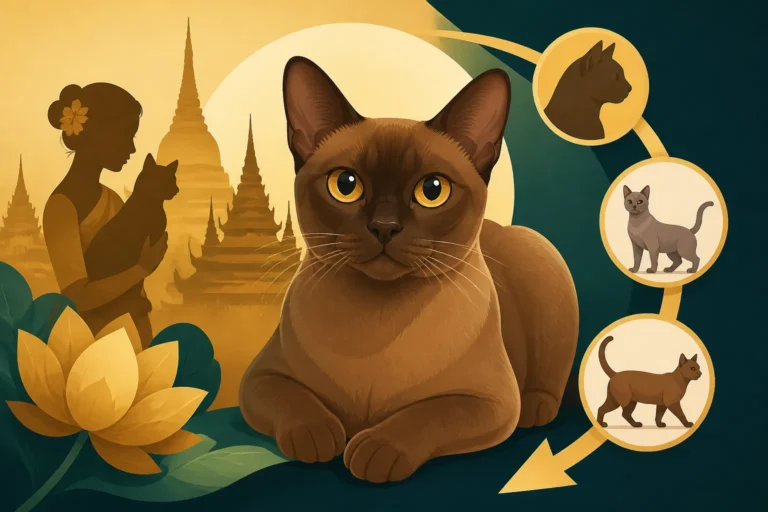
Burmese kittens are often born lighter than they will appear as adults. As the coat grows and pigment develops, the color can deepen. This gradual change can surprise people who expect a kitten’s first coat to match its adult appearance closely, but it does not mean the kitten’s inherited color gene has changed.
The TYR variants are present from conception. What changes is the visible coat as the kitten grows and produces new hair. Temperature-sensitive pigment production contributes to the pattern, while age and coat development influence how the color is expressed over time. The result may be a coat that looks richer or darker than it did in early kittenhood.
The timing and degree of darkening can differ between individual cats. It is more useful to think of the kitten coat as an early stage of the adult color than as a final, fixed shade. Why a Burmese Kitten Darkens as It Grows explores that change in more detail.
Cooler areas may appear darker
Because the Burmese color allele is temperature-sensitive, cooler areas of the body can show stronger pigmentation. This helps explain why extremities may look darker than warmer parts of the body, although the contrast is usually subtler than in a classic Siamese pattern. The effect relates to pigment production while hair grows; it is not a coat “switch” controlled by the cat’s moment-to-moment surroundings.
The same basic idea helps explain why temperature-sensitive color patterns can look different from one another. The specific allele inherited influences how strongly the pattern contrasts. In Burmese cats, the result is associated with the breed’s characteristic sepia appearance rather than the high-contrast pointed look associated with Siamese cats. See How a Burmese's Color Gene Reacts to Temperature and Why a Burmese Is Darker at the Extremities for more on these effects.
A cat’s coat can also be affected by other inherited color traits and by ordinary changes in coat condition. If a coat seems to change suddenly, becomes patchy, or looks unhealthy, that is different from gradual color development during kittenhood and is worth discussing with a veterinarian.
What the gene location means for owners and breeders
A chromosome location is not a visible marking
Knowing that the Burmese color gene is at the TYR locus on chromosome D1 does not mean an owner can identify a cat’s genotype by looking at one spot on the coat. The locus is a position in the cat’s DNA, not a physical mark on the animal. Coat appearance is the visible outcome of inherited genetic instructions and pigment production.
That distinction is especially useful when comparing kittens in a litter. Two kittens may look different in shade while carrying the same Burmese allele combination, or a cat may carry a relevant variant that is not obvious from its own appearance. If a particular breeding outcome matters, a pedigree or an appropriate genetic test is more informative than guessing from coat color alone.
A DNA result should also be interpreted in context. It can identify the tested variant or variants, but it does not automatically answer every question about a cat’s breed identity, registry status, or full appearance. Ask what the test examines and how the result relates to the specific question you are trying to answer.
Coat color is only one part of a cat’s genetics
The Burmese color allele helps explain a familiar feature of the breed, but it is only one part of a cat’s inherited makeup. It does not, by itself, describe temperament, overall health, or every trait that may appear in a litter. Color genetics can be fascinating, but it should not be treated as a complete picture of a cat or a breeding program.
For prospective owners, clear records are more useful than confident-sounding color claims. Ask how the breeder identifies the cat’s type and color, what the pedigree records, and whether genetic testing was used for a specific purpose. If the question is simply why a kitten is lighter than an adult Burmese, gradual coat development is a likely explanation. If the question concerns expected kitten colors, the parents’ inherited variants matter.
The key points are straightforward: the Burmese color pattern is associated with the TYR gene on chromosome D1; cb is the Burmese allele; and the combination of TYR alleles helps produce Burmese, Siamese, and Tonkinese-associated patterns. The gene’s location stays the same, while the inherited version and its expression shape the coat you see.
Disclaimer
This article is for general informational purposes only and does not constitute professional advice. Laws, prices and regulations vary by location and change over time. Consult a qualified professional for guidance on your specific situation.