What the Burmese Contributed to the Modern Cat Fancy
The Burmese cat’s influence reaches far beyond its own breed standard. Its genes helped shape several familiar modern breeds, while the story of its color and early breeding became part of cat fancy history. If you have wondered what the Burmese contributed, this guide traces the best-known breed connections, the genetic ideas behind them, and the limits of that legacy.
The Burmese became a foundation for other breeds
The Burmese and the birth of the Tonkinese
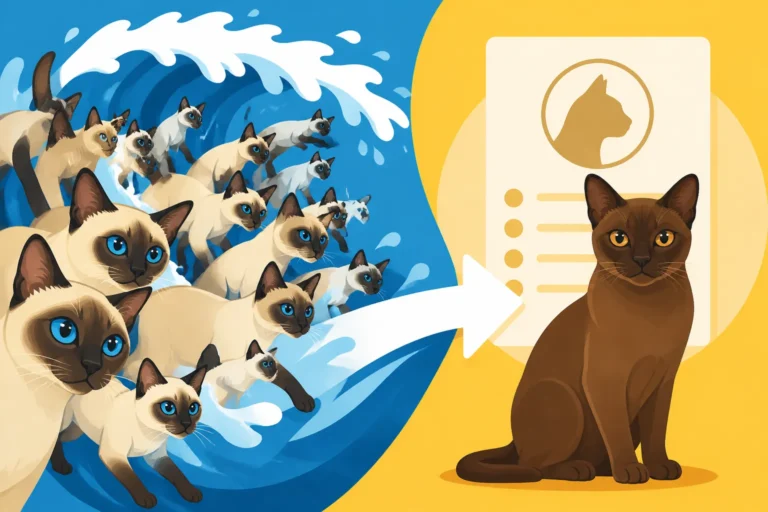
The Burmese’s role in modern breed development is easy to see in the Tonkinese. The breed was developed from Burmese and Siamese cats, bringing together traits associated with both: a moderate body type, a short coat, and a coat pattern that falls between the Burmese’s more solid appearance and the Siamese’s strong points.
That “in-between” look is more than a casual description. Coat color in these breeds is affected by related forms of the temperature-sensitive color gene. The body’s cooler areas tend to show darker color, but different versions of the gene produce different degrees of contrast. The result is a spectrum rather than a simple switch from one breed’s appearance to another.
The Tonkinese also carries a social reputation shaped by its background. It is often described as active, people-oriented, and communicative—qualities that suit a cat expected to be part of household life rather than a decorative presence. Individual temperaments vary, of course, and a breed’s reputation should never substitute for getting to know a particular cat.
The Tonkinese story makes the Burmese’s influence especially clear: it helped create a recognized breed whose defining identity depends on the meeting of Burmese and Siamese characteristics. For more on how those parent breeds relate, see How the Tonkinese Was Made From a Burmese and How a Burmese Differs From a Tonkinese.
The Burmese helped create the Bombay
The Bombay is another well-known breed with Burmese ancestry. Breeders developed it by combining Burmese cats with black American Shorthairs, aiming for a cat with a sleek, panther-like appearance. Its dark coat and coppery or gold-toned eyes give it a distinctive look, while the Burmese contributed to the compact, muscular body and close human companionship often associated with the breed.
The Bombay is not simply a black Burmese. The two breeds have different histories and standards, and appearance alone does not tell the whole story. A black cat with a rounded head might remind someone of a Bombay, but breed identity depends on documented lineage and the rules of the relevant registry, not just resemblance.
This distinction is useful for anyone comparing breeds or looking at a cat from a rescue organization. A cat can share features with a pedigree breed without being registered as one. Breed histories explain how traits were intentionally developed; they do not make every similar-looking cat part of that breed.
The Burmese contribution to the Bombay shows how a breed can shape another without being copied wholesale. Breeders selected particular traits and combined them with those from another population to create a separate identity. The related history is explored in How the Bombay Was Made From a Burmese and How a Bombay Differs From a Burmese.
Burmese ancestry made an accidental cross historically important
The Burmilla began with an unexpected pairing
Not every breed-development story starts with a long-term plan. The Burmilla is associated with an accidental mating between a Burmese and a Chinchilla Persian in Britain. The kittens’ appearance and qualities caught attention, and breeders later worked to establish the resulting type as a breed.
This history illustrates how the cat fancy sometimes turns an unexpected litter into a structured breeding program. A striking kitten alone does not create a breed. Breeders need to decide which traits they want to preserve, establish consistent standards, maintain healthy populations, and work with registry systems that recognize the developing cats.
The Burmese side of the Burmilla’s ancestry contributed to a short-haired, Burmese-influenced foundation, while the Persian side brought a different coat and appearance influence. The outcome is its own breed rather than a Burmese variation. Its story is a reminder that pedigree breeds are shaped by deliberate choices over generations, not merely by a single cross.
The Burmilla’s development is one reason the Burmese appears in discussions of modern breed history beyond its own show ring. For the specific origin story, see How the Burmese Produced the Burmilla by Accident.
Crossbreeding and breed recognition are not the same thing
A cross between two breeds can produce kittens, but that does not automatically create a new recognized breed. The cat fancy relies on standards, records, breeding plans, and registry policies. Those rules help distinguish an established breed from a one-off cross or a cat whose ancestry is unknown.
For a new breed to become consistent, breeders generally need to agree on what it should look like and how it should be bred. They also need enough unrelated or carefully managed lines to avoid narrowing the gene pool too severely. Depending on the registry, recognition may involve stages, documentation, and specific requirements.
That process can be frustrating for people who assume that a familiar appearance settles the question. A short-haired, dark-coated cat may look Burmese-like, for example, but appearance does not establish ancestry. Likewise, a crossbred cat can be wonderful without having a recognized breed name. The distinction is about documented history and registry status, not a judgment of a cat’s value as a companion.
Burmese color genetics helped shape cat fancy understanding
Wong Mau and the early study of coat color
The Burmese’s history became especially significant because early breeders and researchers investigated how its coat color was inherited. Wong Mau, the cat associated with the breed’s founding history in the United States, was bred with Siamese cats. The kittens’ differing appearances helped prompt closer attention to the inheritance of coat color and pattern.
That work contributed to a broader understanding of how cat colors can be produced through combinations of inherited traits. The Burmese’s warm, shaded appearance is not simply the same genetic pattern as a pointed Siamese with the color spread more evenly. Related color genes can interact in ways that create distinct visual effects, and breeding results helped make those differences more apparent.
For a short history of the founding cat and the early breeding program, see The Burmese Began With One Cat Called Wong Mau and Dr Joseph Thompson and the Burmese He Bought in 1930. The early Burmese story is also tied to the question of what the first matings revealed, which is covered in What the First Burmese Litter Told Thompson.
The cb allele and the meaning of Burmese color
The Burmese color pattern is commonly associated with the Burmese allele, written as cb. It affects how pigment is expressed and is part of the explanation for the breed’s characteristic color. The Siamese pattern is associated with a different allele, and cats inheriting different combinations can show appearances that fall between those familiar breed types.
This is why discussions of Burmese genetics often connect back to other breeds. Breeders and geneticists do not just observe coat colors; they consider how inherited variants combine and what those combinations can produce in offspring. Understanding those patterns makes it easier to explain why a cross between Burmese and Siamese cats can yield a range of appearances rather than a uniform litter.
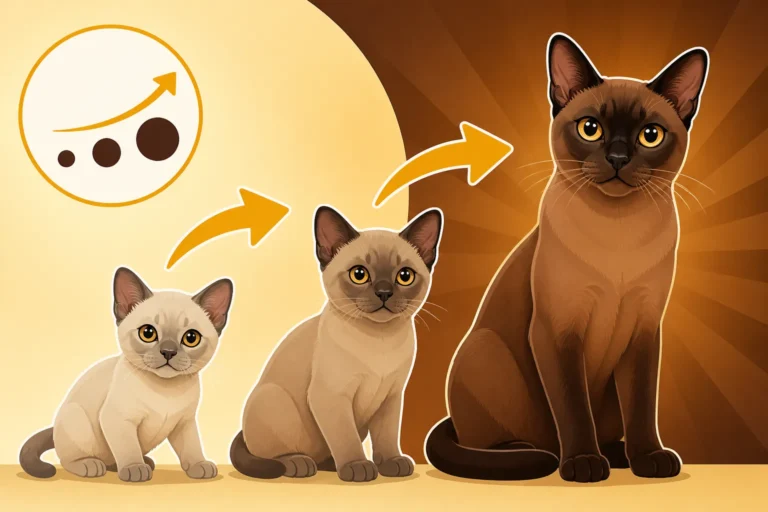
A cat’s color can also change as it matures. Burmese kittens are generally paler than they will become as adults, and temperature-sensitive pigmentation contributes to darker coloring in cooler areas of the body. The visual effect is subtle compared with the sharply contrasting points of some other breeds, but it is part of what makes Burmese coloration distinctive. Learn more in The cb Allele Is What Makes a Burmese Brown and What Happens When Burmese and Siamese Genes Meet.
| Burmese influence | What it contributed | What to keep in mind |
|---|---|---|
| Tonkinese development | Burmese ancestry combined with Siamese ancestry to create a distinct breed type | The Tonkinese is its own breed, not simply a Burmese-Siamese mix in every context |
| Bombay development | Burmese ancestry helped shape a sleek, muscular cat developed with black American Shorthair cats | A black cat that resembles a Bombay is not necessarily a pedigreed Bombay |
| Burmilla development | A Burmese was part of the unexpected cross that led to a separate breed | An accidental litter becomes a breed only through sustained breeding and recognition |
| Coat genetics | Burmese color inheritance contributed to understanding how related color variants interact | Appearance alone cannot establish a cat’s genotype or pedigree |
The Burmese shaped ideas about type and breed identity
A recognizable look helped define a breed standard
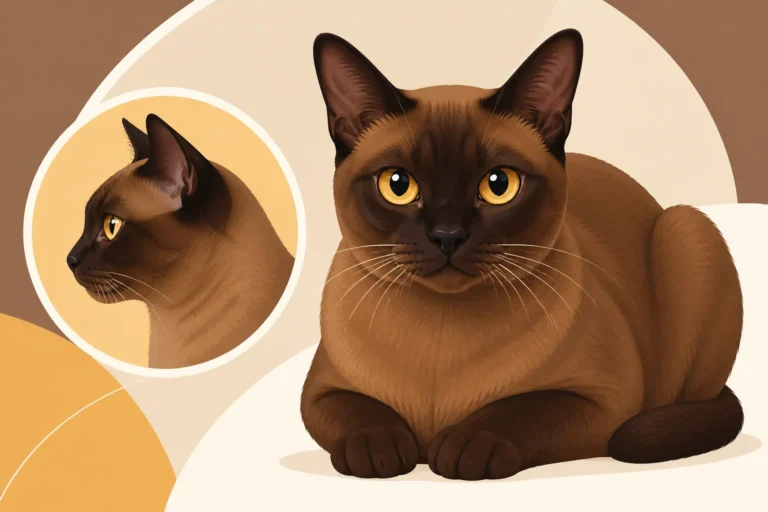
The Burmese’s contribution is not limited to producing other breeds. Its own recognizable combination of a compact, muscular body, close-lying coat, and expressive eyes helped establish a distinct standard within the cat fancy. The breed is often described as feeling heavier than it looks, a quality that reflects its solid build beneath a smooth, short coat.
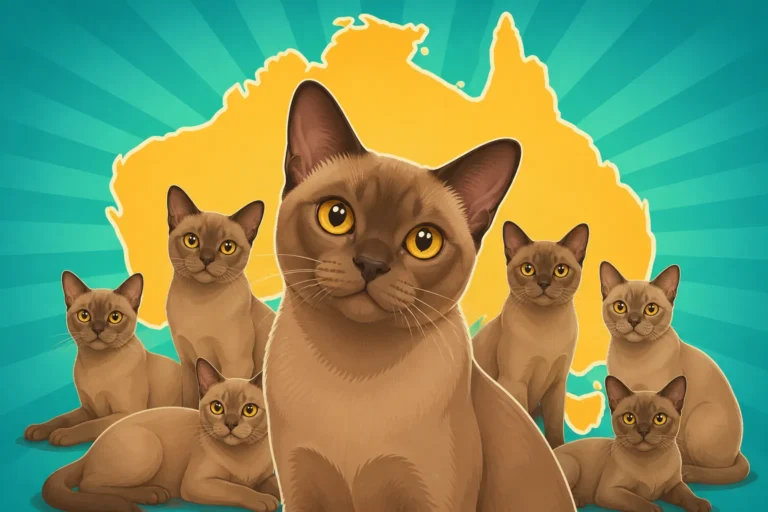
Breed standards give judges and breeders a shared language for describing a cat’s structure and appearance. They also help preserve a recognizable type over generations. But standards are not universal across all registries or regions. American and European Burmese lines developed along different paths, and the standards associated with them do not always emphasize exactly the same features.
That divergence matters when people speak loosely about “the Burmese.” Depending on location and registry, the term can refer to different accepted types. A breeder or prospective owner who wants to understand a cat’s background should ask which type is represented and which registry records the pedigree. How the American and European Burmese Split explains the historical distinction.
The Burmese expanded the possibilities breeders considered
The breed’s history also reflects a broader practice in the cat fancy: breeders study existing populations and select traits to develop new, consistent types. The Burmese became part of that process because its looks, temperament, and inherited color characteristics offered a foundation for later breeding work.
This does not mean that every modern breed with a short coat or affectionate reputation descends from the Burmese. Breed ancestry should be described carefully, based on documented histories rather than loose visual comparisons. The Burmese is directly connected to several important breed-development stories, but its influence has boundaries.
Nor does “influence” mean that the Burmese is superior to the breeds that followed. The Tonkinese, Bombay, and Burmilla each became distinct breeds with their own standards, histories, and communities of breeders. Their connection to the Burmese is a shared part of their origins, not a reason to treat them as lesser versions of it.
The lasting importance of the Burmese is therefore both practical and historical. It helped create new breeds, contributed to the exploration of coat-color inheritance, and became a recognizable standard in its own right. To see the broader family tree, The Bombay and the Tonkinese Came Out of the Burmese brings two major branches together, while What the Burmese Contributed to the Modern Cat Fancy points to the wider legacy of the breed itself.
What the Burmese legacy means for cat owners
Pedigree is more than a familiar appearance
If you are choosing a cat, the Burmese’s influence on other breeds can make breed descriptions confusing. A cat may look Burmese-like, have a similar coat, or show a people-focused temperament without being a registered Burmese. Conversely, cats with Burmese ancestry may not look exactly like the breed standard, especially if they come from a mixed or less documented background.
Ask breeders for clear information about lineage, type, and registry documentation. If you are adopting, focus on the individual cat’s health, behavior, and needs rather than trying to assign a pedigree based on looks. A cat does not need to be purebred to be affectionate, striking, or a good fit for a household.
It is also worth remembering that breed traits describe tendencies, not guarantees. Burmese cats are often sociable and people-oriented, but every cat has an individual personality shaped by genetics, early experiences, health, and home environment. A breed’s history can offer useful context; it cannot tell you exactly how a particular cat will behave.
The breed’s influence is a story of collaboration
The Burmese did not shape the modern cat fancy alone. Its influence came through the work of breeders, registries, geneticists, and cat owners who documented lineages and debated what made a type distinct. Some developments were planned, such as breeding Burmese and Siamese cats to establish the Tonkinese. Others, such as the origin of the Burmilla, began with an unexpected pairing and became meaningful through later, organized work.
That combination of chance and planning is one of the most interesting parts of breed history. A kitten can prompt curiosity, but only sustained care and careful recordkeeping can turn that curiosity into a credible breeding history. Responsible development also requires attention to health and genetic diversity, not just a desired coat or head shape.
The Burmese’s place in cat fancy history is therefore not simply that it “created” other cats. It contributed important ancestry, a distinctive genetic story, and a model of how breeding programs can influence new breed identities. Understanding that legacy makes the Burmese easier to appreciate—not only as a companion and show breed, but as part of a much larger history of domestic cats.
Disclaimer
This article is for general informational purposes only and does not constitute professional advice. Laws, prices and regulations vary by location and change over time. Consult a qualified professional for guidance on your specific situation.