Why the Burmese Is One of the Oldest American Made Breeds
A modern Burmese may look like a compact, glossy companion cat, but its breed history began with one cat brought to the United States from Southeast Asia. This guide explains how Wong Mau, Dr. Joseph Thompson’s breeding program, and early cat-fancy decisions made the Burmese one of the oldest breeds developed in America—and what “American-made” does and does not mean.
What “American-made” means for the Burmese
A breed developed in the United States
Calling the Burmese an American-made breed does not mean its earliest ancestry originated in America. It means the breed as a defined, registered type was developed through a breeding program in the United States. Its modern story begins when a cat named Wong Mau arrived in San Francisco in 1930.
Wong Mau was unusual to American breeders because her coat was a rich brown, with darker coloring at the face, ears, legs, and tail. She did not look quite like the solid-colored cats familiar to them, nor did she match the pointed Siamese they knew. Her appearance raised a practical question: was she a Burmese cat, a Siamese type, or a cat with traits between the two?
That uncertainty became the starting point for a deliberate breeding effort. Dr. Joseph Thompson and other breeders studied Wong Mau’s appearance and bred her to a Siamese. The kittens helped reveal that the coat pattern was inherited in a way that could produce distinct-looking offspring. By selecting cats with the desired brown coloring and body type over generations, breeders shaped a recognizable breed in America.
So “American-made” describes the place and process of breed development, not a claim that the Burmese has no roots outside the United States. The distinction is similar to the difference between a breed’s historical ancestry and the organized breeding program that established its modern identity.
The difference between an old breed and an old American breed
The Burmese is not one of the oldest cat breeds in the world. Domestic cats have lived alongside people for thousands of years, and many populations existed long before modern breed registries. The Burmese is comparatively recent as a formally developed breed.
Its significance is more specific: it is among the early breeds shaped and organized in the United States. The breed’s history is tied to the rise of organized cat breeding, pedigree records, and formal standards that described which traits breeders aimed to preserve. Those institutions helped turn a distinctive cat into a consistent breed.
That is why the Burmese can be described as one of the oldest American-made breeds without claiming it was the first breed ever kept in America or that it predates all other recognized cats. The phrase refers to its early place in American breed development.
For a wider look at the breed’s beginnings, The Burmese Began With One Cat Called Wong Mau explores the founding cat’s place in the story. The related history of the original breeding program is covered in Dr Joseph Thompson and the Burmese He Bought in 1930.
A name that can cause confusion
The name “Burmese” points toward Burma, now commonly called Myanmar, but the breed’s formal development took place in the United States. That can make the name sound like a complete explanation of the breed’s origins when it is only part of the story.
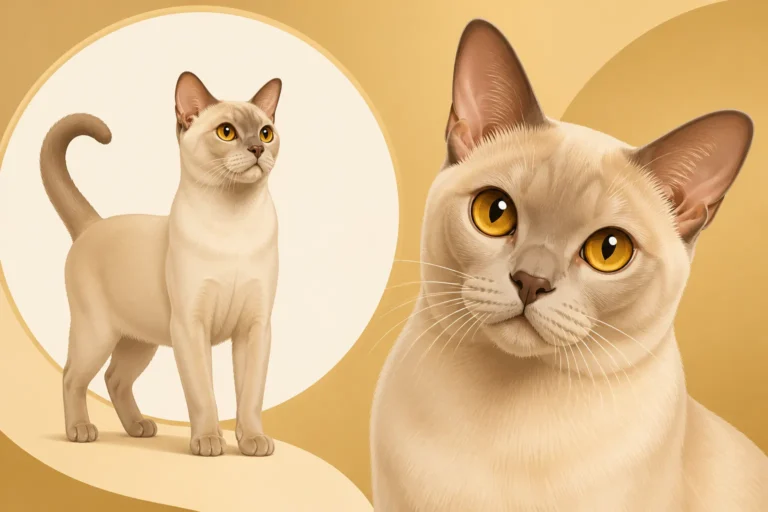
The Burmese is also sometimes confused with the Birman because the names are similar. They are separate breeds with different histories and appearances. A Burmese is typically short-coated, muscular, and solid in color, while a Birman is known for its longer coat, colorpoint pattern, and white-gloved paws.
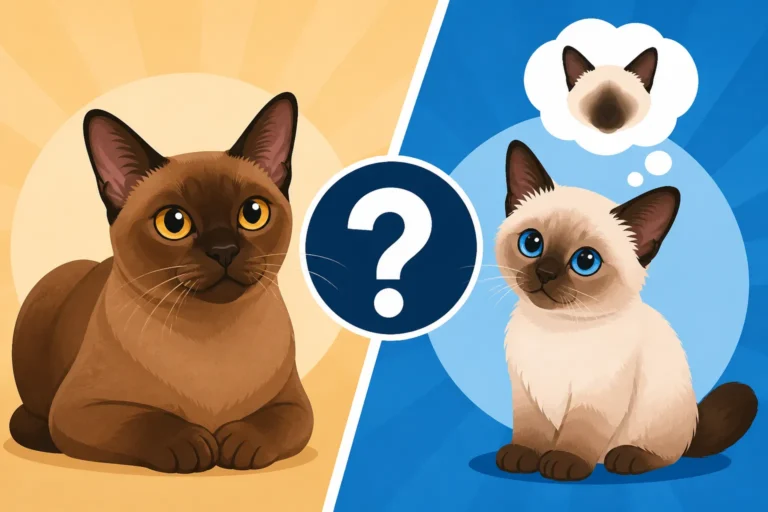
The Burmese can also be confused with a Tonkinese, particularly by people who are new to the breed. Their histories are connected, but they are not interchangeable. The Burmese breeding program helped establish a distinct brown-coated cat, while later crosses between Burmese and Siamese cats contributed to the development of the Tonkinese. For a closer comparison, see How the American and European Burmese Split and How a Burmese Differs From a Tonkinese.
Wong Mau and the early breeding program
Why Wong Mau mattered
Wong Mau mattered because she gave breeders a real cat to observe, rather than an idea of what a Burmese might look like. Her brown coat and darker extremities were visible clues, but a single cat could not establish whether those features would reliably appear in her descendants.
Dr. Thompson’s breeding work helped answer that question. When Wong Mau was bred to a Siamese, the kittens did not all look alike. Their varied appearances suggested that the cats carried different combinations of inherited traits. Some kittens had a pointed pattern, some were darker, and some showed the rich brown coloring that would become central to the Burmese.
Those results mattered because a breed needs more than one attractive individual. Breeders must be able to produce cats with recognizable, repeatable features while maintaining health and a stable type. Wong Mau’s descendants gave the early breeders material to study and select from.
The founding-cat story is not simply about a rare color being admired. It is about observing how traits appeared across litters and using those observations to develop a consistent population. The history of that first cross is explored further in Why the First Burmese Was Bred to a Siamese.
From unusual cat to defined breed
A cat breed becomes established gradually. Breeders identify a set of traits, choose cats that show those traits, keep records of ancestry, and compare each generation with a written standard. In the Burmese’s case, the early goal was to preserve the distinctive brown coat and create a cat with a consistent appearance.
The process required careful selection. If breeders relied on a single generation, the offspring might not reliably resemble the cats they hoped to produce. By tracking descendants and mating cats with desirable characteristics, they could strengthen the traits associated with the developing breed.
This is where the Burmese’s American-made identity becomes clearest. Wong Mau provided the foundation, but American breeders and cat organizations defined the breed through generations of selection, documentation, and standards. The breed did not become established merely because one cat arrived in California; it became established because people built a breeding program around her descendants.
The coat color itself also has a genetic explanation. Burmese coloring is not simply a flat brown pigment distributed in exactly the same way over the whole body. The relevant color gene affects how pigment appears, and temperature can influence the depth of coloring in different parts of the coat. The cb Allele Is What Makes a Burmese Brown explains that feature in more detail.
The importance of pedigree records
Pedigree records are more than paperwork for show cats. They help breeders understand which traits have appeared in a line, where particular colors came from, and whether cats are closely related. In a breed developed from a small founding population, keeping reliable records is especially important.
A pedigree also helps distinguish the history of an individual cat from the history of the breed as a whole. A Burmese may have a documented ancestry, while the breed’s wider story includes the founding cat, early crosses, registration decisions, and changes in breeding standards. Those are related but different kinds of evidence.
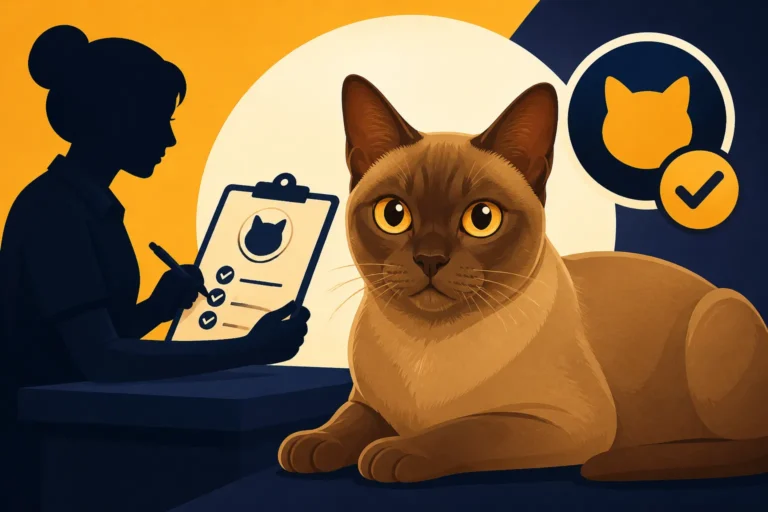
For anyone considering a Burmese kitten, it is reasonable to ask a breeder what type of Burmese they raise, which registry records the cats, and what health screening is done. The purpose is not to demand a perfect historical essay from the breeder. It is to understand the kitten’s background and the breeder’s approach to responsible planning.
Recognition, registration, and a difficult chapter
How cat organizations shaped the breed
Early cat organizations played a major part in turning the Burmese into a recognized breed. A registry’s rules determine which cats can be recorded as members of a breed, which features are described in a standard, and whether a cat can compete in shows under that breed name.
Recognition was not a simple, permanent stamp of approval. The early Burmese population included cats with Siamese ancestry, which helped breeders explore the inheritance behind Wong Mau’s unusual appearance. But as the breed developed, registries and breeders became concerned about whether cats being entered as Burmese were sufficiently consistent and whether the breed could be maintained as a distinct type.
That tension is part of the breed’s history, not an embarrassing footnote. It shows how breed development involves decisions about both appearance and ancestry. A registry must decide how much variation it will accept, and breeders must decide which traits are essential to preserve.
The history of those changing rules is described in CFA Suspended the Burmese in 1947 and Took It Back. The suspension and later return to registration helped shape the Burmese population and the standards breeders followed.
Why registration was suspended
As the Burmese gained interest, demand for kittens increased. Some breeders continued crossing Burmese with Siamese cats, and offspring could resemble the desired Burmese type while still reflecting more mixed ancestry. The result was concern that cats with different backgrounds were being registered under the same breed name.
The registry response was to pause Burmese registration until the breed could be established with greater consistency. This was a significant setback for breeders, but it also encouraged them to demonstrate that the Burmese could reproduce as a distinct, recognizable type without relying on continual crosses to Siamese cats.
The issue was not that Siamese ancestry made a cat inferior. The early cross was part of the Burmese story. The concern was whether the registry could define and maintain a separate breed with predictable traits. Cat registries work through standards and eligibility rules, so a pause in registration can have major consequences for pedigrees, breeding plans, and show participation.
The Burmese eventually returned to registration after breeders produced cats that met the required criteria. The episode is a reminder that the breed’s identity was built through both biology and institutional decisions.
What recognition does and does not prove
Formal recognition gives a breed an accepted name, standard, and registry pathway. It does not prove that every cat registered under that name is identical in appearance, health, or temperament. Nor does recognition mean that a breed’s history is settled forever.
Standards can vary across organizations, and different breeding populations may develop distinct looks. That is particularly relevant to the Burmese, which is often discussed in American and European forms. The differences are not simply a matter of one cat being “more Burmese” than another; they reflect separate standards and breeding histories.
When learning about a Burmese, use registry terms carefully. Ask which standard or registry a breeder follows rather than assuming that every Burmese worldwide is judged by the same description. What a Burmese Looks Like Against the Standard offers a useful starting point for understanding how appearance is assessed.
What the Burmese’s history means to owners today
A historical breed is still an individual cat
The Burmese’s origin story is fascinating, but it should not overshadow the cat in front of you. A particular Burmese may be outgoing or cautious, energetic or content to nap beside its person. Breed tendencies can offer clues, but they cannot predict every individual’s personality.
Burmese cats are often described as people-oriented and social. Many enjoy being close to household members and may follow a person from room to room. That reputation is one reason people sometimes call the Burmese a “dog in a cat’s body.” Still, a kitten’s temperament is shaped by its early experiences, socialization, health, and home environment as well as its breed.
The breed’s compact, muscular build can also be misleading. A Burmese may feel surprisingly heavy when picked up, even when it is in good body condition. Owners should judge weight with a veterinarian’s guidance and by body shape, not by a quick glance at the scale alone. Why a Burmese Is Called a Brick Wrapped in Silk explains why this solid feel is part of the breed’s familiar description.
Choosing a Burmese responsibly
If you are looking for a Burmese kitten, the breed’s long history should make you curious about documentation, not just appearance. Ask to see the kitten with its littermates, learn how the breeder raises young cats, and ask which health tests and veterinary checks have been completed. A kitten’s coat color or round eyes cannot tell you whether it comes from thoughtful breeding.
It is also worth asking whether the kitten is an American or European Burmese type, where the parents are registered, and how the breeder describes the line. Those questions help prevent misunderstandings, especially when online listings use “Burmese” loosely. The details may vary by country and registry, so clarity matters.
Practical preparation matters too. A new owner may need a secure carrier, litter equipment, food bowls, scratching surfaces, and grooming supplies. Chewy is one place some owners use to compare basic pet supplies, but the right choices depend on the cat’s needs and the advice of its breeder or veterinarian. For instance, a short-coated Burmese generally does not need elaborate coat care, while a sturdy carrier is useful for any cat’s veterinary visits.
Keeping the history in perspective
The Burmese earned its place in American cat history through a chain of events: Wong Mau’s arrival, Dr. Thompson’s breeding program, the study of her descendants, and the decisions of breeders and registries. That is what makes it one of the oldest American-made breeds: its modern identity was developed in the United States during the early era of organized breed development.
It is not a claim that the Burmese was invented from nothing, that cats with similar ancestry did not exist elsewhere, or that the breed is older than every other American cat. The phrase points to a specific achievement: a distinctive cat became a defined breed through American breeding and registration.
That history also explains why the Burmese is more than its glossy coat or affectionate reputation. Its development reflects how people turn variation in cats into a carefully maintained breed, while registry rules and breeding choices shape what the breed becomes over time. For readers interested in the breed’s broader legacy, The Bombay and the Tonkinese Came Out of the Burmese traces some of the influence Burmese cats had on other breeds.
Disclaimer
This article is for general informational purposes only and does not constitute professional advice. Laws, prices and regulations vary by location and change over time. Consult a qualified professional for guidance on your specific situation.