What Color the First Burmese Was
It’s easy to look at a sleek, modern Burmese cat, with its rich, deep coat, and wonder where it all began. The origins of any beloved breed can sometimes feel shrouded in mystery, and when it comes to the very first Burmese cat brought to the West, there’s often a little confusion about her exact appearance. This guide will delve into the precise color and unique genetic makeup of the foundational queen, Wong Mau, who launched the entire Burmese breed, and explain why her specific shade was so revolutionary.
The Enigma of Wong Mau's Original Hue
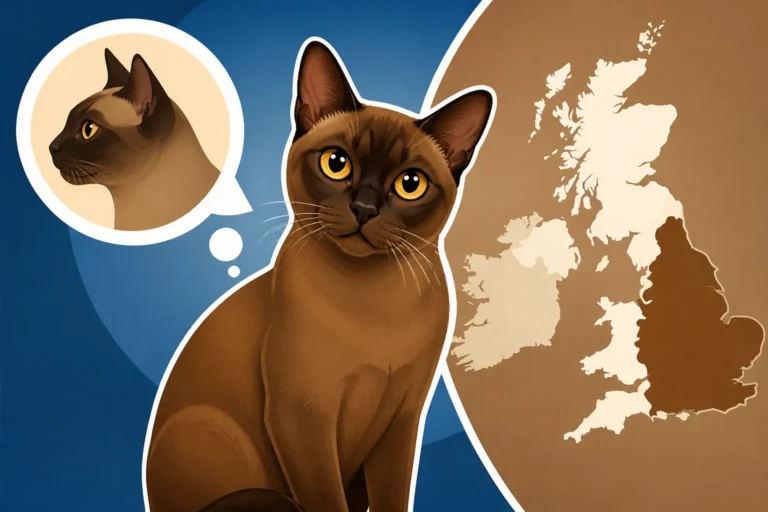
When Dr. Joseph Thompson brought Wong Mau from Burma to San Francisco in 1930, he knew he had something special on his hands. She was clearly not a Siamese, a breed that was well-established by then, yet she shared some features. Her arrival marked a pivotal moment, but what color was this history-making feline? It's a question that often sparks curiosity because her color wasn't just another shade; it was a genetic revelation.
Dr. Thompson’s initial observations of Wong Mau were meticulous, as he was truly breaking new ground in feline genetics. He wasn't just admiring a beautiful cat; he was observing traits that would define an entire new breed. Her particular coloring was the first clue that she harbored unique genes, setting her apart from other domestic cats and even the Siamese, which she bore some resemblance to. This foundational cat, The Burmese Began With One Cat Called Wong Mau, was the puzzle piece that would unlock the mysteries of a whole new genetic code.
Early Observations and Descriptions of Wong Mau
Dr. Thompson, a U.S. Navy medical doctor with a keen interest in genetics, described Wong Mau's coat as a rich, dark brown, but with a nuanced distinction. It wasn't uniformly dark like a solid black cat, nor did it have the stark contrast of a Siamese. Her body was a warm, medium brown, deepening slightly at the points – her face, ears, legs, and tail. This subtle difference from a solid color, yet not as extreme as the pointed pattern, was key. He documented her unique appearance with great care, laying the groundwork for how we understand Burmese color genetics today.
Imagine you're seeing a cat that looks distinctly different from anything you've encountered before. It’s neither purely one thing nor another. That’s the experience Dr. Thompson had with Wong Mau. He noted her muscular, compact body, her expressive golden eyes, and above all, her captivating, lustrous brown coat. This wasn't just a casual observation; it was the scientific starting point for an entirely new classification of cat.
Why "Walnut Brown" Caused Such a Stir
The term "walnut brown" became the descriptive touchstone for Wong Mau's color, and it’s a term that accurately captured the rich, warm, and somewhat variegated nature of her coat. This wasn't a standard "brown" in the way we might think of a brown tabby or a Havana Brown. Instead, it was a genetically distinct brown that became known as "sable" in American Burmese circles. This color, a deep sepia, was uniform across most of her body but still showed subtle shading.
The "stir" wasn't just about aesthetics; it was scientific. At the time, cat genetics were not as well understood, and the prevailing thought was that cats were either solid colored or pointed like a Siamese. Wong Mau presented an intermediate phenotype that demanded a deeper investigation. Her particular brown, with its subtle darkening, was a genetic anomaly that promised new insights into coat color inheritance. Her hue was, in essence, a living challenge to the existing understanding of feline genetics. Why the First Burmese Was Called Walnut Brown delves deeper into the significance of this descriptive term.
Unpacking the Genetics Behind the Brown
The mystery of Wong Mau's "walnut brown" was eventually solved through diligent breeding and genetic analysis. It turns out, her color wasn't just a variation of existing hues; it was the expression of a distinct gene. This gene, the cb allele, is a fascinating piece of the feline genetic puzzle, responsible for the Burmese's signature coat. Understanding this allele helps us appreciate just how unique Wong Mau truly was and why her color set her apart from all other known breeds at the time.
This genetic discovery was groundbreaking because it explained why her coat had that unique, warm, almost glowing brown that wasn't quite solid and wasn't quite pointed. It revealed that she was, in fact, a carrier of a temperature-sensitive gene, but one that expressed itself differently than the Siamese point gene. This genetic insight clarified why the Burmese coat, specifically the sable, has such a distinct appearance and texture, feeling like "a brick wrapped in silk."
The cb Allele and Temperature-Sensitive Pigment
The cb allele is a form of partial albinism, which means it limits the amount of pigment that can be produced in the cat's fur. Specifically, it affects how pigment is deposited in the hair shaft based on temperature. Cats with two copies of the cb allele (homozygous cb/cb) express the full Burmese color. This gene is semi-dominant to the Siamese pointed gene (cs) but recessive to the full-color gene (C). What this all boils down to is a unique color expression.
The enzyme responsible for pigment production (tyrosinase) is heat-sensitive. This means that in warmer parts of the cat's body, the enzyme is less active, resulting in lighter fur. In cooler areas, like the extremities (ears, nose, paws, tail), the enzyme is more active, leading to a slightly darker shade. This is why a Burmese, even a solid sable, will often appear slightly darker on these points, especially in cooler climates. It’s a subtle but distinct difference from a truly solid-colored cat, giving the coat a beautiful depth and luster. You can read more about this in Why a Burmese Is Darker at the Extremities.
Distinguishing Wong Mau's Color from Solid Black or Siamese Point
To truly appreciate Wong Mau's color, it's crucial to understand how it differed from the two main categories of cat color known at the time: solid black and Siamese point.
Solid Black: A solid black cat has an even distribution of pigment across its entire body. There are no lighter areas at the warmer parts of the body, nor are there darker points. The color is dense and consistent from root to tip. Wong Mau's "walnut brown" was distinctly not this; it had a perceptible warmth and subtle variance that a true black cat lacks.
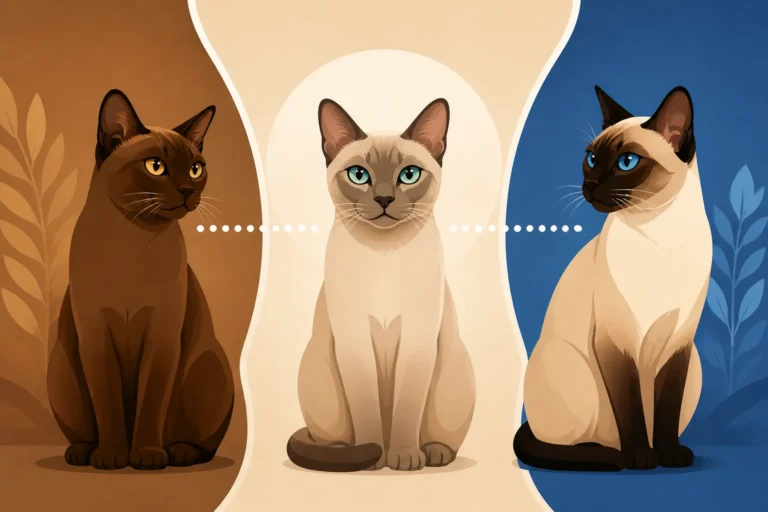
Siamese Point: Siamese cats have a striking contrast. Their bodies are very pale (often cream or white), while their extremities are very dark (seal, blue, chocolate, or lilac). This extreme contrast is due to a different allele (cs) that is even more temperature-sensitive. Wong Mau's brown, while showing some darkening at the points, was far less dramatic. Her body color was a definite brown, not a pale cream. The gradient was soft and seamless, not a stark demarcation. This middle ground is what made her so genetically fascinating and distinct. Why a Burmese Is Brown and a Siamese Is Pointed explores this fascinating genetic difference further.
The table below summarizes the key visual differences between these foundational color patterns:
| Feature | Solid Black Cat | Siamese Point Cat | Wong Mau (Burmese Sable) |
|---|---|---|---|
| Body Color | Uniform, dense black | Very pale (cream/white) | Rich, warm medium brown |
| Point Color | No distinct points (uniform black) | Dark, sharply contrasted to body | Slightly darker than body, subtle blend |
| Contrast | None | Extreme | Subtle, gradual |
| Genetic Allele | Full-color (C/C) or (C/c^b) | Siamese point (cs/cs) | Burmese (cb/cb) |
| Temperature Effect | None (uniform pigment distribution) | High (drastic pigment reduction in warm areas) | Moderate (some pigment reduction in warm areas) |
The Breeding Program and Confirming the Color
The true confirmation of Wong Mau's unique color and genetic makeup came through Dr. Thompson's carefully planned breeding program. He didn't just admire her; he set out to understand her. His groundbreaking work involved breeding Wong Mau to a Siamese cat, a strategic choice that would illuminate the recessive genes she carried and irrevocably establish her as the progenitor of a new breed. Dr Joseph Thompson and the Burmese He Bought in 1930 details this fascinating historical journey.
This wasn't a random pairing. By breeding her to a Siamese, Dr. Thompson essentially used the Siamese's known genetics as a "test" to see what hidden traits Wong Mau carried. The results of these early litters were crucial; they provided the empirical evidence needed to prove that Wong Mau was indeed a new type of cat, not just a variant of an existing one. This scientific approach was unprecedented in the cat fancy at the time.
The First Litter's Revelation
When Wong Mau was bred to a Siamese, her first litter was a revelation. It produced three distinct types of kittens:
- Siamese-pointed kittens: These kittens looked exactly like typical Siamese cats, with very pale bodies and dark points. This proved that Wong Mau carried the recessive gene for the Siamese pattern (cs) in addition to her visible Burmese gene.
- Burmese-colored kittens: These kittens had the same "walnut brown" color as Wong Mau, confirming that her distinctive color was indeed her primary trait and could be passed on.
- Intermediate-colored kittens: These kittens displayed a color pattern somewhere between Burmese and Siamese, with a light tan body and darker, well-defined points. This new, previously unseen color pattern eventually became known as the Tonkinese.
This mixed litter was the smoking gun. It demonstrated that Wong Mau was neither a pure Siamese nor a simply "brown" domestic cat. She was genetically distinct, carrying a unique allele (cb) that, when combined with the Siamese allele (cs), created the intermediate Tonkinese appearance, and when paired with another cb gene, resulted in the classic Burmese brown. What the First Burmese Litter Told Thompson further elaborates on the significance of this pivotal litter.
The Spectrum of Burmese Colors Today vs. the Origin
While Wong Mau herself was a specific shade of brown (sable), the Burmese breed has, over time, been developed to include a handful of other recognized colors. These modern colors are all variations on the original genetic theme established by Wong Mau, simply expressing different dilute genes on top of the foundational cb allele.
- Sable (Brown): This is the original, classic Burmese color, just like Wong Mau's. It's a rich, warm, dark brown.
- Champagne (Chocolate): A lighter, warmer brown, often described as a milky chocolate color.
- Blue: A soft, medium grey with a slight bluish cast.
- Platinum (Lilac): A very pale, delicate grey with a pinkish or lavender tone.
These variations showcase the genetic diversity that breeders have carefully cultivated from Wong Mau's initial discovery. However, it's vital to remember that all these beautiful hues stem from that single, ground-breaking "walnut brown" cat who first graced Dr. Thompson's life. The standard for The Four Colors a Burmese Comes In maintains the integrity of the breed's distinct coat type across all recognized shades.
The Legacy of Wong Mau's Unique Hue
Wong Mau’s distinct walnut brown color wasn’t just a pretty shade; it was the foundation upon which the entire Burmese breed was built. Her unique hue and the genetic secrets it held didn't just lead to the creation of the Burmese; it revolutionized our understanding of cat coat color genetics and indirectly influenced the development of other popular breeds. Her legacy is deeply etched into the fabric of the cat fancy, proving that sometimes, the most significant discoveries come in the most unexpected packages.
Her appearance essentially dictated the initial breed standard, setting the benchmark for what future Burmese cats should look like. It provided a tangible, observable trait that breeders could work towards and judges could evaluate. Without that striking original color, the breed's distinct identity might never have taken hold.
Shaping the Burmese Standard
Once Wong Mau's unique genetic profile was understood, the first Burmese breed standard was written to capture her essence. The description of the ideal Burmese cat, particularly concerning color, was directly derived from Wong Mau's phenotype. The "sable" color, her hallmark brown, became the original and defining color for the breed. This meant that future Burmese cats had to possess this rich, warm brown, with its subtle depth and characteristic satin sheen.
This standardization was critical for the recognition of the breed by associations like the CFA. It provided a blueprint for breeders, ensuring that as the breed developed, it maintained the unique characteristics that made Wong Mau so special. Every Burmese cat today, regardless of its specific color variation, carries the genetic echo of Wong Mau's original, defining hue. When the First Burmese Standard Was Written goes into detail about this historical process.
How the Color Gene Impacted Other Breeds
Wong Mau's genetic contribution extended beyond just the Burmese breed. The discovery of the cb allele and its interaction with the Siamese cs allele paved the way for the creation and understanding of other breeds. Most notably, the cb allele, combined with cs, is what defines the beautiful coat of the Tonkinese cat. The Tonkinese, with its mink pattern (an intermediate between Burmese and Siamese), perfectly exemplifies the direct genetic influence of Wong Mau.
Furthermore, the general understanding of temperature-sensitive albinism in felines, largely kickstarted by Thompson's work with Wong Mau, deepened genetic research across many cat breeds. It helped scientists and breeders understand how various color patterns emerged and how to selectively breed for desired traits. So, in many ways, Wong Mau didn't just give us the Burmese; she gave us a deeper scientific appreciation for the incredible genetic diversity within the feline world. Why the Founding Burmese Produced Two Breeds further explains her far-reaching genetic impact.
Disclaimer
This article is for general informational purposes only and does not constitute professional advice. Laws, prices and regulations vary by location and change over time. Consult a qualified professional for guidance on your specific situation.