Why a Burmese Is Not a Solid Colored Cat
A Burmese can look like one uninterrupted shade from nose to tail, which makes “solid-colored” seem like an obvious description. The confusion comes from the difference between what the coat looks like and how its color pattern is produced. This guide explains the Burmese sepia pattern, why its shading is subtle, and how to interpret color descriptions without mistaking appearance for genetics.
What “solid colored” means in cats
A smooth-looking coat is not necessarily a solid pattern
In everyday conversation, “solid-colored” usually means a cat appears to be one color, without obvious stripes, spots, or sharply contrasting patches. A sable Burmese, for instance, may look like a sleek, even brown cat at a glance. The subtle shading across its body can be easy to miss, especially in a dim room or in a photograph.
In coat genetics, though, “solid” can mean something more specific. A cat may lack visible tabby markings or white patches and still have a pattern that affects how pigment appears across the body. Those markings and patterns are not always bold. On a Burmese, the difference in color between the body and its extremities is often soft enough that the coat looks nearly uniform.
This is why people can reasonably describe a Burmese as solid-colored in a casual sense, while breed and coat terminology may identify its color as a Burmese, or sepia, pattern. The two descriptions refer to different things: one is about the overall impression to the eye, and the other is about how the coat’s pigment is distributed.
Burmese cats have a subtle form of color restriction
Burmese coat color is linked to a temperature-sensitive form of pigment production. Pigment tends to develop more strongly in cooler areas of the body, such as the face, ears, legs, and tail. Warmer areas tend to be lighter. The effect is far less dramatic than the high-contrast points people may recognize on a Siamese, so a Burmese’s pattern can be present without looking sharply divided.
The Burmese color gene is often described in relation to the Burmese allele, written as cb. A Burmese cat with two copies of this allele typically shows the characteristic Burmese pattern. For a closer look at that genetic detail, see The cb Allele Is What Makes a Burmese Brown and What Two Copies of cb Produce in a Burmese.
The word “brown” can also be confusing because it may refer to a particular recognized coat color, rather than to every brown-looking Burmese. In the American Burmese, for example, sable is the deep brown color, while champagne is a warmer, lighter brown. Color names and accepted varieties depend on the registry and breed standard being used.
Why a Burmese can look almost one color
The contrast is softer than a Siamese pattern
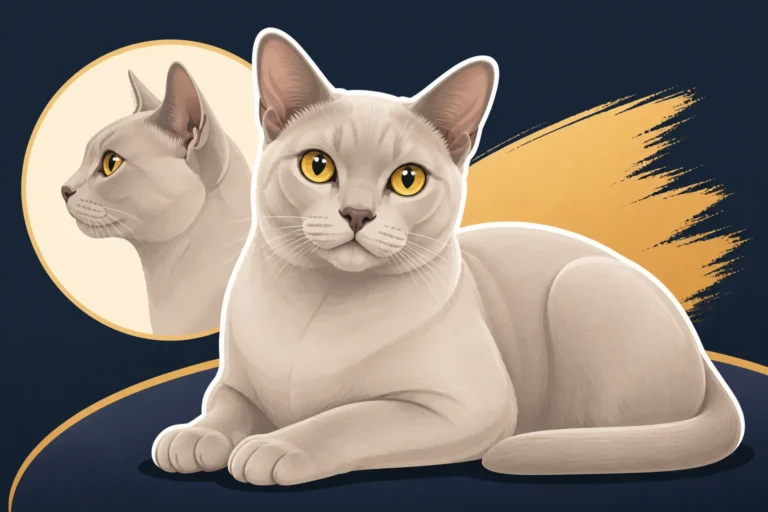
A Siamese’s darker face, ears, paws, and tail can stand out clearly against a pale body. Burmese shading is usually more restrained: the body and extremities may be different shades of the same general color, rather than two strongly contrasting colors. This lets the pattern blend into the coat instead of announcing itself from across the room.
That difference is useful to keep in mind when comparing breeds. Both Burmese and Siamese cats have color patterns influenced by temperature-sensitive pigment production, but the visible result is not the same. The Burmese pattern is often called sepia, while the Siamese pattern is strongly pointed. How a Burmese's Coat Differs From a Siamese's explains that contrast in more detail.
A camera can flatten the distinction further. Bright lighting, shadows, a dark background, or automatic image adjustments may make the body color appear more uniform than it is. A close-up taken in natural light may show gradual shading around the mask, ears, and tail that disappears in a small online image.
Body temperature and coat color shape the pattern
Pigment production is affected by temperature, so cooler parts of a cat’s body may show darker coloring. This helps explain why a Burmese’s face, ears, legs, and tail can be a little darker than its torso, even when the difference is subtle. The pattern is not a set of painted-on patches; it is a gradual shift in the coat’s pigmentation.
The degree of visible shading can vary between individual cats. Coat shade, lighting, age, and seasonal conditions can all affect what an owner notices. A Burmese may seem nearly even-colored in one setting and show more contrast when standing beside a pale wall in daylight.
For a deeper explanation of the temperature effect, see How a Burmese's Color Gene Reacts to Temperature and Why a Burmese Is Darker at the Extremities. The key point is that a low-contrast pattern is still a pattern. Subtle does not mean absent.
| What you notice | What it may mean |
|---|---|
| The coat looks like one shade from a distance | The Burmese pattern may be low contrast and difficult to see at a glance |
| The face, ears, legs, or tail look slightly darker | Cooler areas may show stronger pigment |
| A kitten’s coat changes as it grows | Burmese coloring can deepen or become more defined with age |
| A listing calls the cat “solid brown” | The description may be casual rather than a precise coat-pattern term |
| Two Burmese cats look noticeably different in photos | Lighting, age, individual shade, and camera settings can affect appearance |
Burmese kittens often change shade as they mature
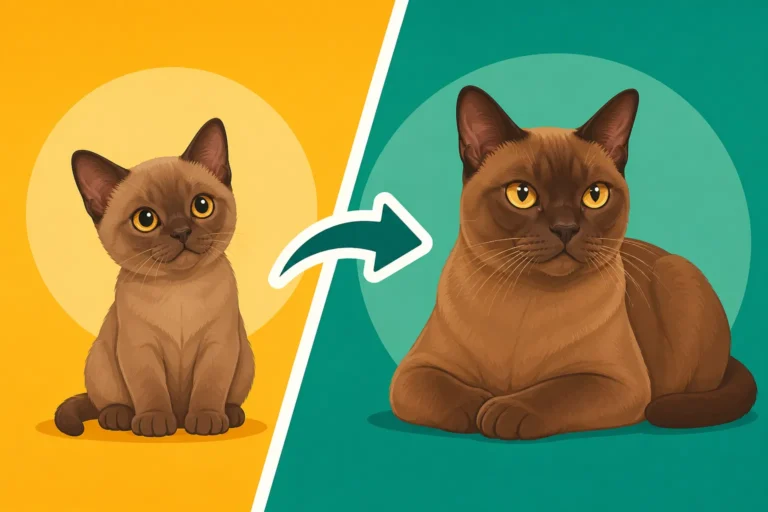
A Burmese kitten may be lighter than the adult it will become. As the coat develops, the color can deepen and the difference between warmer body areas and cooler extremities may become easier to notice. This is one reason a kitten’s early appearance does not always predict its exact adult shade.
That gradual change can surprise new owners. Someone who chooses a pale-looking kitten may later see the coat grow richer or darker, without anything being wrong. It is part of how Burmese coloring develops, rather than evidence that the kitten has turned into a different color variety.
If you are comparing kitten and adult photos, remember that they may not be directly comparable. Age, sunlight, camera exposure, and the background can all change how the coat reads. Why a Burmese Kitten Darkens as It Grows covers this transition, while The Four Colors a Burmese Comes In explains the commonly recognized color names.
How to interpret Burmese color descriptions
Color names and pattern names describe different features
A color name describes the shade of the coat, while a pattern name describes how that shade is distributed. A cat may have a named color and still show the Burmese sepia pattern. Treating those terms as interchangeable is an easy way to end up wondering why a cat called “solid” has darker coloring on its face or tail.
The vocabulary can also differ between registries and regions. American and European Burmese standards do not always describe or recognize color varieties in exactly the same way. If a pedigree or breeder description uses an unfamiliar color term, ask which registry’s terminology it follows rather than assuming the label has the same meaning everywhere. What a Burmese Looks Like Against the Standard provides useful context for understanding how a breed standard shapes these descriptions.
General pet-education pages and shopping sites may simplify terminology for a broad audience. A description on Chewy, for example, may be helpful for getting an accessible overview, but a simplified color label is not the same as a genetic explanation or a registry’s formal classification. If you are trying to understand a specific cat, compare the wording with the breeder’s records or the relevant registry standard.
Photos are useful, but they are not a reliable color test
Online photos can help you recognize broad differences between sable, champagne, blue, and platinum Burmese cats. They are less dependable for judging subtle shading or deciding whether a cat fits a specific registered color. A photo can make a coat look warmer or cooler depending on the lighting, screen settings, and image processing.
When looking at a breeder’s photos, compare several pictures rather than drawing a conclusion from one image. Look for the overall coat shade and any gentle difference between the body and the points. Ask how old the cat was when the pictures were taken, since a kitten’s coat may still be developing.
Chewy and other general pet sites can be a starting point for learning common breed and color terms, but they should not replace a pedigree or a direct conversation with a knowledgeable breeder. If the distinction matters for registration, breeding, or a show entry, ask for the exact registered color and the registry that recorded it.
Grooming does not turn a patterned coat into a solid one
A Burmese’s short, close-lying coat can make its color appear especially sleek and even. Regular gentle grooming can remove loose hairs and bring out the coat’s natural shine, but it does not change the underlying pattern. A glossing product, bath, or brush cannot make a Burmese genetically solid-colored.
When choosing grooming supplies from a retailer such as Chewy, focus on whether the item suits a short-haired cat and your cat’s skin and coat needs, not on claims that it will change the coat color. If the coat suddenly looks dull, patchy, or unusually different, that is a separate concern from normal Burmese shading; ask a veterinarian if you notice changes alongside itching, hair loss, or skin irritation.
Telling appearance apart from genetics
Ask what the description is actually trying to say
If someone calls a Burmese “solid-colored,” ask whether they mean the cat looks like one shade or whether they are describing a formal pattern classification. Often, there is no real disagreement: the speaker is using an everyday visual description, while a breeder or registry is using more precise coat terminology.
For a pet owner, the practical distinction is usually straightforward. A Burmese can look remarkably even-colored while still showing the characteristic sepia pattern. You do not need to identify every genetic detail to appreciate the coat, but understanding the terms can make breeder conversations and pedigree descriptions less confusing.
Chewy’s broad educational content can be one place to encounter common breed language, but if you are evaluating a particular Burmese, ask the breeder or registry to clarify the cat’s recorded color. The most useful questions are simple: What color is listed on the pedigree? Which registry’s terms are being used? Is the description about the shade, the pattern, or both?
The short answer is about what you mean by “solid”
A Burmese is often called solid-colored because the coat can look smooth and nearly uniform, especially compared with a strongly pointed Siamese. In the more technical sense, however, Burmese coloring is associated with a distinctive, subtle sepia pattern. The body and cooler extremities may show gentle differences in pigment rather than the crisp contrast of a high-contrast pointed coat.
So when you hear that a Burmese is “not a solid colored cat,” the point is not that it must have obvious stripes or patches. It is that its color is shaped by a pattern, even when that pattern is quiet enough to blend into the overall coat. Understanding that distinction makes the description easier to read—and makes a Burmese’s beautiful, understated shading easier to notice.
Disclaimer
This article is for general informational purposes only and does not constitute professional advice. Laws, prices and regulations vary by location and change over time. Consult a qualified professional for guidance on your specific situation.