What Thompson’s Program Proved About the Burmese
It’s easy to look at the sleek, muscular Burmese cat today and take its existence for granted, but the journey to establishing this beloved breed was far from straightforward. For years, there was confusion around its unique appearance, leading some to mistakenly dismiss it as a mere variation of the Siamese. This guide delves into the pioneering work of Dr. Joseph Thompson, whose meticulous breeding program finally proved the Burmese was a distinct breed, paving the way for the intelligent, affectionate companions we cherish today.
The Enigmatic Arrival: Wong Mau and Her Unique Look
Imagine a time when the cat world was largely dominated by common domestic shorthairs and the striking, vocal Siamese. Then, in the early 1930s, a remarkable feline arrived in San Francisco, brought from Burma by a sailor. This cat, named Wong Mau, possessed a captivating appearance that immediately stood out. She wasn't quite a Siamese, nor was she a typical domestic cat. Her rich, dark brown coat was unlike anything seen consistently before, leading to a great deal of speculation and debate among cat enthusiasts and geneticists alike. This was the starting point for everything we now know about the Burmese.
The Mystery of Wong Mau's Origin
Wong Mau's exact lineage was shrouded in a bit of mystery. She was said to have come from Burma (modern-day Myanmar), a region known for its unique feline populations. However, her specific background – whether she was a purebred of an unrecognized type or a naturally occurring variation – was initially unclear. Her presence sparked intense curiosity because she didn't fit neatly into any existing breed categories. She was smaller and more compact than many domestic cats, with an unusually short, fine coat that felt like satin to the touch. This distinctive combination made her an object of fascination, and frankly, a bit of a genetic puzzle. Many wondered if she was just an odd-colored Siamese, or if she held the key to an entirely new breed. The stakes were high, as establishing a new breed required rigorous proof of genetic distinction. The Burmese Began With One Cat Called Wong Mau beautifully illustrates this initial enigma.
Why Wong Mau Puzzled the Cat Fancy
At the time, the concept of cat breeds was still developing, and the Siamese was a well-established and highly recognizable breed with its pointed coloring and loud voice. Wong Mau, while sharing some similarities, also had pronounced differences. Her overall body color was a solid, warm brown, albeit slightly darker at the points – a trait that hinted at a connection to the Siamese but was not fully expressed. This "sable" color, as it would later be known, was perplexing. Was she a Siamese with a genetic anomaly? Or something entirely different? The established cat fancy, cautious about new breeds, required undeniable evidence that Wong Mau represented a unique genetic pool, not just a phenotypic variation of an existing one. This challenge, the need to prove a distinct genetic heritage, was precisely what Dr. Thompson set out to tackle.
Dr. Joseph Thompson's Scientific Pursuit
Into this intriguing debate stepped Dr. Joseph C. Thompson, a US Navy medical doctor with a keen interest in genetics and a passion for cats. He recognized something truly special in Wong Mau and understood that her unique traits warranted scientific investigation rather than mere anecdotal observation. Thompson wasn't just a cat lover; he was a scientist who saw the potential to apply genetic principles to feline breeding, an approach that was revolutionary for its time in the cat fancy. His dedication would lay the very foundation for the Burmese breed. Dr Joseph Thompson and the Burmese He Bought in 1930 details his crucial role.
A Doctor's Dedication to Genetics
Dr. Thompson's background as a medical doctor gave him an invaluable perspective. He approached Wong Mau not just as a pet, but as a biological specimen holding genetic secrets. He understood the importance of controlled breeding experiments to unravel genetic mysteries, something common in scientific research but practically unheard of in cat breeding circles of the era. He wasn't interested in simply producing pretty kittens; he wanted to understand the underlying genetic mechanisms that gave Wong Mau her distinct look. This commitment to scientific rigor would be the bedrock upon which the Burmese breed was built, ensuring its legitimacy and genetic integrity from the very beginning.
Setting Up the Breeding Experiment
To scientifically analyze Wong Mau's genetic makeup, Dr. Thompson devised a classic breeding experiment. He needed to breed Wong Mau to a cat with a known genetic background, specifically one that could help reveal recessive or co-dominant traits. His choice of a seal point Siamese was not arbitrary; it was a deliberate decision based on genetic principles. The Siamese carried the well-understood colorpoint gene, which would act as a genetic marker against which Wong Mau's traits could be compared. By observing the offspring of such a cross, Thompson could deduce the genetic contribution of Wong Mau and determine if her unique coloring was dominant, recessive, or something else entirely. This carefully planned experiment was truly groundbreaking in the world of cat breeding, setting a precedent for future genetic studies in domestic animals.
Unveiling the Burmese Phenotype: The Siamese Cross
The results of Dr. Thompson's breeding program were nothing short of revelatory. When Wong Mau was bred to a seal point Siamese, the resulting litter provided concrete evidence that she was indeed genetically distinct. This wasn't just about pretty kittens; it was about understanding how feline coat color inheritance worked and establishing the genetic basis for a new, distinct breed. The initial outcomes challenged existing assumptions about cat genetics and paved the way for a deeper understanding of feline diversity. Why the First Burmese Was Bred to a Siamese explains the reasoning behind this critical pairing.
The Expected vs. the Observed Kittens
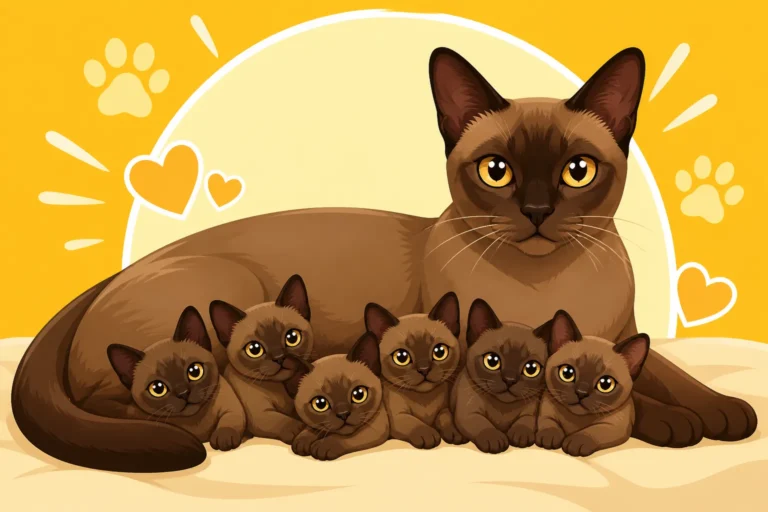
If Wong Mau had simply been a variant of a Siamese, breeding her to a purebred Siamese should have produced kittens that were all Siamese in appearance, or perhaps a mix of Siamese and domestic shorthair if she carried those genes. However, the first litter from the union of Wong Mau and the Siamese proved otherwise. Instead of just two types, Dr. Thompson observed three distinct categories of kittens. This immediately indicated that Wong Mau carried a unique genetic factor that was interacting with the Siamese gene in an unexpected way. The variation in the litter was the first undeniable clue that Wong Mau was more than just an unusual Siamese; she was a genetic treasure waiting to be fully understood. This surprise was exactly what was needed to push the scientific inquiry forward.
Recognizing Three Distinct Types
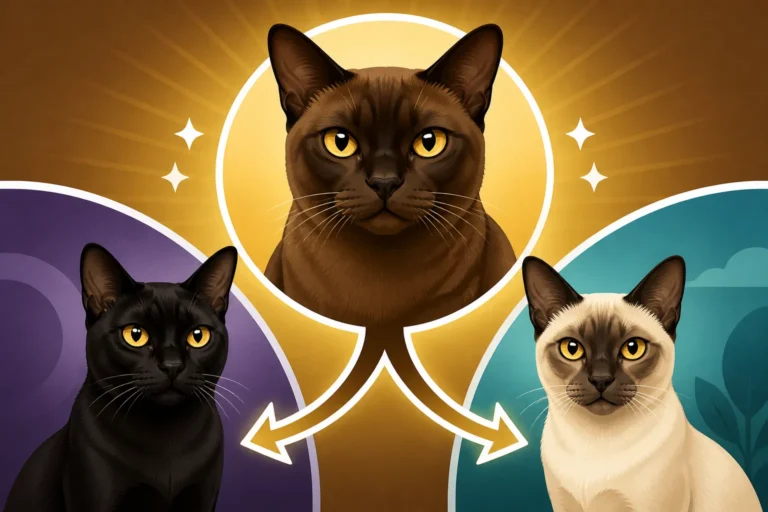
In that pivotal first litter, Thompson identified three key phenotypes:
- Siamese-like kittens: These offspring inherited the classic pointed pattern of the Siamese, demonstrating that Wong Mau, surprisingly, carried the Siamese gene (cb). This was a crucial piece of the puzzle, suggesting that Wong Mau herself was not homozygous for the gene that made her brown.
- Wong Mau-like kittens: Some kittens closely resembled Wong Mau herself, displaying the rich, solid brown body color with slightly darker points. This group represented the expression of the gene responsible for the Burmese phenotype.
- Intermediate kittens: Perhaps the most intriguing were the kittens that displayed a color and pattern intermediate between Wong Mau and the Siamese. They had a darker body than a Siamese but weren't as uniformly rich brown as Wong Mau, often showing a lighter shade with a more defined pointing than the solid Burmese. These cats would later become known as Tonkinese, and their appearance was key to understanding the genetics at play. What the First Burmese Litter Told Thompson delves into these fascinating observations. This triple outcome was the smoking gun, proving that a novel gene was at work.
The Genetic Breakthrough: Understanding the 'Burmese Gene'
The observation of three distinct phenotypes in the first cross wasn't just interesting; it was a goldmine for geneticists. Dr. Thompson, working with other scientists, meticulously analyzed these results to uncover the inheritance pattern of Wong Mau's unique color. This led to the groundbreaking identification of the "Burmese gene," a discovery that reshaped how coat color genetics were understood in cats. It was a moment of true scientific advancement in the realm of domestic animal breeding, moving beyond mere selection to genetic understanding.
The Incomplete Dominance Explained
Through further controlled breeding, including breeding the Wong Mau-like cats back to the Siamese, and interbreeding the intermediate types, Dr. Thompson and his colleagues confirmed that Wong Mau carried a gene for brown coloration (now known as the 'cb' allele, for Burmese color restriction) that exhibited incomplete dominance with the Siamese gene (cs).
Here's a simplified breakdown of what that means:
- Siamese cats (cs/cs): Have two copies of the Siamese gene, resulting in classic pointed coloration.
- Burmese cats (cb/cb): Have two copies of the Burmese gene, resulting in the rich, solid brown (sable) body color. The cb Allele Is What Makes a Burmese Brown is a fantastic resource on this.
- Intermediate cats (cb/cs): These are the Tonkinese! They inherit one copy of the Burmese gene and one copy of the Siamese gene. Because of incomplete dominance, neither gene completely masks the other. Instead, they produce an intermediate expression – a mink pattern, darker than a Siamese point but lighter than a full Burmese, with aqua eyes.
This discovery was monumental. It wasn't a simple dominant/recessive scenario; it demonstrated a more nuanced form of genetic interaction. It clearly showed that Wong Mau herself was not a true "sable" Burmese but actually heterozygous (cb/cs), meaning she carried one Burmese gene and one Siamese gene. This explained why she produced Siamese-like kittens when bred to a Siamese – she passed on her cs gene. The kittens that looked like her were the cb/cs, the Tonkinese phenotype! The true "sable" Burmese (cb/cb) were actually created by breeding the cb/cs cats to each other or back to pure Burmese.
The Creation of the Tonkinese (Initially)
The intermediate cats, those beautiful "mink" colored kittens from Wong Mau's initial crosses, were incredibly important. While they were not the focus of establishing the Burmese breed as we know it today, their existence was crucial evidence of the incomplete dominance. Initially, these mink cats were simply considered part of the Burmese breeding program, necessary for understanding the genetics. It wasn't until much later that the Tonkinese was recognized as a distinct breed in its own right, celebrated for its unique blend of Burmese and Siamese traits. What Happens When Burmese and Siamese Genes Meet truly clarifies this genetic interaction, and How the Tonkinese Was Made From a Burmese explains its genesis. This genetic understanding allowed breeders to intentionally produce all three phenotypes, further solidifying the Burmese's unique genetic standing.
From Discovery to Breed Status: Early Recognition and Challenges
With the genetic puzzle largely solved, the next phase was to officially establish the Burmese as a recognized breed. This journey, however, was not without its hurdles. The cat fancy, while intrigued by the scientific findings, was inherently conservative and wary of new additions. Dr. Thompson and his supporters faced the significant task of convincing breed registries that the Burmese was a legitimate, genetically stable breed deserving of its own category. This period was critical in ensuring the long-term future of the Burmese cat.
Advocating for the New Breed
Dr. Thompson didn't just stop at understanding the genetics; he became a fierce advocate for the Burmese. He collaborated with geneticists and fellow breeders, rigorously documenting his findings and presenting them to the major cat registries. His scientific approach lent immense credibility to his claims, something often lacking in the subjective world of animal fancy at the time. He and his partners, including the formidable Virginia Cobb, worked tirelessly to breed true-to-type Burmese, ensuring that successive generations consistently displayed the desired sable coloration and conformation. This sustained effort was vital for overcoming initial skepticism and demonstrating the breed's stability. Anyone purchasing cat supplies today, whether from a local pet store or a massive online retailer like Chewy, benefits from this meticulous early work that ensured healthy, well-defined breeds. Why the Burmese Was the First Breed Studied by Geneticists highlights the scientific weight behind these efforts.
The Initial Suspension and Reinstatement
Despite the strong scientific backing, the journey to full acceptance for the Burmese was not smooth. The breed was initially recognized by the Cat Fanciers' Association (CFA) in 1936. However, by 1947, CFA suspended Burmese registration. This suspension wasn't due to genetic instability, but rather concerns about the widespread practice of outcrossing Burmese to Siamese cats, particularly by less scrupulous breeders. This practice diluted the distinct Burmese gene pool, making it difficult to maintain true-to-type animals and blurring the lines between the two breeds.
CFA demanded stricter adherence to breeding standards, requiring three generations of pure Burmese breeding before registration would be reinstated. This was a challenging period for Burmese breeders, but it ultimately forced greater discipline and genetic purity within the burgeoning breed. It pushed breeders to prove, beyond a shadow of a doubt, the genetic integrity of their lines. After considerable effort and strict adherence to the new rules, the Burmese was finally reinstated for championship status in CFA in 1956. This entire saga is detailed in CFA Suspended the Burmese in 1947 and Took It Back. This commitment to genetic purity ultimately strengthened the breed and cemented its place in the cat fancy, allowing future generations of owners to enjoy these wonderful cats, easily finding specialized food or toys from retailers like Chewy.
| Breeding Pair (Phenotype) | Genotype | Expected Offspring Phenotypes | Resulting Breeds/Types |
|---|---|---|---|
| Wong Mau (Mink) x Siamese (Point) | cb/cs x cs/cs | 50% Mink, 50% Point | Tonkinese, Siamese |
| Mink x Mink | cb/cs x cb/cs | 25% Burmese, 50% Mink, 25% Point | Burmese, Tonkinese, Siamese |
| Burmese x Siamese | cb/cb x cs/cs | 100% Mink | Tonkinese |
| Burmese x Mink | cb/cb x cb/cs | 50% Burmese, 50% Mink | Burmese, Tonkinese |
| Siamese x Siamese | cs/cs x cs/cs | 100% Point | Siamese |
| Burmese x Burmese | cb/cb x cb/cb | 100% Burmese | Burmese |
This table clearly illustrates the genetic outcomes that Dr. Thompson's program uncovered, proving the distinct genetic basis for the Burmese and, inadvertently, the Tonkinese. Without this scientific approach, the unique brown beauty of the Burmese might never have been fully appreciated or established as the distinct breed it is today. When you see a Burmese cat lounging on a sunbeam, or hear its distinctive rasping rumble, remember the journey it took to get here, a journey rooted in scientific curiosity and a passion for understanding feline genetics. Today, finding specific breed information or products, like a new scratching post, for your Burmese from stores like Chewy is simple, thanks to the dedicated pioneers who worked to solidify its status.
Disclaimer
This article is for general informational purposes only and does not constitute professional advice. Laws, prices and regulations vary by location and change over time. Consult a qualified professional for guidance on your specific situation.