Why Britain Rejected the American Burmese Type
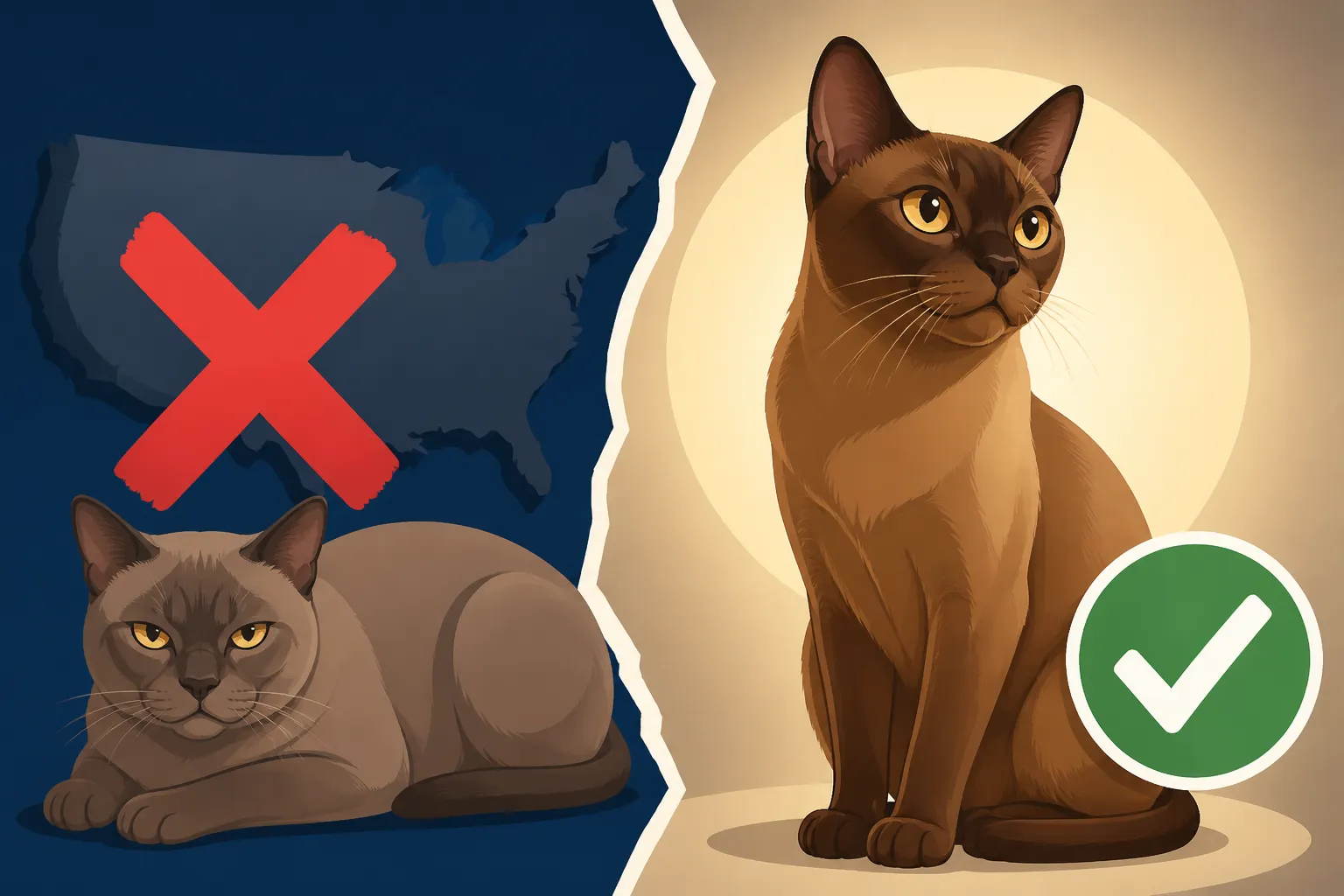
Britain did not reject Burmese cats from America; British breeders and judges rejected the increasingly compact, round-headed American show type as the ideal for their own standard. That distinction matters: the split was about preferred appearance and breeding direction, not whether one type was a “real” Burmese. Here’s how the two styles diverged, and why British Burmese developed a different look.
Britain rejected a look, not the Burmese breed
What “rejected the American Burmese type” means
The phrase can sound as if British cat organisations refused to recognise American Burmese cats altogether. That is too broad. The disagreement was chiefly over which features a Burmese should have and how strongly those features should be emphasised in the show ring. British fanciers wanted a different balance of head shape and body type from the increasingly compact American ideal.
In the United States, breeders moved toward a cat with a broad, rounded head, a short muzzle, and a compact, substantial body. British breeders preferred a more moderate outline: still muscular and rounded, but less extremely compact, with a head and body that looked less exaggerated. The two populations shared Burmese ancestry, yet selection over generations made their show styles increasingly distinct.
This is why the history is often described as a divergence rather than a simple rejection. British fanciers did not have to deny the Burmese’s origins to prefer a different standard. They could value the breed while deciding that a particular American interpretation did not fit their own idea of the Burmese.
For a wider account of how the types separated over time, see How the American and European Burmese Split. The key point is that a breed standard guides which cats are favored in shows and breeding; it does not erase the shared history of cats that developed under different standards.
Why British breeders wanted a different outline
A standard is more than a checklist of features. It describes the overall impression a cat should give, and individual traits can look very different depending on how they combine. A short muzzle, round head, and compact body may create a distinctly different silhouette from a slightly longer, more moderate head and body—even if both cats have the Burmese’s characteristic short coat, expressive eyes, and muscular build.
British breeders and judges placed value on proportion. They sought a Burmese that looked balanced rather than especially extreme in any one direction. This preference reflected the local breeding tradition and the standard being used, not proof that American cats were unhealthy or that British cats were automatically better.
It is also worth separating the show ideal from everyday variation. A pet Burmese may not look exactly like a show-ring example, whether it comes from an American or European line. Cats within a type can differ, and the words “American” and “European” are useful descriptions of breeding and standard traditions—not guarantees that every individual has an identical face or body.
How the two Burmese types came to look different
Selection over generations changed the show ideal
The American and British Burmese populations did not become different overnight. Breeders make choices over time: which cats they show, which cats they breed, and which features they aim to preserve or strengthen. When those choices differ between regions, the resulting populations can gradually develop distinct appearances.
In the American tradition, selection favored a rounder head, shorter muzzle, and more compact body. In Britain, breeders followed a more moderate standard. Because the preferred traits were reinforced in different breeding communities, the difference became recognizable even though the cats remained closely related.
The history of the British lines is often discussed as a story of local development rather than a sudden break with the American breed. Why the British Burmese Went a Different Way and How the British Burmese Diverged After the War explore that broader path. The British Burmese became its own familiar type through sustained breeding choices, not through a single decision that instantly transformed every cat.
The standards show the difference most clearly
A written standard helps explain what judges are looking for, but it should not be read as a description of every Burmese. The American standard emphasizes the compact, rounded look associated with American Burmese. The European standard describes a more moderate balance. Comparing them side by side makes the disagreement easier to understand than relying on loose labels such as “traditional” or “extreme.”
| Feature | American Burmese type | European Burmese type |
|---|---|---|
| Overall impression | Compact, rounded, and substantial | Moderate, balanced, and less compact |
| Head | Broad and rounded | Gently rounded, with a less pronounced compact appearance |
| Muzzle | Shorter and more rounded | More moderate in proportion |
| Body | Compact and muscular | Muscular, but generally less cobby in outline |
| Regional context | Developed under American breeding and show preferences | Developed under British and European breeding and show preferences |
For the written descriptions, compare What the American Burmese Standard Asks For with What the European Burmese Standard Asks For. Those pages are more useful than trying to decide from one photograph, where camera angle, age, coat condition, and the cat’s posture can change its apparent shape.
A standard also explains why a cat might be described differently depending on where it is shown or registered. The name used for the type can vary across organisations and countries. In Britain, the cat is generally referred to simply as a Burmese; “European Burmese” is especially useful when distinguishing that type from the American one in places where both are discussed.
What British fanciers objected to in the American type
A different idea of balance, not a verdict on quality
The central issue was the preferred balance of features. British fanciers did not necessarily object to a round head or muscular body in itself. They objected to making the cat more compact and rounded than their own standard called for. In a show context, that could make an American-style Burmese a poor match for British judging preferences, even while the cat remained recognisably Burmese.
This distinction matters because breed discussions can quickly turn into claims that one type is “correct” and the other is not. In practice, each style reflects the standard and breeding community that shaped it. A cat judged against the wrong regional ideal may simply be evaluated by criteria that were not used to produce its type.
The breed’s background is also more complicated than a neat national divide. Burmese cats were bred and exchanged across borders, while local fanciers developed their own preferences. The resulting styles became distinct through history, registry practices, and generations of selection. Which Cats Founded the British Burmese gives more context on the lines behind the British type.
Why the disagreement still causes confusion
People often encounter Burmese cats online without knowing which standard a breeder follows. A photograph may show a notably round head and compact body, while another cat labelled Burmese looks more moderate. Both may be described accurately within their own breeding context, but the shared name can make the difference seem like a mistake or misrepresentation.
Registry language adds another layer. Some organisations use separate terms or categories to distinguish the types, while others use “Burmese” within their own national standard. For that reason, a buyer or enthusiast should ask which registry and standard the breeder follows rather than relying only on a listing title. Whether the Two Burmese Types Are Separate Breeds explains why the answer depends in part on how the question is being asked.
If you are comparing breeders, ask to see pedigrees, registration details, and photographs of adult relatives—not only kitten pictures. A kitten’s head and body continue to develop, and young cats do not always show their eventual proportions clearly. A breeder should be able to explain which type they work with and how their cats fit the standard they follow.
What the type difference means for owners today
Appearance matters more than day-to-day care
For a prospective owner, the most noticeable difference is usually appearance. The American type tends to look more compact and round, while the European type generally has a more moderate outline. That does not automatically determine a cat’s personality, suitability for a household, or care needs. Temperament depends on the individual cat, its early socialisation, and its environment as well as its breeding background.
Basic care is not selected by type. Both have short coats that need ordinary maintenance, and both need appropriate nutrition, play, companionship, and routine veterinary care. A person comparing food online—whether through a local shop or a retailer such as Chewy—should choose based on the cat’s age, health, and veterinary guidance, not on whether its pedigree says American or European Burmese.
The same practical approach applies to equipment. A carrier should fit the individual cat comfortably, and a scratching post should be stable enough for that cat’s size and habits. Product dimensions on retailers’ listings, including Chewy, can help you compare options, but measuring the cat and checking the product specifications is more useful than assuming every Burmese of a particular type needs the same size.
Questions to ask a breeder or registry
A clear conversation can prevent confusion before it starts. Ask whether the breeder follows an American or European standard, which registry records the kittens, and how the parents are described in their paperwork. If the breeder uses a regional term such as “Burmese” without specifying the type, ask them to explain what they mean by it.
Look beyond the label. Ask to meet adult cats or see recent photos of the parents, and ask how their appearance compares with the standard they breed toward. If you are choosing a kitten for companionship rather than showing, the most important questions are still about health, temperament, socialisation, and the breeder’s practices. The type label is useful context, not a substitute for those checks.
For records and registration terminology, How GCCF Registers the Burmese and How CFA Registers a European Burmese can help clarify why the same broad breed name may be handled differently by different organisations. If you are searching for supplies after bringing a cat home, retailers such as Chewy may make it convenient to compare everyday items, but those purchases do not depend on which Burmese type you have.
Britain’s rejection of the American Burmese type was ultimately a disagreement over the show ideal: British fanciers wanted a more moderate Burmese than the increasingly compact American style. The cats share a breed history, while different standards and breeding choices shaped the two recognizable types. Knowing that distinction makes breed descriptions, pedigrees, and breeder conversations much easier to interpret.
Disclaimer
This article is for general informational purposes only and does not constitute professional advice. Laws, prices and regulations vary by location and change over time. Consult a qualified professional for guidance on your specific situation.