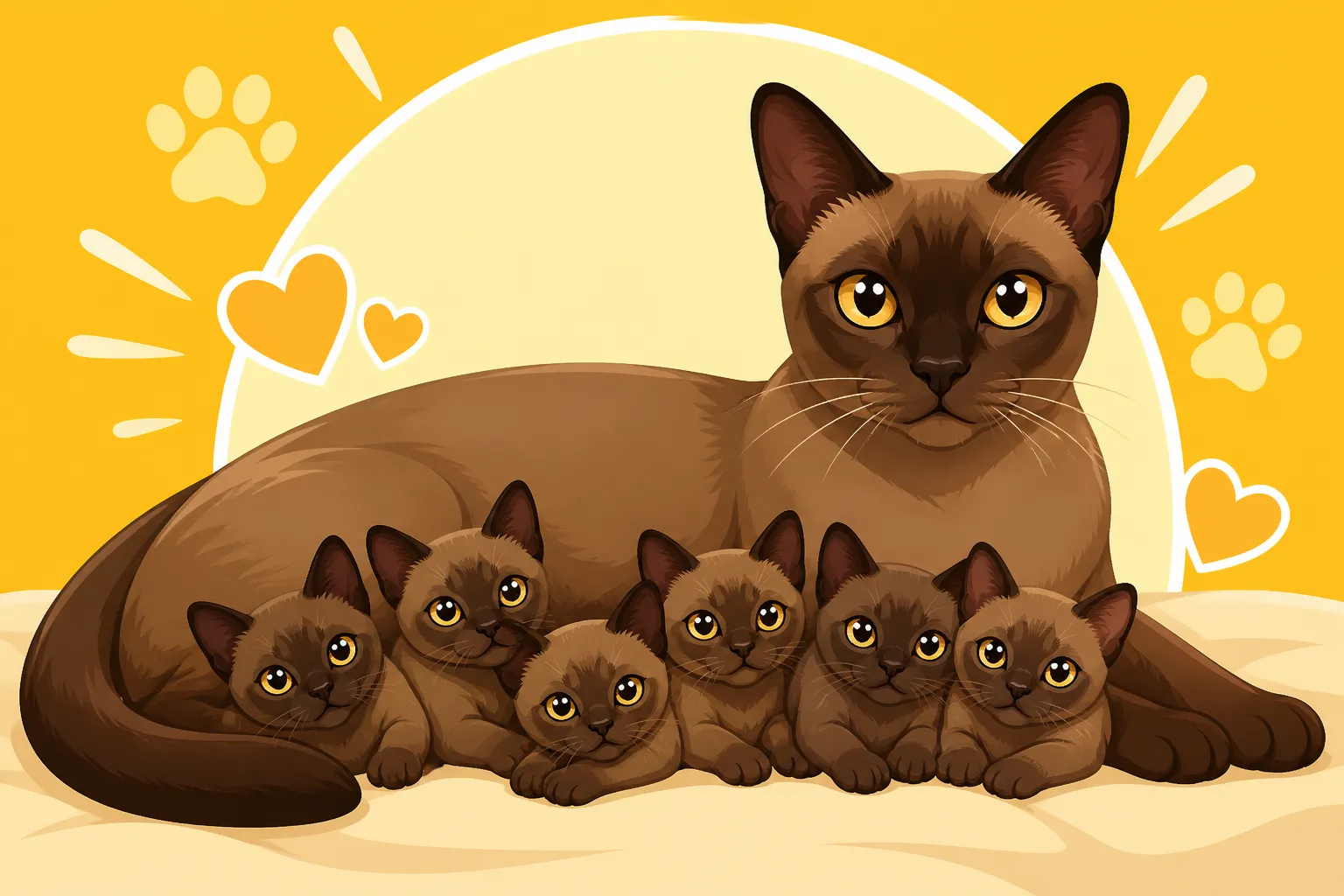
How Many Kittens a Burmese Queen Has
A Burmese queen commonly has around four to six kittens in a litter, but there is no breed-specific number you can count on. One queen may have a small first litter; another may have more kittens after a healthy pregnancy. This guide explains what affects litter size, how to prepare for birth, and when a queen or kitten needs veterinary help.
How many kittens does a Burmese queen usually have
A litter of four to six kittens is a useful general expectation for a Burmese, but it is not a promise. Litters can be smaller or larger, and a single kitten or a litter of eight or more is possible. The number depends on the individual queen and pregnancy, not simply on the breed name.
| Litter size | What it may mean |
|---|---|
| One or two kittens | Can happen, including in a queen’s first litter; the kittens may be larger, so a veterinarian should advise on monitoring |
| Four to six kittens | A reasonable general expectation for many litters |
| Seven or more kittens | Possible, but the queen may need extra support to feed and care for a larger litter |
| No kittens after an apparent pregnancy | Needs veterinary assessment; pregnancy signs alone do not confirm that kittens are developing normally |
Why there is no exact Burmese litter-size average
Breed descriptions sometimes say Burmese litters are larger than those of many other cats. That may be true in some lines, but it does not mean every Burmese queen will have a big litter. A breed-level trend cannot predict an individual pregnancy, and records from particular catteries may not represent all Burmese cats.
A queen’s age, health, reproductive history, and the timing of mating can all affect the number of kittens. The tom’s fertility and the queen’s ovulation also matter. Even when the parents are healthy and the mating is planned carefully, litter size remains variable.
If you are researching Burmese breeding, it helps to separate a general expectation from a guarantee. A responsible breeder can discuss the history of their own queens, while a veterinarian can assess the health of a particular cat. For more on breed background, see Why Burmese Litters Are Larger Than Most.
Do first-time Burmese queens have smaller litters
A first litter may be smaller than a later one, but this is not a rule. Some young queens have several kittens the first time; others have only one or two. Age and general reproductive maturity can play a role, but a small first litter alone does not prove something is wrong.
The queen’s condition matters more than the number. A cat that is eating, behaving normally, and receiving appropriate veterinary care may have a small litter without an emergency. Still, if the pregnancy was not confirmed, if the queen seems unwell, or if labor appears difficult, contact a veterinarian rather than trying to interpret the litter size on your own.
What affects a Burmese queen’s litter size
Litter size reflects several parts of reproduction, and no single factor explains every pregnancy. The queen’s health and breeding history are important, but timing and fertility matter too. Some influences are within a breeder’s control; others are simply natural variation.
Age, health, and reproductive history
Very young cats may not be fully mature, while older queens may have different reproductive needs. That does not mean age alone determines litter size. A veterinarian should assess whether an individual cat is healthy enough for breeding and what monitoring is appropriate for her.
Body condition, nutrition, and underlying illness can also affect pregnancy. A queen should not be put on a restrictive diet during pregnancy unless her veterinarian specifically recommends it. At the same time, “feeding for two” without guidance can lead to excess weight, which may make it harder to assess her condition and manage her health.
Previous litters can provide context, but they do not reliably predict the next one. A queen who had five kittens before might have two or seven later. Keep records of mating dates, veterinary checks, birth outcomes, and kitten weights so you and your vet can compare pregnancies rather than relying on memory.
Mating, fertility, and inherited health
The timing of mating and the fertility of both cats can influence how many eggs are fertilized. A planned mating does not guarantee conception, and conception does not guarantee a particular litter size. If a queen has repeated difficulty conceiving or carrying pregnancies, a veterinarian can investigate possible causes.
Breeding decisions should also consider inherited health, not just the likelihood of a large litter or desirable appearance. Before any mating, discuss relevant screening and the health histories of both cats with a veterinarian and an experienced, responsible breeder. The guide What a Burmese Breeder Must Test Before Any Mating can help you understand why health checks belong in the planning stage.
A Burmese queen’s litter size is not a measure of her quality as a breeding cat. A smaller litter can be healthy; a large one can require extra attention. The priority is the queen’s welfare and the kittens’ health, not achieving a particular number.
How to prepare for a Burmese queen’s litter
Preparing for birth means arranging veterinary support, creating a quiet nesting area, and having a plan for weighing and observing kittens. It is normal to feel unsure about what you should buy or what you should leave alone. A clear setup can prevent frantic searching once labor begins.
Set up a calm nesting space
Choose a warm, quiet place away from busy walkways, household noise, and other pets. A roomy box or nesting bed with clean, washable bedding can help the queen feel sheltered while still letting you observe her. Let her investigate it before labor; moving her at the last moment may make her uneasy.
Gather clean towels, a digital scale suitable for small weights, a notebook or phone for records, and the contact details for your regular veterinarian and an emergency clinic. If you need basic supplies, you might compare options at a local pet shop or Chewy, but ask your veterinarian what is actually useful for your queen. Avoid buying medicines, supplements, or feeding products for newborn kittens without professional guidance.
Keep the area warm and free from drafts, but make sure the queen and kittens can move away from any heat source. A heat source that is too hot or cannot be escaped can be dangerous. If you are unsure how to keep the nest at a safe temperature, ask the veterinary team before the due date.
Plan for kitten monitoring and early care
Newborn kittens should be checked regularly without unnecessary handling. Note each kitten’s appearance and, if your veterinarian recommends it, record its weight at consistent times using the same scale. A steady record can help identify a kitten that is not thriving, though the vet should interpret concerns and advise on what to do.
Watch for practical signs that each kitten is warm, able to nurse, and not being pushed away from the queen. The mother usually provides most of the care, but a large litter can mean more competition at feeding time. If a kitten seems weak, cold, unusually quiet, or unable to latch, seek veterinary advice promptly instead of trying home remedies.
Kittens develop quickly, but milestones vary. For a closer look at early development, read How Early Burmese Kittens Open Their Eyes and What a Burmese Kitten Looks Like at Eight Weeks. If the queen has a kitten with an unusual chest shape or breathing difficulty, Why a Burmese Kitten's Chest Should Be Checked at Birth explains why prompt veterinary attention matters.
What to expect during birth and after the kittens arrive
A Burmese queen may seek privacy, become restless, groom herself, or show less interest in food as labor approaches. These changes are not a precise clock. Keep the environment calm and observe from a respectful distance, while remaining available to contact a veterinarian if something seems wrong.
When to call a veterinarian during labor
Labor can vary, so a veterinarian should guide you on what is normal for your queen and when to seek help. Call promptly if the queen seems exhausted or distressed, has strong repeated straining without producing a kitten, has heavy bleeding, or shows unusual discharge before a kitten is born. Do not pull on a kitten or try to reposition one unless a veterinarian gives direct instructions.
It is also sensible to call if you think a kitten remains inside after labor appears to have stopped, or if the queen is neglecting the kittens or seems unwell. A veterinarian can advise whether she needs an examination. Keep the clinic number easy to find before labor begins; searching for it in the middle of a worrying birth adds stress.
Do not assume that a long pause between kittens is always safe or always dangerous. The queen’s behavior, contractions, and overall condition matter. If you are uncertain, describe what you see to a veterinary professional and follow their guidance rather than relying on a fixed online timetable.
Caring for the queen and litter after birth
Once the kittens arrive, give the queen quiet and access to food, water, and a nearby litter tray. Nursing takes energy, so she may need more food than usual, but the amount and type should suit her health and be discussed with a vet. Keep clean bedding available and change it when needed without disturbing the family more than necessary.
Check that the kittens are nursing and that the queen is comfortable. Contact a veterinarian if she refuses food, seems weak, has a feverish or painful appearance, develops unusual discharge, or is not caring for the litter. For the kittens, urgent warning signs include difficulty breathing, persistent crying, weakness, feeling cold, or failure to nurse.
As the kittens grow, their needs change: they begin exploring, eating solid food, and learning from their mother and littermates. Responsible placement involves more than choosing a pickup date; kittens need time for social development and veterinary care. See Why Burmese Kittens Are Sold at Thirteen Weeks for more on why an early handover is not simply a matter of convenience. If you are considering the breed as a future owner, Whether a Burmese Is the Right Cat for You can help you think through the commitment beyond kittenhood.
Keep expectations flexible
The most realistic answer to “How many kittens will my Burmese queen have?” is usually “around four to six is a reasonable expectation, but the actual number varies.” A small litter is not automatically a problem, and a large litter does not automatically mean something is wrong. The queen’s health, safe delivery, and thriving kittens matter more than matching a typical range.
Planning ahead makes the uncertainty easier to manage. Arrange veterinary support, prepare a calm nesting area, and keep simple records. If anything about pregnancy, labor, or a newborn kitten concerns you, contact a veterinarian rather than waiting for a problem to become obvious.
Disclaimer
This article is for general informational purposes only and does not constitute professional advice. Laws, prices and regulations vary by location and change over time. Consult a qualified professional for guidance on your specific situation.