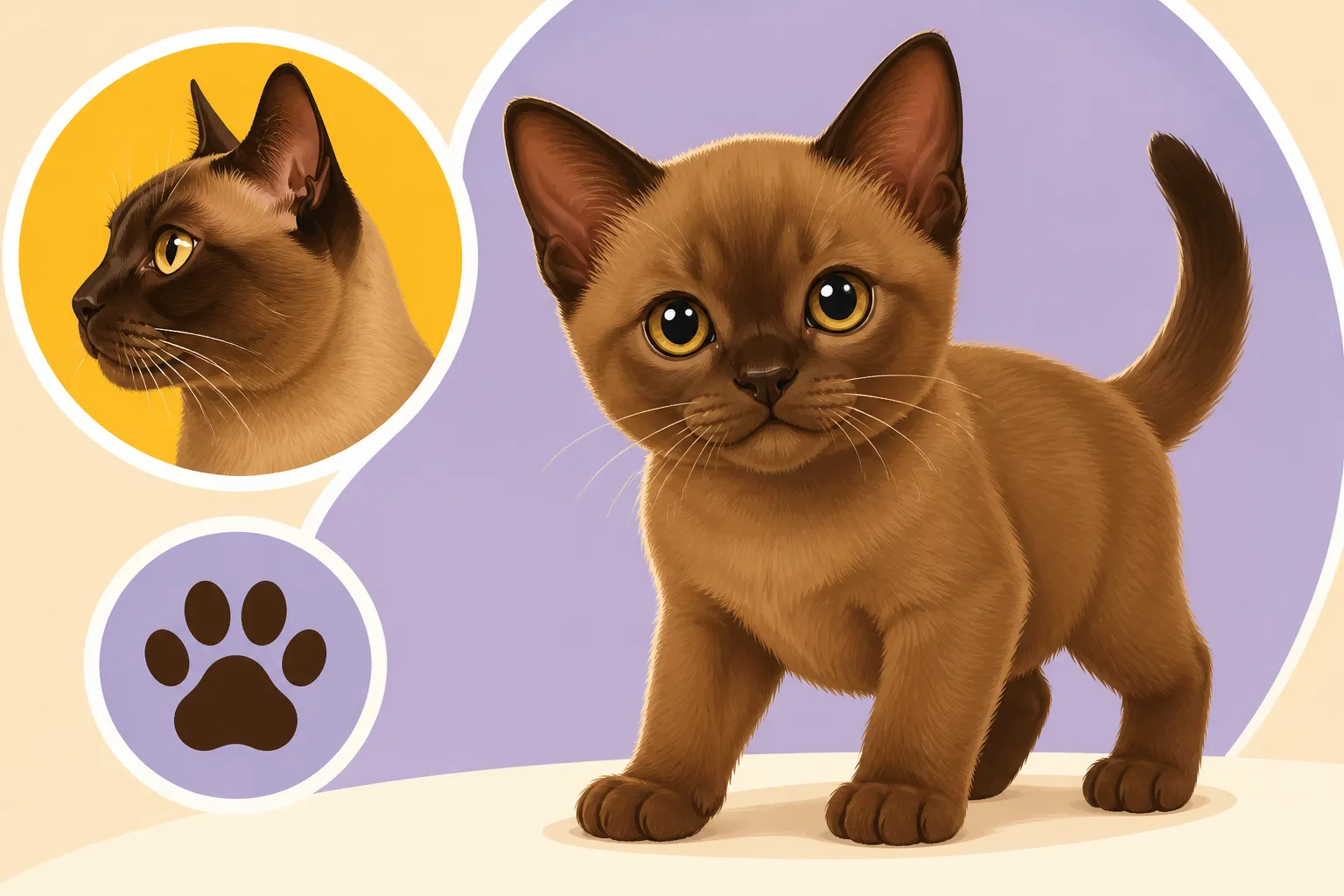
What a Burmese Kitten Looks Like at Eight Weeks
At eight weeks, a Burmese kitten can look less like the polished, compact adult cat in breed photos and more like a soft, round-faced ball of energy. Its coat may still be pale, its eye color may be changing, and its proportions are very much kittenish. This guide explains what is typical, what varies, and which signs deserve a closer look.
The Burmese kitten’s face, eyes, and expression
A rounded face that is still growing
An eight-week-old Burmese usually has a short muzzle, rounded cheeks, and a soft outline to the head. The exact look depends partly on the line: American Burmese tend to have a more compact, rounded appearance, while European Burmese often have a more moderate, slightly less rounded head shape. At this age, though, the kitten’s features are still developing, so it may not yet resemble the adult standard closely.
The ears often look large compared with the head, and the paws can seem a little oversized for the body. That is normal kitten proportion, not a reliable clue that the cat will grow unusually large. As the kitten grows, the head and body develop together, and the overall balance becomes easier to judge.
If you are comparing a kitten with adult photos online, remember that coat color, expression, and head shape can all look different in a young cat. What a Burmese Looks Like Against the Standard explains the adult features breeders and judges look for, but an eight-week-old kitten should not be expected to have the finished appearance of a mature show cat.
Eyes that may not have settled into their adult color
Burmese eyes are known for warm shades that can range from yellow through gold to deeper amber. At eight weeks, a kitten’s eyes may still be developing, and their color may look lighter or less intense than it will later. Lighting also changes how the shade appears: golden eyes can seem pale in bright daylight and richer in a dim room.
A single photograph can be misleading. Phone cameras may shift eye color, and reflections from windows or indoor lighting can make the eyes look unusually green, yellow, or blue. If you are choosing a kitten, try to see it in ordinary natural light and look at both eyes rather than relying on a close-up image.
Eye color alone does not establish that a kitten is a Burmese. Breed identity is best understood through the pedigree and the breeder’s records, along with the kitten’s overall features. For a closer look at the breed’s adult eye expectations, see How a Burmese's Eye Color Is Judged.
A lively expression, not a fixed temperament test
Burmese kittens often look alert and people-focused, but a photograph captures only a moment. One kitten may be watching the camera; another may be asleep after play; a third may be hiding briefly because a visitor has arrived. None of those snapshots can tell you exactly how the kitten will behave at home.
During a visit, observe how the kitten responds after it has had time to settle. Does it explore, play, or approach people once it feels safe? Does it recover after a small surprise, such as a toy rolling nearby? These observations are more useful than expecting an eight-week-old kitten to perform on cue.
Burmese cats are often known for close human companionship, but personality is shaped by socialization, experience, and the individual animal. Why the Burmese Is Called a Dog in a Cat's Body explores some of the breed’s familiar social traits, while Why a Burmese Kitten Socializes Itself describes how early experiences can influence a kitten’s comfort with people.
Coat color and body shape at eight weeks
A soft, short coat that may look paler than expected
The Burmese coat is short and lies close to the body. At eight weeks, it often looks soft and plush rather than fully sleek, and the color may appear lighter than the adult coat. The coat can deepen as the kitten matures, so a pale-looking baby may develop a richer, more defined color over time.
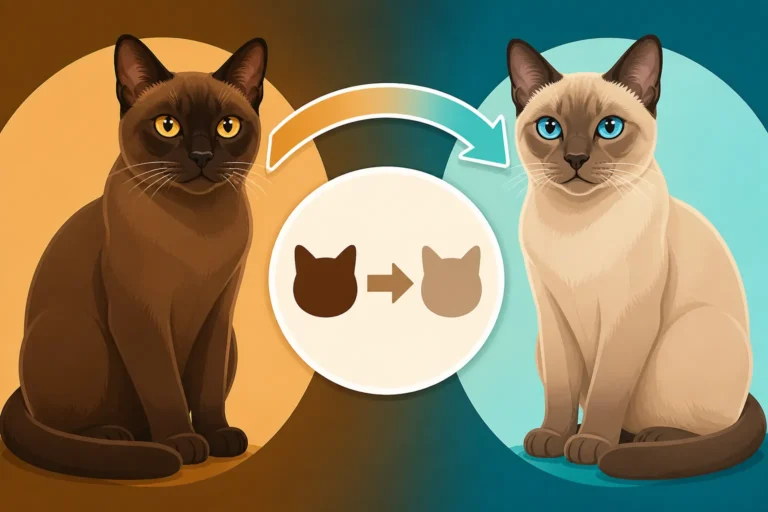
Burmese color is affected by temperature-sensitive pigment. Cooler areas of the body can become darker than warmer areas, and the pattern may become more noticeable as the cat grows. The face, ears, paws, and tail may eventually look deeper in color than the torso, although the contrast is often more blended than the strong points seen in some other breeds. Why a Burmese Kitten Darkens as It Grows goes into more detail about this gradual change.
At eight weeks, do not assume that the color will stay exactly as it looks in the first photo you receive. Ask the breeder what color is recorded in the kitten’s paperwork and whether the parents’ coats changed as they matured. If you are buying a kitten, the breeder should be able to explain the color and type represented in its pedigree rather than relying on a casual label such as “brown.”
Compact, muscular potential in a small body
Burmese cats are often described as feeling heavier than they look because of their solid, muscular build. An eight-week-old kitten, however, is still tiny and growing. It may have a rounded belly after eating, a narrow waist, or a slightly awkward stance as it becomes more coordinated. Those features should be considered alongside overall condition and the breeder’s veterinary care, not judged in isolation.
A kitten should appear lively and reasonably well nourished, with a clean coat and clear eyes. You should be able to see it move around comfortably and play without persistent difficulty. A very young kitten’s body shape is not a dependable way to predict its adult weight or build. Burmese cats also vary by sex, family line, and individual growth pattern.
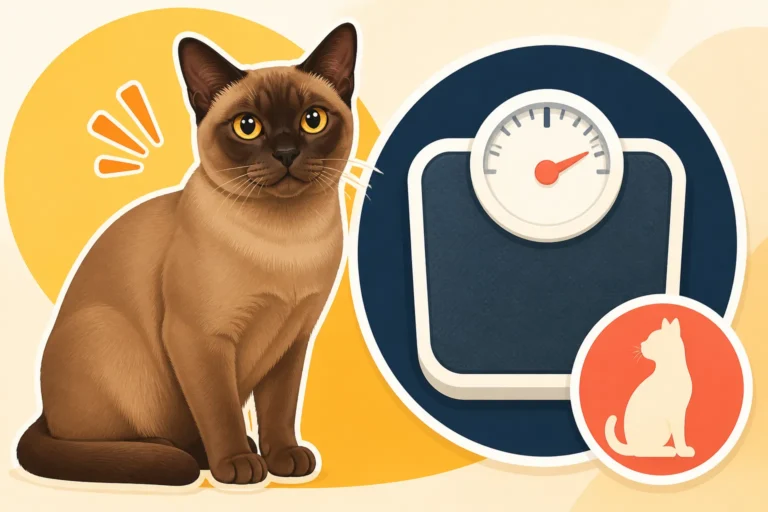
If you are unsure whether a kitten looks too thin or unusually round, ask the breeder how its growth is being tracked and have your own veterinarian assess it after it comes home. A household kitchen scale can help you record changes over time, but it is not a substitute for an examination if the kitten seems unwell. How Big an Adult Burmese Gets gives a broader sense of the adult breed, while When a Burmese Reaches Full Size explains why the eight-week stage is only the beginning.
Recognizing color and type without over-reading a photo
The familiar Burmese colors include sable, champagne, blue, and platinum in the American tradition. Other registries may recognize additional colors for European Burmese. Because the standards and accepted colors differ, it helps to know which type the breeder is describing rather than assuming every Burmese is judged by the same set of rules.
A kitten’s coat in a photograph may not show its final shade accurately. Sunlight, indoor bulbs, camera settings, and the kitten’s age all affect the appearance. Ask to see the kitten in person if possible, and request the pedigree or registration information that identifies its type and color. How the American and European Burmese Split explains the distinction between the two types, and Which Colors CFA Accepts in a Burmese covers color recognition in one major registry.
| Feature at eight weeks | What you may notice | Why it can change |
|---|---|---|
| Face | Rounded cheeks, short muzzle, large-looking ears | Head and body proportions are still developing |
| Eyes | Yellow or gold tones that may look lighter in photos | Eye color and intensity can continue to mature |
| Coat | Short, soft, and sometimes paler than an adult coat | Burmese color often deepens with age |
| Body | Small, energetic, and sometimes a little uncoordinated | Muscle, balance, and adult proportions develop over time |
| Color pattern | Some darkening around cooler areas may be visible | The coat’s final shade and contrast can take time to settle |
How to assess a kitten beyond its appearance
Look at movement, alertness, and everyday behavior
When you visit a litter, watch the kittens in a calm setting before picking one up. A healthy kitten may switch quickly between exploring, playing, eating, and sleeping. It should be able to walk and play without repeatedly stumbling or seeming distressed. Brief shyness in an unfamiliar room is not automatically a concern, but ongoing weakness or difficulty moving deserves a direct conversation with the breeder and a veterinarian.
Notice how the kitten responds to its littermates and surroundings. Does it show curiosity after a pause? Can it settle after play? Does it seem comfortable being handled gently? These observations give you a more useful picture than coat color alone, though no short visit can guarantee a future personality.
Ask what veterinary care the kitten has received and what is planned before it leaves the breeder. A responsible breeder should be willing to discuss the kitten’s health, development, socialization, and parentage. The kitten’s appearance may catch your eye first, but a clear account of its care is what helps you make an informed decision.
Ask for records and clear answers
Before committing, ask which Burmese type the kitten is, how its color is recorded, and what documentation will come with it. Request the pedigree or registration details and ask whether the breeder can show relevant health records for the parents. If an answer is vague, take your time rather than feeling pushed to decide quickly.
A breeder should also be comfortable explaining the kitten’s age, feeding routine, and transition plan. Eight weeks is an early stage for a kitten to be away from its mother and littermates, so ask when the kitten will be ready to go home and what the breeder’s placement practices are. Why Burmese Kittens Are Sold at Thirteen Weeks discusses why many breeders keep kittens longer for development and socialization.
You can also ask to see the litter interacting together, not just a carefully chosen portrait of one kitten. Seeing the group may help you understand each kitten’s energy and confidence, and whether the environment appears clean and well managed. Why a Burmese Litter Has to Be Handled, Not Photographed offers more on why real interaction matters.
Plan for the first days at home
A kitten’s appearance can change quickly, but the first days at home are mostly about helping it feel secure. Prepare a quiet room with a bed, litter tray, scratching surface, water, food, and a few safe toys. Keep the kitten’s familiar food at first, then discuss any planned diet changes with your veterinarian so the transition is gradual.
For basic supplies, Chewy can be one place to compare kitten food, litter, bowls, and carriers; check product labels and your veterinarian’s advice before choosing food, especially if the kitten has a health concern. A sturdy carrier that opens easily can make the first trip to the vet less stressful. Chewy also carries a range of litter options, but the most useful choice at first is usually one that matches what the kitten already knows.
If there are other pets in the home, introduce them gradually rather than expecting an immediate friendship. Give the new kitten time to explore its safe room and become comfortable with household sounds. For a practical overview of early care, see What a Burmese Kitten Should Eat and Why a Burmese Kitten Needs an Early Vet Check.
When a difference in appearance deserves attention
Normal kitten variation versus a reason to ask questions
It is normal for kittens in the same litter to have slightly different expressions, coat shades, and levels of boldness. One may appear rounder, while another has a longer-looking face. A kitten may also look different in person than it did in a photograph because camera angles can exaggerate the head, paws, or body.
What matters is whether the kitten appears comfortable and is developing appropriately. Persistent discharge from the eyes or nose, labored breathing, marked lethargy, repeated vomiting, or difficulty walking are not matters of breed appearance; they are reasons to ask the breeder for prompt veterinary attention. If the kitten is already in your care, contact a veterinarian rather than trying to diagnose the cause from a photo.
Similarly, a single unusual pose does not tell you that something is wrong. A kitten can sit awkwardly while playing or look round after a meal. If you see the same concern repeatedly, ask for a direct explanation and, where appropriate, an independent veterinary assessment.
Be cautious about claims based on looks alone
No coat shade, eye color, or round face can confirm that a kitten has a particular genetic result or is free from inherited conditions. Those questions require records, appropriate testing, and veterinary guidance. A breeder who describes a kitten as “perfect” based only on its appearance is not giving you the full picture.
It is sensible to ask about the health history of the family and the tests relevant to the line. Which Tests Belong on a Burmese DNA Panel can help you understand what kinds of screening may be discussed, while What a Burmese Breeder Must Test Before Any Mating covers the breeder’s responsibilities before a litter is produced.
Most of all, remember that an eight-week-old Burmese is a growing kitten, not a finished version of the adult cat. Its eyes may deepen, its coat may darken, and its body will become more coordinated and muscular. A healthy kitten’s charm is often in that unfinished, changing stage. Look at the whole animal, ask thoughtful questions, and give its appearance time to develop.
Disclaimer
This article is for general informational purposes only and does not constitute professional advice. Laws, prices and regulations vary by location and change over time. Consult a qualified professional for guidance on your specific situation.