Why a Burmese Is Confused With a Siamese
A Burmese can look Siamese at first glance: both breeds have short coats, expressive faces, and plenty of personality. The confusion usually starts with a brown or dark-coated cat whose color seems to deepen around the face, ears, legs, and tail. This guide explains the differences in coat pattern, eye color, body shape, temperament, and pedigree so you can make a more informed identification.
Why Burmese and Siamese Cats Are So Often Mixed Up
Their shared features can make a quick guess difficult
Both Burmese and Siamese cats are short-haired, people-oriented breeds with alert expressions and noticeable voices. They can be curious, interactive, and eager to follow household activity. If you meet a cat briefly in a shelter or see a single photo online, those similarities may be all you notice.
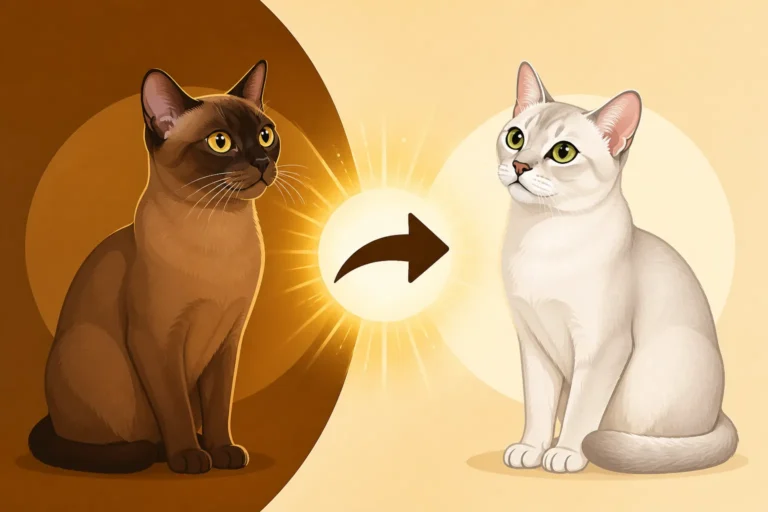
Color can add to the uncertainty. A dark Burmese may have a visibly deeper face and ears than the rest of its body, which can make it seem “pointed” at a glance. Siamese cats are known for their darker points too, so the pattern can look similar from across a room. Lighting, age, and the cat’s individual coat can make the distinction even less obvious in a photograph.
A useful starting point is to look at the whole cat rather than one feature. Coat pattern, eye color, head shape, and build together are more informative than a dark mask or a lively personality on its own. For a broader look at Burmese appearance, see What a Burmese Looks Like Against the Standard.
The breeds have a historical connection, but they are not the same breed
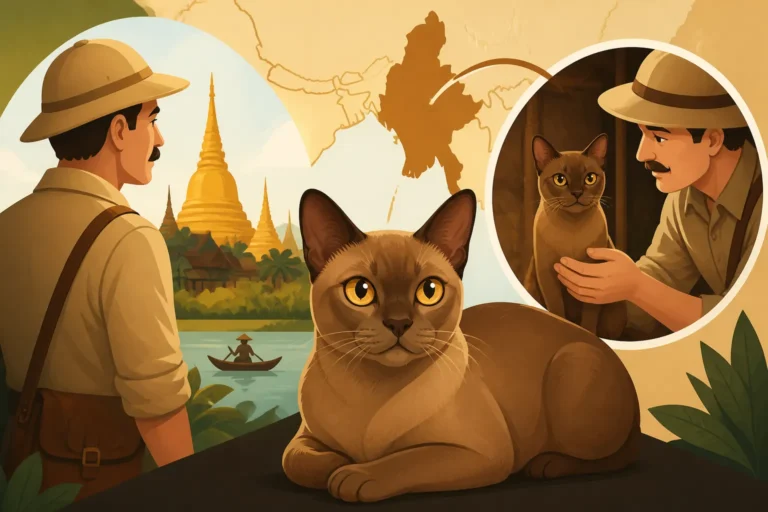
The Burmese breed developed from cats with a distinctive coat-color pattern, and Siamese cats played a role in the breed’s early development. That connection helps explain why people sometimes notice a family resemblance. It does not mean that a modern Burmese is simply a Siamese with a different color, however. The breeds have their own standards and characteristic combinations of appearance.
The color genetics are part of the story. Burmese coat color is influenced by a temperature-sensitive form of pigmentation, which can make cooler areas of the body appear darker. Siamese coloring is also temperature-sensitive, but the classic Siamese pattern has clearly contrasting points on the face, ears, paws, and tail, with a paler body. The visual effect is usually more sharply defined than on a Burmese.
For a closer explanation of how the genes relate, read What Happens When Burmese and Siamese Genes Meet. That background can help make sense of the resemblance without treating the breeds as interchangeable.
The Most Reliable Differences in Appearance
Compare the coat pattern, not just the darkness of the face
A Burmese usually has a more even, solid-looking coat across the body, though the color may be deeper at the extremities. The transition is often gradual: the face, ears, legs, and tail can be darker without forming the high-contrast pattern many people associate with a Siamese.
A Siamese typically has a pale body with darker points that stand out clearly. The exact shade varies, but the contrast between the body and points is often the first clue. A seal-point Siamese, for example, can have very dark brown points against a lighter body, while other point colors create different contrasts.
A quick comparison can help organize what you’re seeing:
| Feature | Burmese | Siamese |
|---|---|---|
| Typical coat impression | More even and solid-looking, with subtle shading | Pale body with clearly darker points |
| Eyes | Usually yellow to gold shades | Blue |
| Overall build | Compact and muscular, often deceptively heavy | Varies by line, but commonly more elongated and fine-boned |
| Head shape | Rounded, with a broad expression in many Burmese | Often more wedge-shaped, especially in modern show lines |
| What can mislead you | Darker face or extremities can resemble points | A dark point pattern may look less distinct in a photo |
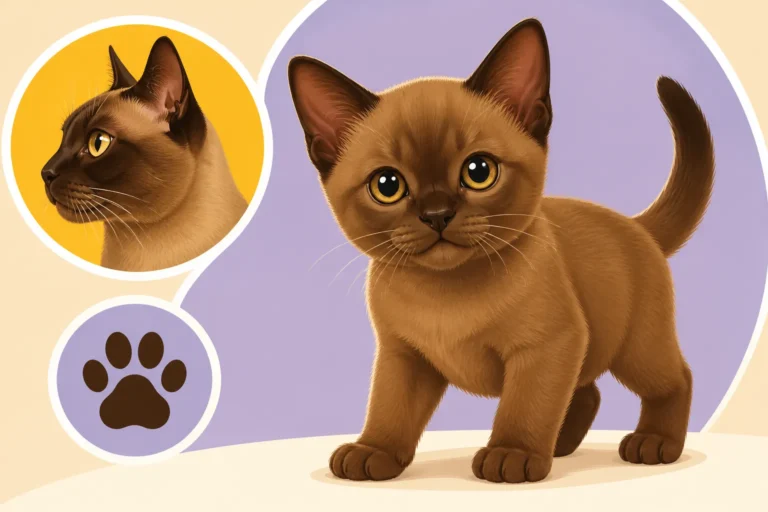
These are general breed tendencies, not a checklist that proves ancestry. A cat can be overweight, underweight, young, elderly, mixed-breed, or photographed in lighting that hides important details. A kitten’s coat can also change as it matures, so a single early photo may not show its adult coloring clearly.
Eye color is a strong clue
Eye color is often one of the clearest visual differences. Burmese cats are generally expected to have yellow-to-gold eyes, while Siamese cats are known for blue eyes. When coat color or camera lighting makes the pattern hard to judge, eye color can provide a useful extra clue.
Photos can be misleading here too. Indoor lighting may make gold eyes look brown, and flash can change the apparent shade. If you are looking at a cat in person, notice the color in natural light if possible. Even then, eye color alone does not establish breed. A cat may have mixed ancestry, and a breed label should be supported by reliable records rather than appearance alone.
For more on Burmese eye expectations, see Which Eye Color a Burmese Should Have. It is especially useful when you are comparing a cat with a breed standard rather than trying to make a quick guess from a listing.
Head shape and body build tell a fuller story
Burmese cats are often described as compact and muscular. They can feel heavier than their size suggests, which surprises people who expect a short-haired cat to feel light. Their heads tend to look rounded, and the overall expression is often broad and open. These traits are best judged together rather than by focusing on the muzzle or ears in isolation.
Siamese cats vary in appearance. Many people picture the modern Siamese with a long, fine body, a wedge-shaped head, and large ears. Other lines may have a less extreme look, so “not slender enough” is not a reliable reason to rule out Siamese ancestry. Breed standards also differ between registries and types, so comparisons should be made carefully.
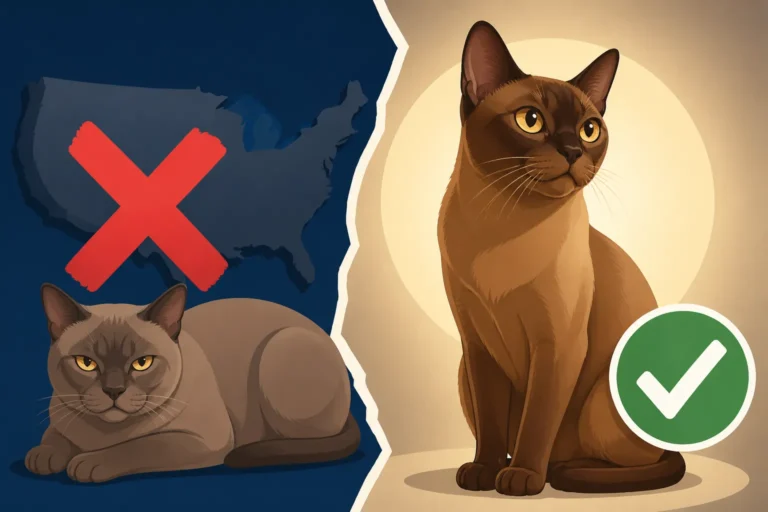
The Burmese has its own breed history and standards, including differences between American and European Burmese types. Those differences can affect head shape and overall appearance. If the Burmese you are looking at does not match one familiar image, that does not automatically make it Siamese. How the American and European Burmese Split explains why Burmese cats do not all have one identical outline.
Personality Can Resemble, but It Cannot Confirm, a Breed
Both breeds may be highly social and vocal
A Burmese may follow you from room to room, settle close by, or make a raspy sound to get your attention. Siamese cats are also widely known as communicative companions. Because both breeds can be involved in household life, behavior alone is rarely enough to distinguish one from the other.
There are individual differences within every breed. One Burmese may be chatty and constantly underfoot; another may be affectionate but quieter. The same is true of Siamese cats. A cat’s early socialization, home environment, age, and experiences all influence how comfortable it is with people.
So if someone says, “This cat talks a lot, so it must be Siamese,” take that as a guess, not proof. Personality can help you understand what the cat may need from its home, but it cannot verify its pedigree. For a pet-focused comparison, see How a Burmese Compares to a Siamese as a Pet.
Look at the cat’s needs, not just the label
If you are choosing a companion, it may be more useful to ask how the cat behaves in everyday situations than to focus only on whether it looks Burmese or Siamese. Does it settle comfortably when left for a while? Does it seek play, company, or a quiet resting spot? How does it respond to other pets and visitors? Those answers are more relevant to a good home match than a visual label.
A busy household might suit a cat that enjoys regular interaction, but a cat that becomes distressed when alone may need a more thoughtful routine. Ask the current caregiver about the cat’s daily habits, preferred play, and comfort with handling. A shelter or breeder may also have useful observations that a short visit cannot reveal.
If you are preparing for an adoption, make a simple list of what the cat already uses and what you need to provide. A carrier, litter supplies, and food bowls are practical basics; whether you buy locally or look through a retailer such as Chewy, the important thing is to choose suitable supplies and avoid making abrupt changes to the cat’s routine.
How to Identify a Burmese or Siamese More Responsibly
Treat appearance as a clue, not a pedigree certificate
A cat that resembles a Burmese is not automatically a purebred Burmese, and a pointed-looking cat is not automatically a Siamese. Many non-pedigreed cats share features with recognized breeds. A short coat, darker face, or social temperament can suggest a resemblance, but none of those details proves ancestry on its own.
If breed identity matters to you, ask for documentation. A pedigree from a recognized registry is more informative than a sales listing that simply uses a breed name. Ask which registry recorded the cat, whether the papers identify its type, and whether the documented parents match the claimed breed. If a seller cannot explain the records, treat the label cautiously rather than relying on a confident description.
For a Burmese, it can also help to understand how registries handle different types. You can learn more in How CFA Registers a European Burmese. When checking any paperwork, focus on what the documents actually state rather than what the cat’s appearance seems to suggest.
Use a practical checklist when comparing cats
If you are trying to identify a cat from a photo or in person, look at several features in sequence:
- Check the eyes. Blue eyes are characteristic of Siamese cats; yellow-to-gold eyes are typical of Burmese cats.
- Study the coat contrast. A pale body with distinct dark points suggests Siamese coloring. A more even coat with gradual shading is more consistent with Burmese coloring.
- Look at the whole outline. Consider head shape and body build, while remembering that Siamese lines can vary.
- Ask about age and lighting. Coat shades can change with age, and dim or artificial light can distort color.
- Request records if breed identity matters. A visual guess is not a substitute for pedigree documentation.
This checklist is meant to guide observation, not diagnose breed. If the cat is a rescue or its history is unknown, it may be most accurate to describe it as resembling a Burmese or Siamese rather than making a firm claim. That approach respects what you can see without inventing a history you cannot confirm.
A retailer such as Chewy may be useful when you are gathering ordinary care supplies after adopting, but no purchase can resolve uncertainty about a cat’s ancestry. Keep breed identification and everyday preparation as separate questions: ask the shelter or breeder for records, and choose supplies based on the individual cat’s needs.
Avoid relying on a single online image or DNA result
Online photos are particularly easy to misread. A warm filter can make a coat look darker, while a bright background can wash out the body color. A cat curled up with its face in shadow may appear more pointed than it does in person. Before deciding, look for several clear photos from different angles, ideally in natural light.
A DNA test may provide clues about ancestry, but results should not be treated as the same thing as registry pedigree papers. Breed ancestry and formal registration answer different questions. If you need to verify a purebred claim for a purchase, breeding decision, or show eligibility, ask the relevant registry or qualified breed organization what documentation it recognizes.
When contacting a breeder or rescue, ask direct, neutral questions: “What records are available?” “Which registry is listed?” “Can I see the cat’s parents or pedigree?” A responsible conversation should make room for those questions. If you are also comparing Burmese with other related cats, How a Burmese Differs From a Tonkinese can help clarify another common source of confusion.
Disclaimer
This article is for general informational purposes only and does not constitute professional advice. Laws, prices and regulations vary by location and change over time. Consult a qualified professional for guidance on your specific situation.