Why the Burmese Is Called the Sacred Cat of Burma by Mistake
People often hear “Sacred Cat of Burma” and assume the Burmese cat is an ancient temple breed. The mix-up is understandable, but the nickname belongs to the Birman, a different breed. This guide explains how the two names became tangled, what is known about the Burmese’s beginnings, and how to tell the breeds apart without relying on folklore.
Why the Burmese and Birman names get mixed up
The sacred-cat nickname belongs to the Birman
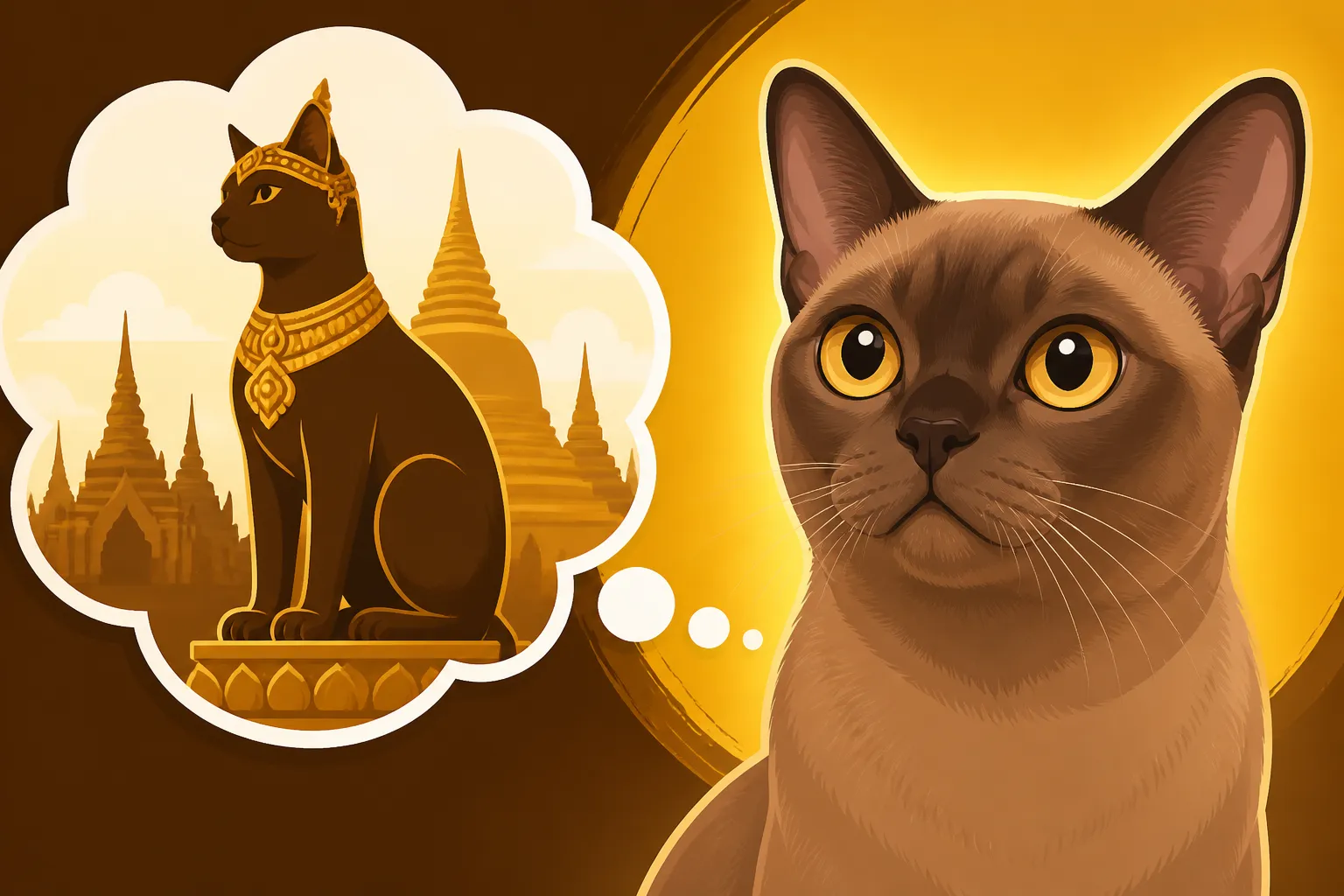
The Birman is commonly called the “Sacred Cat of Burma.” Its name and popular legend connect it with temples in Burma, now Myanmar. In the best-known version of the story, temple cats were associated with a sacred place and acquired their distinctive appearance through a miraculous transformation. It is an appealing tale, but it is a legend rather than a verified account of how the modern breed was developed.
The Burmese is a separate breed. Its name points toward Burma as part of its early history, but that does not make it the temple cat of the Birman story. Over time, the similar words “Burmese” and “Birman,” along with their shared geographical association, have encouraged people to use the sacred-cat nickname for both.
That mix-up is common in casual conversation, breed descriptions, and family stories. Someone may call a Burmese a sacred cat simply because they have heard the phrase before, not because they are trying to make a claim about the cat’s ancestry. The distinction is worth correcting gently: the Birman owns the familiar nickname, while the Burmese has a different modern breed history. Why the Burmese Name Causes Confusion With the Birman
A shared geographical name does not make them the same breed
“Burmese” and “Birman” sound close enough that it is easy to treat them as alternative names for one cat. They are not. Breed names can reflect geography, appearance, or the history of a particular breeding program, and similar names do not establish that two breeds share the same identity.
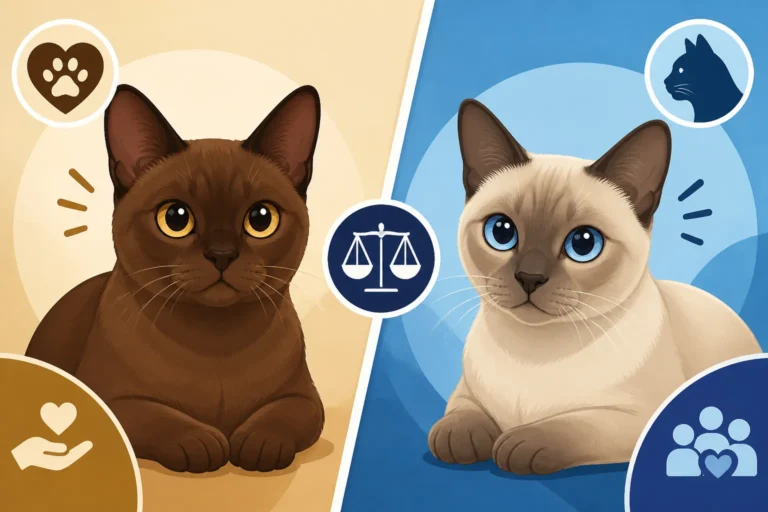
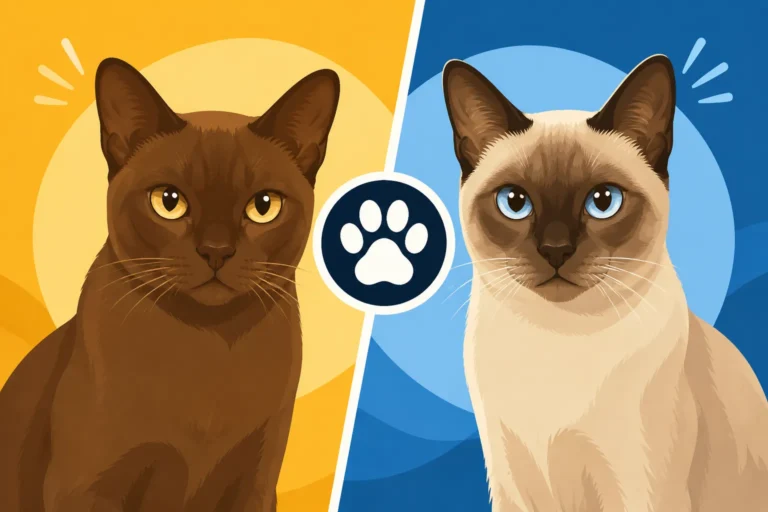
The two breeds also look noticeably different once you know what to look for. Birmans have a semi-long coat and characteristic white paws, often described as gloves. Burmese cats have a short, close-lying coat and a compact, muscular body. Their typical appearance is not defined by white gloves or the Birman’s longer coat.
Their eyes and coat patterns can help distinguish them, too. A Birman is known for blue eyes and a pointed coat pattern, where the face, ears, legs, and tail are darker than the body. Burmese cats are associated with a different coat pattern and commonly have yellow-to-gold eyes. Individual cats vary, of course, and a pet may not match every show-standard feature exactly. What a Burmese Looks Like Against the Standard
| Feature | Burmese | Birman |
|---|---|---|
| Common nickname | Not the Sacred Cat of Burma | Often called the Sacred Cat of Burma |
| Coat length | Short and close-lying | Semi-long |
| Distinctive paws | No required white gloves | White gloves are a defining feature |
| Typical eye color | Yellow to gold | Blue |
| Coat pattern | Burmese color pattern | Pointed pattern |
A striking blue-eyed, white-pawed, fluffy cat is not a Burmese just because someone calls it one. Likewise, a sleek, short-coated cat is not a Birman simply because a person uses “Sacred Cat of Burma” as a general label. If you are identifying a particular cat, a pedigree or a knowledgeable breeder can tell you more than a nickname can.
Where the Burmese breed history begins
Wong Mau is central to the modern breed’s story
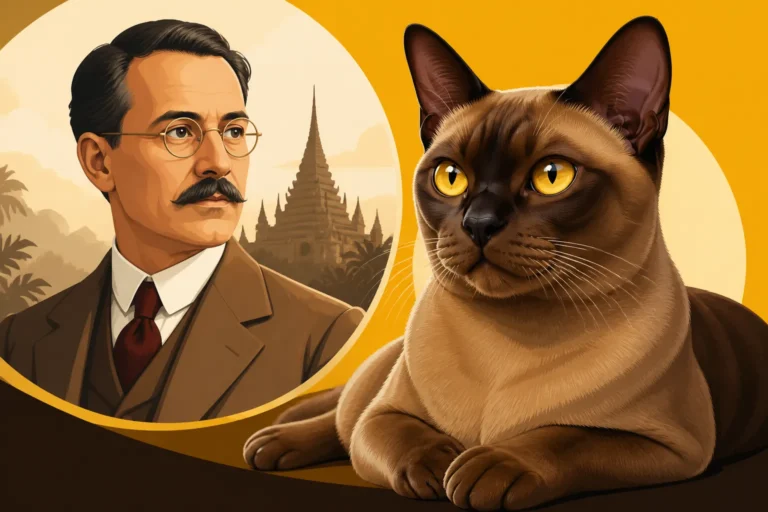
The modern Burmese breed’s recorded history is closely tied to a cat named Wong Mau. She was brought to the United States from Burma and became the foundation of a breeding program associated with Dr. Joseph Thompson. The story is discussed in detail in The Burmese Began With One Cat Called Wong Mau.
Wong Mau is often described as the first Burmese, but that phrase needs a little context. She was not necessarily the first cat of her general type to exist in Burma. Rather, she became a foundational cat in the development and documentation of the modern breed in the United States. A named foundation cat can give a breed’s formal history a clear starting point without proving that no similar cats existed earlier.
Her appearance also shaped the way people understood the new breed. Wong Mau did not fit neatly into the familiar categories available to breeders at the time. Her coat and markings prompted questions about what she was and what her kittens might look like. Those questions became part of the early effort to define Burmese cats as a distinct breed.
The exact details of an individual cat’s background can be difficult to establish after the fact. Wong Mau’s history is often told through the records and interpretations of the breeders who worked with her. That is different from having a complete, independently documented account of her ancestry or birthplace. Where the Founding Burmese Wong Mau Came From
Early breeding shaped the modern Burmese
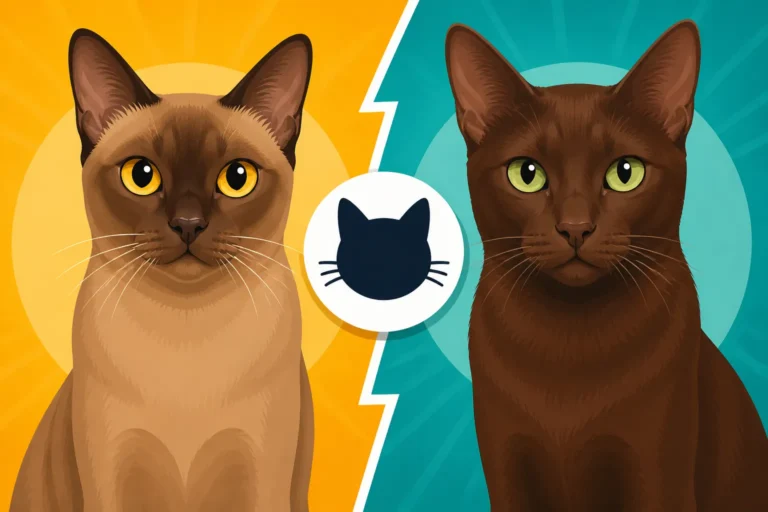
Wong Mau was bred to Siamese cats as part of the early program that helped establish the Burmese. This does not mean today’s Burmese is simply a Siamese with a different coat, nor does it mean the two breeds are interchangeable. It describes one step in the formation of the modern Burmese breed.
The kittens from those early matings helped breeders investigate how coat colors and patterns were inherited. Some kittens looked more Siamese-like, while others displayed the traits breeders wanted to develop in the Burmese. Breeding choices over generations helped establish a more consistent type, including the compact build and distinctive coat associated with the breed.
That history is one reason it is misleading to treat the Burmese as an unchanged ancient breed with a fully documented temple lineage. The modern breed has a traceable development through deliberate breeding in the twentieth century. Its name and the reported Burmese origin of Wong Mau connect it to a place, but they do not substantiate the sacred-temple story associated with the Birman. Why the First Burmese Was Bred to a Siamese
Wong Mau’s classification has also been debated. A cat’s appearance alone cannot always settle whether it belongs to a particular breed, especially when a breed is still being developed and its characteristics are not yet fixed. The question is part of the breed’s history, not proof that the Burmese and Birman are the same. Whether Wong Mau Was a Purebred Burmese
How to separate history from legend
Treat the temple story as folklore, not a pedigree
The Birman’s sacred-cat story is often repeated as if it were a documented account of the breed’s origin. It is better understood as folklore attached to the breed’s identity. A legend can be culturally meaningful and memorable without serving as reliable evidence of a cat’s ancestry.
This distinction matters because stories tend to blur when they are retold. A person may remember that a cat breed is associated with Burma, recall a story about temple cats, and then apply the story to any Burmese-looking cat. The result sounds plausible because the names overlap, but the conclusion does not follow from the name alone.
A useful way to think about it is to separate three things: a breed’s name, its documented development, and the stories people tell about it. The Burmese name and the Birman legend overlap geographically, but the modern Burmese developed through a recorded breeding history centered on Wong Mau. The Birman’s sacred-cat title is connected to a different breed and to a traditional legend.
This also avoids the opposite mistake of dismissing every part of a breed’s history as fiction. There is a real history behind the modern Burmese, even if some details of Wong Mau’s background are uncertain. There is also a real Birman breed, even though its temple origin story is not the same as a verified breeding record.
Use physical traits and records to identify a cat
If you are looking at a cat and wondering whether it is Burmese or Birman, start with the whole picture rather than one striking feature. Coat length, pattern, eye color, body type, and documented ancestry together are more useful than a nickname or an online caption.
A short coat and compact, solid-looking build are consistent with the Burmese type. A longer coat, blue eyes, pointed coloring, and white paws are characteristic of the Birman. Mixed-breed cats and individual variation can complicate visual identification, so appearance alone should not be treated as a definitive pedigree check.
For a pedigreed cat, ask for registration and ancestry documents, and check which breed name appears on them. For a rescue or a cat with unknown parentage, it is more accurate to describe the cat by its visible traits unless its breed background has been established. A vet can help assess health and care needs, but a routine examination does not certify a cat’s breed.
The Burmese has its own breed history, appearance, and personality; it does not need a borrowed sacred title to be special. Learning the distinction also makes it easier to understand other questions about the breed, including How the American and European Burmese Split and Whether a Burmese Is the Right Cat for You.
What the Burmese name means for owners
A name does not determine a cat’s care
The sacred-cat confusion is mostly a naming and history issue. It does not change how a Burmese should be cared for. Whether a cat comes from a breeder or a rescue, day-to-day needs depend on that individual cat’s age, health, temperament, and home environment—not on a temple legend.
For example, a new owner may be more concerned with getting feeding right than sorting out an old nickname. When comparing food, read the nutritional information and ask your veterinarian about a diet that suits your cat’s age and health. If you use Chewy to browse food options, treat product descriptions as a starting point and confirm any medical diet decisions with your vet.
The same practical approach applies to basic supplies. A short coat usually does not call for elaborate grooming, but a soft grooming cloth can help remove loose hair and provide a calm moment of contact. If you are shopping through Chewy or another retailer, choose a tool that feels gentle on your cat’s skin rather than assuming that a breed name requires a particular product.
A carrier is another everyday decision where a cat’s comfort matters more than its story. If Chewy is one place you look for carriers, compare the opening, stability, and room for your cat to turn around, then introduce the carrier at home before a veterinary visit. A cat that can explore it gradually may find travel less stressful than one who sees it only when it is time to leave.
Correcting the nickname can be simple and kind
If someone calls a Burmese the Sacred Cat of Burma, a quick clarification is usually enough: “That nickname is generally used for the Birman; the Burmese is a different breed.” There is no need to turn a casual conversation into a debate over every detail of breed history.
This gentle correction is especially useful when a family is choosing a cat. The names may sound alike, and photographs can be misleading, so prospective owners should ask which breed is being represented and what documentation supports that description. If the cat is not pedigreed, the seller or rescue should not present a guess as a verified breed identity.
For a Burmese owner, the most useful takeaway is that the breed’s name and its history are not the same thing as the Birman legend. The Burmese has a documented modern development that begins with Wong Mau and an early breeding program. The Birman is the breed associated with the Sacred Cat of Burma nickname. Keeping those stories separate makes the history clearer—and lets each breed be appreciated for what it actually is.
Disclaimer
This article is for general informational purposes only and does not constitute professional advice. Laws, prices and regulations vary by location and change over time. Consult a qualified professional for guidance on your specific situation.