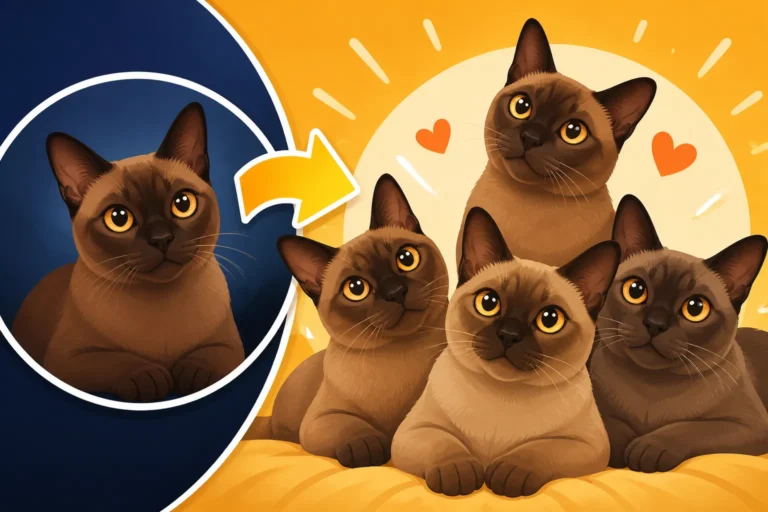
How a Burmese Compares to a Tonkinese as a Pet
Choosing between a Burmese and a Tonkinese can feel like splitting hairs: both are clever, affectionate cats that often want to be involved in whatever you’re doing. The difference shows up in the details—how much conversation you enjoy, the kind of company each cat needs, and what you want from a pet’s appearance and daily routine. This guide compares those practical differences so you can picture life with either breed.
Burmese and Tonkinese at a glance
Both breeds are social, people-focused cats, and either may follow you from room to room. Neither is a good match for someone who wants a very hands-off pet. Still, their personalities and appearance are not interchangeable. A Burmese tends to have a more compact, solid feel and a close, glossy coat; a Tonkinese combines Burmese and Siamese ancestry and can have a more varied coat pattern and a more expressive voice.
| Feature | Burmese | Tonkinese |
|---|---|---|
| General personality | Affectionate, playful, people-oriented | Affectionate, playful, sociable |
| Activity | Energetic and interactive, often playful into adulthood | Energetic and interactive, often enjoys games and company |
| Vocal style | Usually conversational, with a softer, throaty sound | Often more talkative than a Burmese, though individuals vary |
| Build | Compact and muscular; can feel heavier than expected | Medium, muscular, and typically balanced in build |
| Coat | Short, close-lying, glossy | Short, close-lying coat in several patterns |
| Best fit | A home where people make time for daily interaction | A home that welcomes an active, social cat with a little more vocal back-and-forth |
These are tendencies, not guarantees. A cat’s temperament is shaped by its individual personality, early socialization, health, and home environment. If you’re comparing a particular pair of cats, spend time with them and ask the breeder, rescue, or foster carer what they’re like on an ordinary day.
For a closer look at how their physical traits differ, see How a Burmese Differs From a Tonkinese. Their shared history helps explain why people sometimes confuse them: How the Tonkinese Was Made From a Burmese.
How their personalities compare
A Burmese is often described as a companion cat that wants to participate. Yours may settle beside you while you work, climb into your lap when you sit down, or call from the hallway when a closed door gets in the way. That closeness is part of the appeal—but it can be a lot if you’re hoping for a cat that is content to entertain itself for most of the day. The breed’s reputation as a particularly people-focused cat is explored in Why the Burmese Is Called a Dog in a Cat's Body.
Tonkinese cats are also social and playful. Many enjoy interactive games, learning routines, and greeting familiar people. Some are more vocally expressive than the Burmese, but “more talkative” is a broad tendency rather than a promise that every Tonkinese will narrate your day. A quiet Tonkinese and a chatty Burmese are both entirely possible.
Think about the kind of interaction you enjoy. If you like talking to a pet and don’t mind a cat answering back, a vocal individual may be delightful. If frequent calls would wear on you—especially at night or during work calls—ask how the particular cat behaves, rather than relying on breed descriptions alone.
How their appearance and coat differ
The Burmese usually has a compact, muscular body beneath a short coat that lies close and feels smooth. The cat may look modest in size but feel surprisingly substantial when picked up. Burmese coats are known for their polished appearance, but they don’t require elaborate grooming: gentle, regular brushing or wiping can help remove loose hair and keep the coat neat.
Tonkinese cats are also short-haired and relatively easy to groom, but their coats come in different patterns, including pointed, mink, and solid appearances. The visible pattern and eye color can vary, so a Tonkinese may look quite different from one Burmese to another even when both are healthy and well cared for. For the coat comparison specifically, How a Burmese's Coat Differs From a Tonkinese's offers useful context.
Neither breed should be chosen on coat color alone. If you’re meeting kittens, ask what their adult appearance may look like and how the breeder or rescue identifies their breed. Coat patterns can be subtle, and lighting can make them look different in photographs than they do in person.
Daily life with either breed
The main practical question isn’t whether a Burmese or Tonkinese is “better.” It’s whether your household can meet the needs of a social, intelligent cat. Both can thrive in an apartment or a larger home if they have safe places to rest, opportunities to play, and reliable human company. A large house does not automatically solve boredom, just as a smaller home does not automatically prevent a cat from thriving.
Company and time alone
A Burmese may struggle when left alone for long stretches without companionship or enrichment. Some individuals cope better than others, but it’s sensible to plan for company rather than assume a new kitten will simply adapt to a long, empty day. Why a Burmese Cannot Be Left Alone All Day explores the issue in more detail.
Tonkinese cats also tend to seek interaction. A busy household can suit either breed, provided the cat has quiet places to retreat when it wants a break. If your schedule keeps you away for much of the day, consider whether another compatible pet, a trusted visitor, or a more enriching home setup would help. A second cat can be a good companion for some households, but it is not a guaranteed fix: cats need individual introductions, enough resources, and personalities that work together. See Why a Second Cat Fixes Most Burmese Problems for more on that question.
A common real-life scenario is a person who works away from home and expects a kitten to sleep through the day. The kitten may instead seek attention, get into cupboards, or become restless when the household is quiet. Interactive feeders, safe climbing spaces, and scheduled play can help, but they do not replace social contact. Consider your typical weekday—not just the relaxed weekends—before choosing either breed.
Play, training, and household fit
Both breeds can be bright, curious, and quick to learn routines. A short daily play session with a wand toy, a food puzzle, or a toy you toss down the hallway can give them a satisfying outlet. Rotate toys rather than leaving every option out all the time; a familiar toy can become more interesting again after a break.
Many Burmese enjoy being close while their people go about ordinary tasks, and some will learn simple cues or games. Tonkinese cats can also enjoy interactive play and training, especially when it is positive and rewards are small and accounted for. Neither breed needs constant entertainment, but both benefit from regular attention and activities that let them think, move, and engage.
Children and other pets can be a good fit when introductions are calm and everyone is taught to respect boundaries. A cat should always have a quiet retreat where children cannot follow. With dogs, use a gradual introduction and make sure the cat has elevated escape routes. A friendly breed is not automatically comfortable with every person or animal it meets.
Grooming, feeding, and routine care
Neither cat needs a complicated coat-care routine. A soft brush or grooming glove can remove loose hairs, while brief handling practice makes it easier to check paws, ears, and teeth. Begin gently and keep sessions short, especially with a kitten. If the cat starts to wriggle, pause rather than turning grooming into a wrestling match.
Food needs to be measured according to the cat’s age, body condition, activity, and veterinary advice. Burmese cats can be persuasive beggars, and a muscular build can make weight gain harder to spot by eye. Weighing food and checking body condition can help you notice gradual changes. Why a Burmese Needs Fewer Calories Than It Asks For explains why those pleading looks shouldn’t be the only guide to portion size.
For supplies, focus on function rather than breed-specific marketing: sturdy scratching surfaces, a litter box large enough for the cat, safe toys, and food that suits its life stage. If you shop at Chewy, compare product dimensions and feeding instructions instead of choosing a bowl or feeder just because it is labeled for a particular breed. A puzzle feeder can be useful for an enthusiastic eater, but introduce it gradually so mealtimes don’t become frustrating.
Health, breeders, and choosing the right cat
A pet’s health is not determined by breed alone, but breed background can guide the questions you ask. Burmese cats are known to have a noteworthy diabetes risk, so maintaining a healthy body condition and noticing changes in thirst, urination, appetite, or weight are important parts of routine care. Learn the signs and discuss concerns with a veterinarian; don’t try to diagnose diabetes based on one symptom.
Tonkinese cats also need ordinary preventive care, regular veterinary checks, dental attention, and a healthy weight. Ask about health screening in the cat’s family line and what veterinary care the kitten or adult cat has already received. Responsible sources should be willing to discuss health history without brushing aside reasonable questions.
What to ask a breeder or rescue
Ask how the cat has been socialized, what its daily routine looks like, and how it responds to being handled. If you’re choosing a kitten, find out how it behaves around littermates and people. If you’re adopting an adult, ask about its history with children, other animals, being alone, and any known health or behavior needs.
For a Burmese, it can be useful to ask specifically about the family’s health history and how the breeder approaches inherited conditions. What a Burmese Breeder Must Test Before Any Mating outlines why health questions belong in the conversation. A rescue may not have complete pedigree or genetic information, and that does not make the cat a poor choice; it simply means you should discuss appropriate screening and monitoring with your veterinarian.
A thoughtful breeder or rescue should also ask about your household. Questions about your work hours, other pets, and expectations are not necessarily a hurdle—they can help match a cat to a home where it is more likely to settle well. Be cautious if someone guarantees a particular personality or dismisses concerns about health and socialization.
How to decide between them
Choose a Burmese if you’re drawn to a compact, affectionate cat and are prepared for a companion that may want to stay close. You’ll need to enjoy daily interaction and plan carefully for time alone. A Burmese can be a wonderful match for someone who wants an involved pet, but the closeness can feel demanding if your ideal cat is independent.
Choose a Tonkinese if you like the same broad combination of sociability and playfulness, while also appreciating its varied coat patterns and the possibility of more vocal conversation. The Tonkinese is not automatically less needy or easier to care for; it is still a social cat that benefits from engagement, routine, and company.
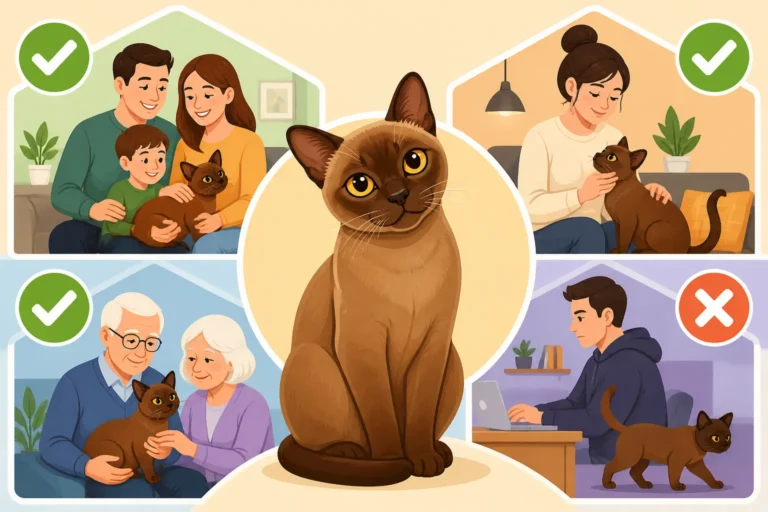
If you’re uncertain, meet adult cats as well as kittens. Kittens are charming and active, but their mature temperament may be easier to gauge in an adult. Ask what the cat does when nobody is actively playing with it, whether it settles comfortably, and how it reacts to ordinary household noise. You can also read Whether a Burmese Is the Right Cat for You and Which Household a Burmese Fits to consider how a Burmese’s needs line up with your day-to-day life.
A simple decision checklist
Before making a choice, ask yourself:
- Do I want a cat that often seeks out company, rather than one that prefers long stretches alone?
- Can I build play and attention into ordinary weekdays, not just weekends?
- Am I comfortable with the possibility of a vocal, interactive pet?
- Can I budget time and money for routine veterinary care and unexpected health needs?
- Have I met the individual cat and asked about its behavior, socialization, and health history?
If your answers point toward an affectionate, highly involved companion, either breed could suit you. The best choice is the individual cat whose needs and personality fit your real routine—not simply the breed name that sounds most appealing.
Chewy may be one place you look for practical supplies such as toys, carriers, or grooming tools. When comparing options, check whether the item is safe and appropriately sized for your cat, and ask your veterinarian before making a health-related food change. That approach matters more than finding a product marketed specifically to Burmese or Tonkinese cats.
Disclaimer
This article is for general informational purposes only and does not constitute professional advice. Laws, prices and regulations vary by location and change over time. Consult a qualified professional for guidance on your specific situation.