Whether Burmese Cats Existed in Burma Before 1930
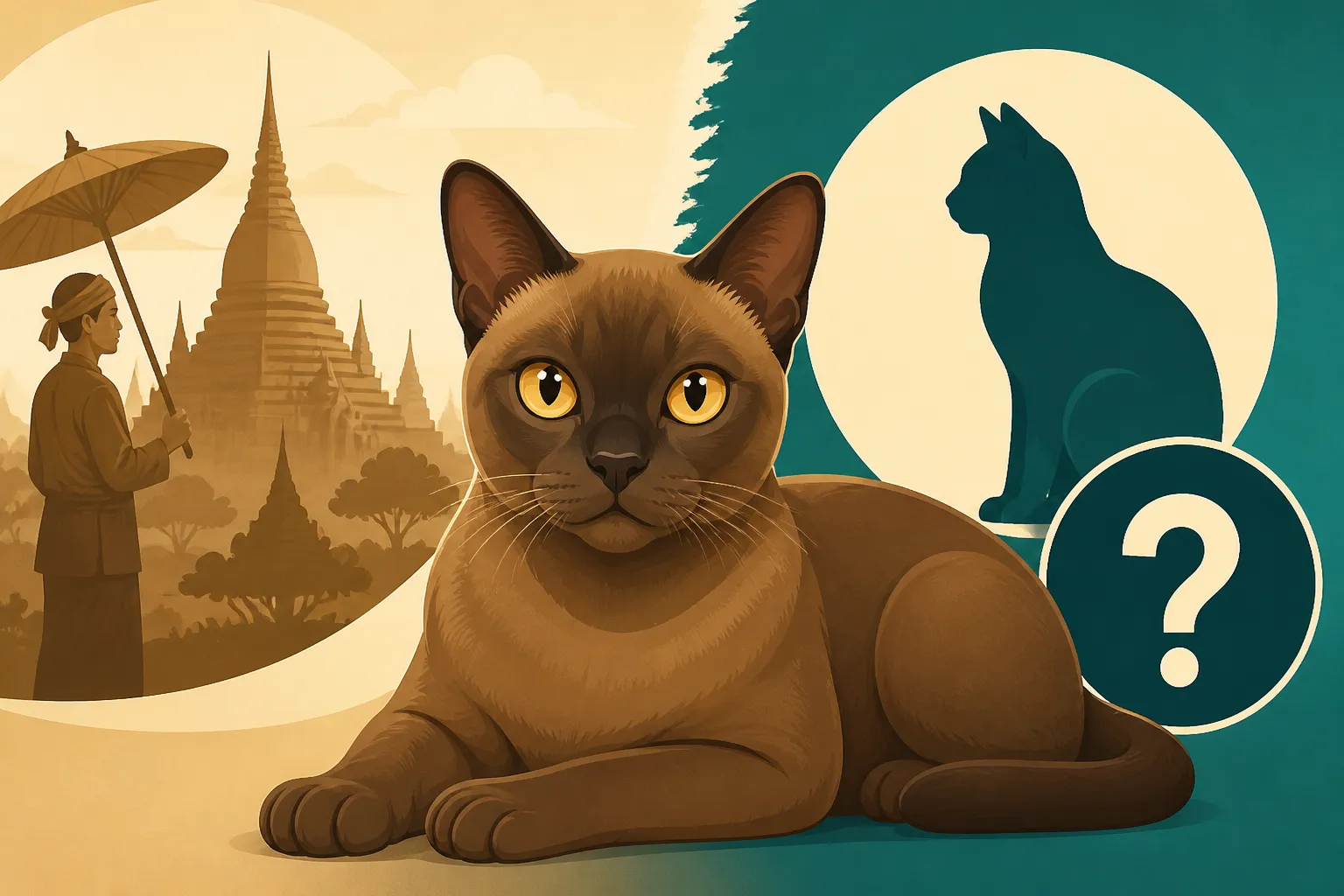
A name can sound like proof: if a cat is called Burmese, surely it must have been a recognized breed in Burma before it reached the United States. The history is less tidy. Cats lived in the region, but the modern Burmese breed is documented as taking shape in the twentieth century. This guide separates what records support from what the breed’s name alone cannot prove.
The short answer about Burmese cats before 1930
Cats in Burma are not the same as a documented Burmese breed
Domestic cats almost certainly lived in Burma, now called Myanmar, long before 1930. People kept cats in homes and communities across the region, as they did in many parts of the world. But evidence that cats lived there is not the same as evidence that a distinct, consistently bred cat population existed under the name “Burmese.”
A modern cat breed usually has a documented history of deliberate breeding, identifiable traits, and a community or registry that recognizes it as a breed. For Burmese cats, the well-known documented story begins in the United States in 1930, when a cat called Wong Mau arrived in San Francisco. That starting point doesn’t mean no similar-looking cats existed in Burma earlier. It means the documented breed history does not establish an organized Burmese breed there before that date.
This distinction can feel frustrating if you are hoping for a simple origin story. Breed histories often compress a complicated past into a catchy line: “an ancient cat from Burma came to America.” The more careful version is that the modern breed was developed from a cat associated with Burma, then shaped through breeding in the United States.
The name is not proof of an ancient breed
“Burmese” points to a geographic association, but a breed name by itself cannot confirm where a cat’s ancestors lived, how long a particular look had existed, or whether local people bred cats to a formal standard. The name may reflect the story attached to Wong Mau, rather than a documented pre-1930 breed registry or breeding program in Burma.
That is why claims about the breed’s history need to be read closely. A statement that Wong Mau came from Burma is not the same as proof that Burmese cats existed there as a recognized breed. Likewise, a claim that the breed is ancient needs more than a familiar name or a story repeated across pet websites.
| Historical question | What the evidence supports | What it does not establish |
|---|---|---|
| Did domestic cats live in Burma before 1930? | It is reasonable to distinguish the presence of cats in the region from the later breed history. | That those cats belonged to a formally established Burmese breed. |
| Was Wong Mau associated with Burma? | She is central to the documented twentieth-century Burmese origin story. | A complete record of her ancestry or the existence of an organized breed in Burma. |
| When does the modern breed history become traceable? | The commonly documented account begins with Wong Mau in the United States in 1930. | That no similar cats existed before then. |
| Does the breed name settle the question? | It indicates a historical or geographic association. | A verified ancient lineage or pre-1930 breed standard. |
For a broader look at why the founding cat’s identity is debated, see Whether Wong Mau Was a Purebred Burmese. The question is not just academic: it helps explain why the modern breed’s story is more complicated than “an ancient breed was imported intact.”
How Wong Mau became central to the Burmese story
The documented story begins in San Francisco
In 1930, Dr. Joseph Thompson acquired Wong Mau, a brown cat associated with Burma, and brought her to San Francisco. She became the starting point for the breeding program that produced the modern Burmese. The story is important, but it also leaves unanswered questions. The exact details of Wong Mau’s background are not as complete as a modern pedigree record, so historians and breed enthusiasts have discussed what kind of cat she may have been.
Thompson’s work involved breeding Wong Mau and examining the kittens’ appearance. The resulting cats did not all look alike. Their differences helped reveal that coat color and pattern could vary depending on the cats’ inherited traits. The breeding program therefore became more than a simple effort to reproduce one attractive cat; it helped establish which traits could be selected and maintained.
If you have encountered different versions of Wong Mau’s arrival, it can help to separate the core fact from the uncertain details. Her role in the American breed’s development is well established in the traditional history. The finer points of where she came from, who brought her, and how precisely to classify her ancestry are less straightforward. Dr Joseph Thompson and the Burmese He Bought in 1930 explores the person and breeding program at the center of that account.
Selective breeding shaped the modern breed
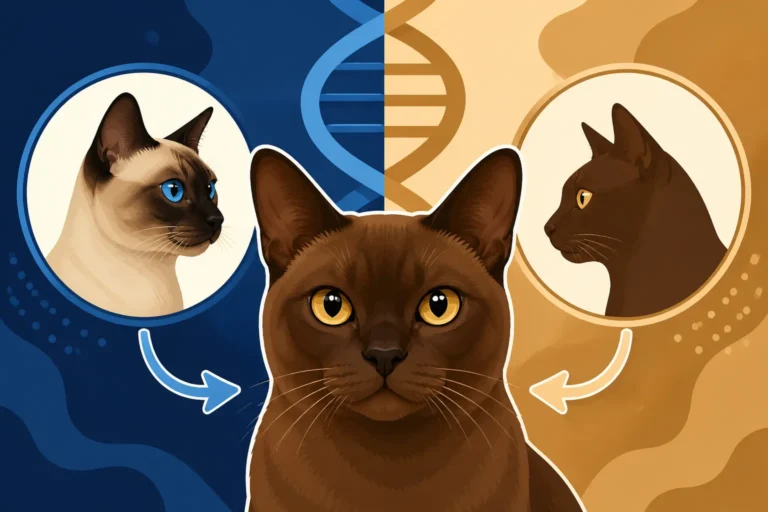
The modern Burmese was not simply presented to a registry as a fully formed breed with a long, documented pedigree stretching back through Burma. Its development involved selective breeding in the United States. Breeders worked with the cats descended from Wong Mau and used Siamese cats in the early program. This process helped produce cats with the characteristics that would become associated with the Burmese.
The early kittens displayed more than one type of appearance. The cats with the desired darker, solid-looking coat characteristics were selected for the Burmese line, while other combinations contributed to the development of related types. This is one reason the phrase “the first Burmese” can be misleading if it suggests that a complete, unchanged breed arrived in 1930. The breed took shape through breeding choices made after Wong Mau’s arrival.
The role of Siamese cats is part of the established origin story, though it can surprise people who assume the Burmese developed in isolation. For more on that early breeding, see Why the First Burmese Was Bred to a Siamese and What Thompson's Program Proved About the Burmese. The short version is that the modern breed’s identity emerged through deliberate selection, not solely from a geographic label.
What Burma’s role in the history can and cannot tell us
Similar-looking cats may have existed without a formal breed
It is entirely possible that cats resembling Wong Mau lived in Burma before 1930. A population of naturally occurring cats can share traits without being a formally recognized breed. People may also have favored or kept certain kinds of cats locally without maintaining written pedigrees or a standardized breeding program.
That possibility is different from a claim that a distinct Burmese breed had been established there. To support the stronger claim, we would want reliable records showing a defined population, recognizable inherited traits maintained through breeding, and some continuity between those cats and the later registered breed. The commonly cited modern history does not provide that kind of complete pre-1930 documentation.
This is a useful way to hold two ideas at once: the Burmese breed may have roots in cats associated with Burma, while the breed as recognized today was developed later. It avoids dismissing local cats from the history, but also avoids treating an appealing origin story as settled proof.
Be cautious with romantic origin stories
Cat breeds are often given origin stories that sound more certain than the available records. Stories may describe a breed as a temple cat, a royal companion, or a sacred animal. Such accounts can be memorable, but they need evidence before being treated as historical fact. The Burmese name has also sometimes been tied to claims about a “sacred cat of Burma”; that description should not be accepted as proof of a documented ancient breed. See Why the Burmese Is Called the Sacred Cat of Burma by Mistake for more on how such stories can become attached to a breed.
When you read a history, ask what kind of claim it is making. Is it saying that cats lived in Burma? That Wong Mau came from there? That a recognizable type existed? Or that a formally maintained breed existed? Those are separate claims, and one does not automatically prove the next.
The distinction also matters when breed histories mention the founding cat’s appearance. Wong Mau may have resembled cats that existed in Southeast Asia, but resemblance alone cannot reconstruct her full ancestry. The most responsible accounts acknowledge what is known about the twentieth-century breeding program and leave room for uncertainty around earlier origins. Where the Founding Burmese Wong Mau Came From looks specifically at that question.
How to understand the Burmese breed’s history today
A practical checklist for evaluating historical claims
If a website or breeder says Burmese cats existed in Burma before 1930, look at the wording. “Cats from Burma” is a broad description; “the Burmese breed was established in Burma” is a much stronger claim. See whether the account offers records, dates, names, or documented breeding practices, rather than repeating a dramatic origin story without supporting detail.
It also helps to notice whether the source distinguishes between the ancestral cats and the modern breed. A careful history can say Wong Mau was associated with Burma, that she became foundational to the American breeding program, and that the modern breed developed through selective breeding. Those points can fit together without pretending that every detail of her earlier lineage is known.
For a useful background on how the Burmese developed into distinct modern types, read How the American and European Burmese Split. That later division is separate from the question of whether a formal Burmese breed existed in Burma before 1930, but it reinforces an important point: breed identities are shaped over time by breeding choices and standards.
The modern breed is defined by its development and standards
Today, “Burmese” refers to a recognized breed with defined characteristics and a documented modern breeding history. The breed’s present-day identity rests on that development, not on proving that a standardized breed existed centuries earlier. Breed standards and registries help describe how cats are classified now, while historical records help explain how those populations came to be.
The history also sits within a wider family of related cats. Early Burmese and Siamese breeding influenced the development of other breeds, including the Tonkinese. If you are comparing origin stories, The Bombay and the Tonkinese Came Out of the Burmese explains some of those connections, while How the Tonkinese Was Made From a Burmese focuses on one branch of that story.
For someone considering a Burmese as a companion, the historical uncertainty does not change how to care for the cat in front of you. The breed’s background can be fascinating, but everyday decisions should be based on the individual cat, veterinary guidance, and reliable care information. A shopper might browse Chewy for basic supplies such as food bowls or litter, but a product listing is not a source for breed history. Chewy can be one place to compare everyday cat-care products; for questions about diet or health, ask your veterinarian rather than relying on a retailer’s description. And if a page on Chewy repeats a dramatic claim about Burmese origins, check it against a detailed breed history before treating it as evidence.
The fairest answer, then, is neither “there were no Burmese-like cats in Burma” nor “the modern Burmese breed is proven to have existed there for centuries.” Cats almost certainly lived in Burma before 1930, and Wong Mau’s association with the region anchors the breed’s origin story. But the modern Burmese as a documented, selectively bred breed is traced through the twentieth-century program that began in the United States.
Disclaimer
This article is for general informational purposes only and does not constitute professional advice. Laws, prices and regulations vary by location and change over time. Consult a qualified professional for guidance on your specific situation.