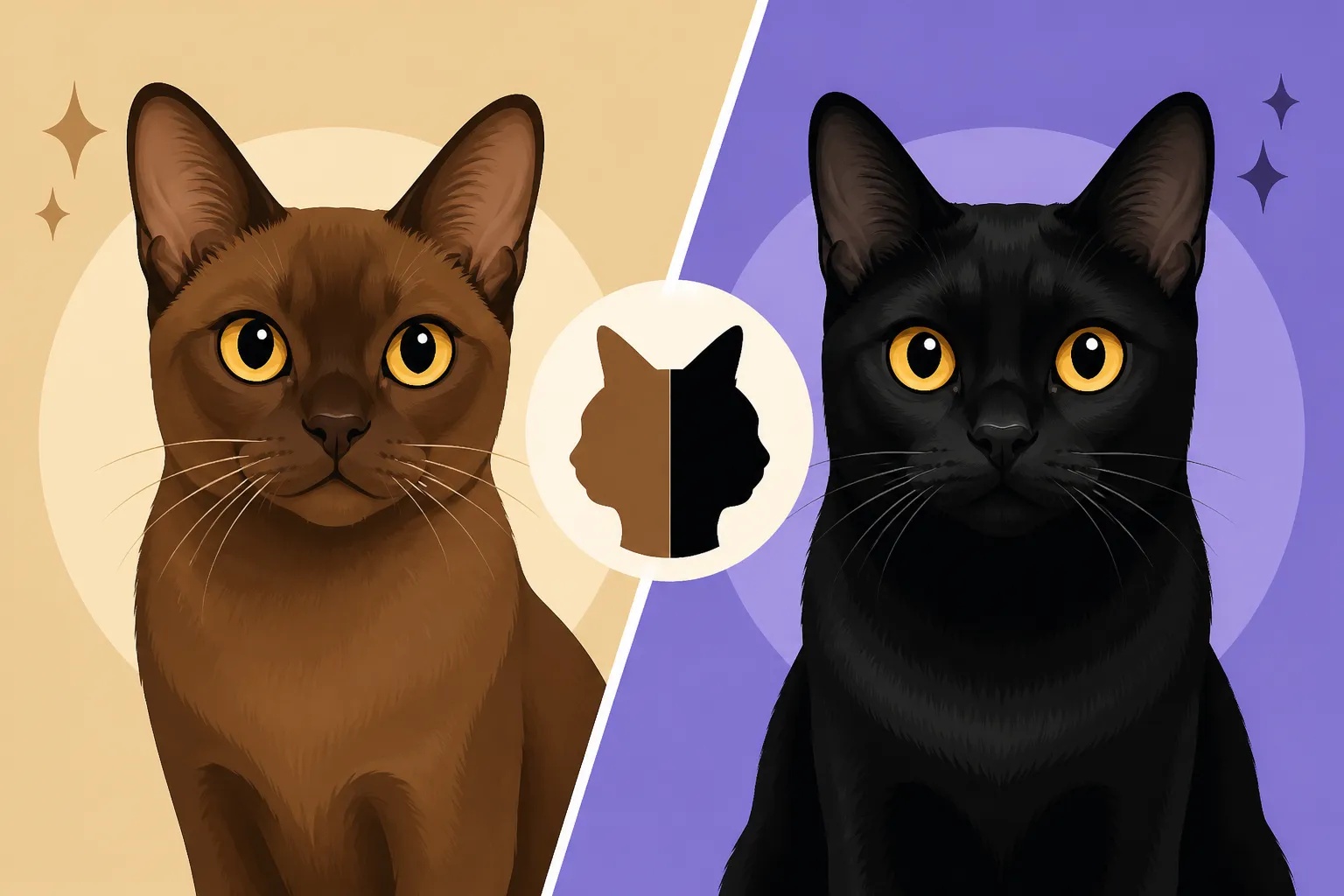
How to Tell a Burmese From a Bombay
If a dark, muscular cat has a round face and bright eyes, it can be surprisingly hard to tell whether you’re looking at a Burmese or a Bombay. Their looks and affectionate personalities overlap, and a very dark sable Burmese may seem almost black indoors. This guide explains the most useful differences—and how to confirm a cat’s background when appearance alone isn’t enough.
Burmese and Bombay cats at a glance
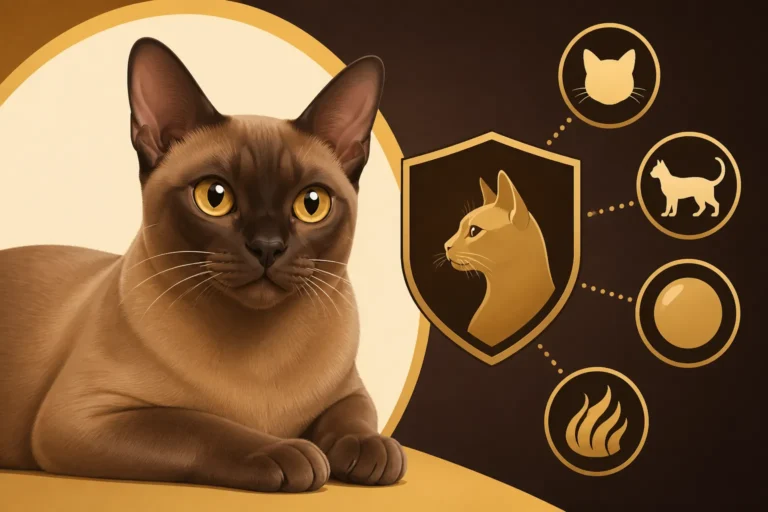
The Burmese and Bombay share some visual traits, but they are separate breeds with different histories and standards. A Burmese can come in several accepted colors, while a Bombay is known for its sleek, solid-black coat. Head shape, eye color and coat appearance can help you make an educated guess, but none of those features proves a cat’s pedigree on its own.
| Feature | Burmese | Bombay |
|---|---|---|
| Coat color | Depends on type and registry; may include sable, champagne, blue and platinum | Solid black |
| Coat appearance | Short, close-lying and satin-like; sable may look very dark | Short, glossy and black, including the nose and paw pads |
| Eyes | Usually yellow to gold shades | Gold to copper shades, with copper strongly associated with the breed standard |
| Build | Compact, muscular and often heavier than the coat suggests | Compact and muscular, with a rounded, panther-like look |
| Head | Shape varies between American and European Burmese standards | Rounded head with a short muzzle |
| Best way to confirm | Pedigree and breeder or rescue records | Pedigree and breeder or rescue records |
Coat color is the quickest clue
A Bombay should have a black coat. Its black coloring is meant to appear consistent across the body, and the nose leather and paw pads are black as well. The coat is short and lies close to the body, giving the cat a polished, glossy appearance.
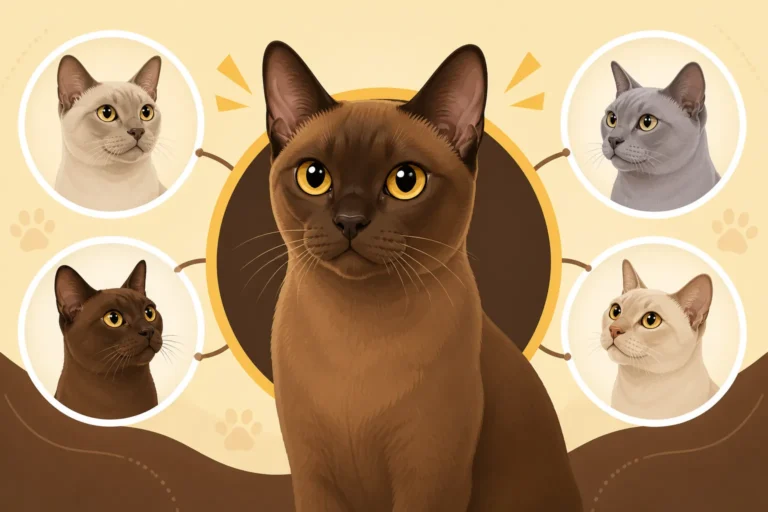
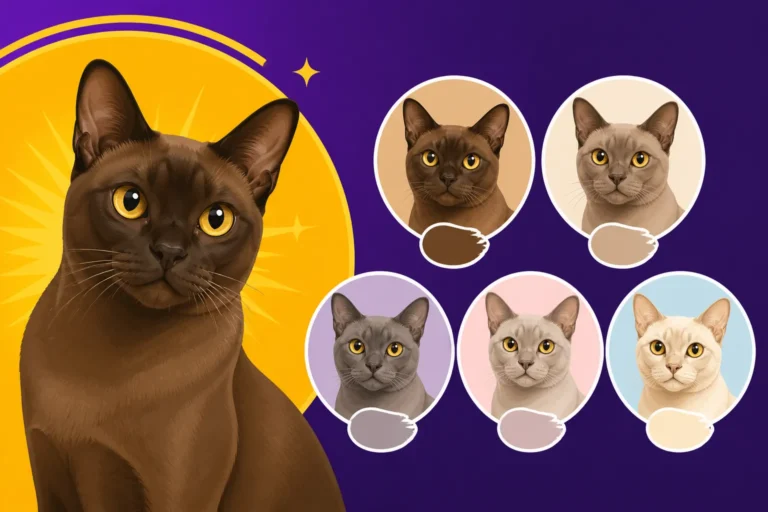
Burmese cats, by contrast, come in recognized colors beyond sable, including champagne, blue and platinum in American Burmese standards. The exact colors recognized depend on the registry and type. Sable Burmese can be especially confusing: in dim light, a very dark brown coat may look nearly black. In natural daylight, you may notice warmer brown tones or subtle shading rather than the uniform black associated with a Bombay.
Burmese coats can also show a soft contrast between the body and the cooler-colored extremities, such as the face, ears, legs and tail. That contrast is often subtle, not a dramatic pattern. For more detail on the breed’s coat colors, see The Four Colors a Burmese Comes In and Which Colors CFA Accepts in a Burmese.
If you are comparing a cat in a shelter photograph or under warm indoor lighting, don’t make a decision from the picture alone. Ask to see the cat in natural light if possible. A photograph can deepen brown tones, flatten subtle color differences and make a sable Burmese appear black.
Eyes offer a hint, not a verdict
Eye color can support an identification, but it should not be treated as a stand-alone test. Burmese eyes are generally in yellow-to-gold shades. Bombay eyes are commonly described in gold-to-copper shades, with copper being a familiar feature of the breed’s look.
There is overlap. A Burmese may have rich golden eyes that seem coppery in a photograph, while lighting can make a Bombay’s eyes look more yellow than expected. Age, camera settings and the angle of the light can all change how eye color appears. Eye color is most useful when it agrees with other clues, especially coat color and reliable background information.
A cat with black fur and copper eyes may look very Bombay-like, but that combination does not establish that it is a registered Bombay. Likewise, a dark coat and golden eyes do not automatically make a cat Burmese. When appearance and paperwork don’t match, ask the breeder or rescue organization to explain the cat’s recorded breed and ancestry.
Body shape and coat texture overlap
Both breeds can feel solid and muscular when you pick them up. Burmese cats are often described as heavier than they look, thanks to their compact build and dense musculature. Their short coat can make that sturdy frame more noticeable. Why a Burmese Is Heavier Than It Looks explains why a Burmese’s size can be misleading at first glance.
Bombays are also muscular and compact. Their rounded, panther-like appearance comes from the overall combination of coat, head and body—not from being a large or long-bodied cat. A cat’s weight by itself is not a reliable way to tell the breeds apart; age, sex, body condition and individual build all matter.
The coat is another area of resemblance. Both breeds have short hair that lies close to the body, so neither should look fluffy or heavily coated. A Burmese coat is often described as satin-like. A Bombay coat is typically glossy and black. A soft grooming mitt can be enough for routine loose-hair removal for either cat; if you’re ordering one through Chewy, choose based on the cat’s coat and comfort rather than a breed label.
Head shape, features and breed standards
Head shape can help narrow down what you’re seeing, but it’s important to account for the two main Burmese types. American and European Burmese standards developed differently, so there isn’t one single Burmese head shape that every cat should match.
Burmese head shape depends on type
The American Burmese is generally associated with a rounder head, a shorter muzzle and a compact appearance. The European Burmese has a different standard, with a more moderate head shape and a more pronounced muzzle. Those differences can affect how close a Burmese looks to a Bombay at first glance.
A round-headed American Burmese might look especially similar to a Bombay, while a European Burmese may appear less alike because of its more moderate features. For a closer look at the different standards, read What an American Burmese's Head Should Look Like and What a European Burmese's Head Should Look Like. What a Burmese Looks Like Against the Standard is also useful if you want to understand how breed descriptions relate to appearance.
Keep in mind that show standards describe ideal features, not a checklist every pet cat will meet perfectly. A cat may be a purebred Burmese without having the exact head shape or proportions you expect from a show photograph. Kittens also change as they mature, so their coat color and overall appearance may look different later.
The Bombay’s look is deliberately panther-like
The Bombay was developed to create the look of a small black panther: a sleek black coat, rounded features and a compact, muscular body. The breed’s black coloring is central to that appearance. The combination can be striking, but it can also encourage people to identify any short-haired black cat with copper eyes as a Bombay.
A Bombay kitten may show faint, temporary markings that are less obvious as the coat matures. That doesn’t mean every black kitten with subtle markings is a Bombay, or that markings alone rule one out. The adult coat and documented ancestry are more useful than a brief look at a young kitten’s coloring.
When comparing a Bombay with a Burmese, pay attention to the whole cat. Ask whether the coat is truly black throughout, what color the nose and paw pads are, how the head is shaped, and whether there are reliable records. No single feature is conclusive, but several clues considered together can help you ask better questions.
Breed history explains why they look alike
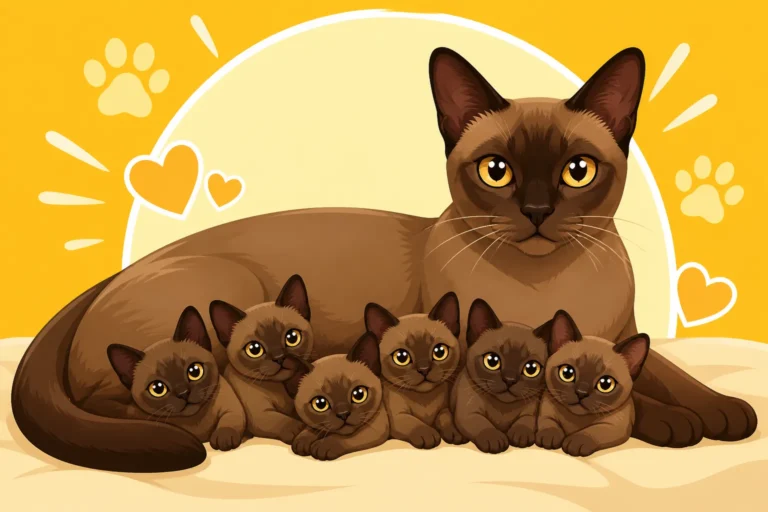
The breeds are related, which helps explain their shared compact build and short coats. The Burmese breed began with a cat named Wong Mau, who was brought to the United States in the early twentieth century. The breed developed through a breeding program that included Siamese cats.
The Bombay came later and was developed by breeding Burmese cats with black American Shorthairs to create a black cat with a distinctive panther-like appearance. That shared Burmese ancestry helps explain why the Bombay can look Burmese-like in its body and expression, even though it is a separate breed. For more on that background, see How the Bombay Was Made From a Burmese.
This history is also why appearance can be misleading. A Bombay may share features with a Burmese, and a dark sable Burmese may resemble a Bombay at a glance. The coat color and breed records help distinguish them more reliably than a general impression of “round, dark and muscular.”
How to identify a Burmese or Bombay in real life
If you’re meeting a cat in person, work through a few clues rather than trying to make a snap judgment. This approach is particularly helpful when the cat is young, the lighting is poor or the animal has no known pedigree.
Use a simple visual checklist
- Look at the coat in natural light. A Bombay should be black. A sable Burmese may look very dark but can show brown warmth or subtle shading in brighter light.
- Check the nose and paw pads. A Bombay is associated with black nose leather and paw pads. This is a clue, not a substitute for records.
- Notice the eye color. Gold-to-copper eyes may support a Bombay identification; yellow-to-gold eyes are typical of Burmese cats. There is enough overlap that eye color should not decide the question by itself.
- Consider the head shape. A rounded head can fit a Bombay or an American Burmese. A more moderate head and muzzle may be consistent with a European Burmese.
- Ask about the cat’s history. A breeder’s pedigree or a rescue’s intake information is more dependable than guessing from photos.
This checklist can help you distinguish a likely appearance type, but it cannot confirm that a cat is purebred. If a shelter describes a cat as a Bombay or Burmese without supporting history, consider treating that label as an estimate unless the organization can explain where it came from.
Check documents before relying on a label
For a cat from a breeder, ask which registry records the cat and request the pedigree or registration documents. Confirm that the paperwork names the breed and, for a Burmese, clarifies the type where relevant. Ask to see the parents’ information as well. A breeder who can explain how the litter fits the breed standard should be able to discuss ancestry and records clearly.
For an adopted cat, ask the rescue or shelter what information it has: owner-surrender records, breeder documents, veterinary paperwork or details from the previous home. A cat may have a strong resemblance to a breed without having a verified pedigree. That does not make the cat any less lovable; it simply means “looks like a Bombay” and “documented Bombay” are different claims.
A retailer’s product or category labels are not breed verification, either. If you’re browsing supplies on Chewy while preparing for a newly adopted cat, use the cat’s actual needs—size, age, coat and health history—to choose products, not an uncertain breed label. A DNA test may provide clues about ancestry, but it should not be confused with registry paperwork or a breeder-issued pedigree.
Know when appearance is not enough
Mixed-breed cats can inherit features that resemble one or both breeds. A black domestic shorthair may have a rounded face and coppery eyes; a Burmese mix may have a dark coat and a compact frame. Those combinations can make visual identification uncertain even for someone familiar with the breeds.
If breed matters for a specific reason—such as confirming a breeder’s claim—request records before committing to a purchase. If you already have the cat, focus on what you can verify: health records, behavior, age, weight and care needs. For everyday decisions, a cat’s individual temperament and medical history matter more than whether its appearance fits a breed description.
What their similarities mean for choosing a cat
Burmese and Bombay cats can both be affectionate, people-oriented companions. Their appearance may help you tell them apart, but it won’t reliably predict how an individual cat will behave at home. Spend time with the cat, ask about its history and think about the household you can offer.
Don’t use temperament as a breed test
A cat that follows you from room to room, seeks laps or greets visitors may remind you of descriptions of Burmese or Bombay cats. But those traits are not unique to either breed. Socialization, previous experiences, age and individual personality all shape how a cat behaves.
A shy cat may become more outgoing after settling in, while a confident cat may need quiet time in a new home. If possible, observe the cat in more than one setting and ask the person caring for it what it is like during ordinary routines—not only during a brief meeting. Whether a Burmese Is the Right Cat for You can help you think through what living with a Burmese might involve.
Choose supplies around the individual cat
The basic setup for either breed is much the same: a suitable carrier, litter box, scratching surfaces, food and water bowls, resting places and age-appropriate play. Make choices according to the cat’s size and habits rather than assuming the breed name tells you everything.
For example, measure your cat when selecting a carrier instead of choosing one based only on a product description that mentions a breed. If you’re shopping through Chewy or another retailer, check the carrier’s interior dimensions and make sure the cat can turn around and lie down comfortably. The same idea applies to beds, litter boxes and food puzzles: fit the item to the cat in front of you.
Both coats are short, so grooming needs are generally modest compared with those of long-haired cats. Gentle, occasional brushing or a grooming mitt can help remove loose hair, but stop if the cat becomes uncomfortable. If you’re unsure about a skin or coat change, ask a veterinarian rather than trying to solve it with a new grooming product.
Make health and history part of the decision
A breed label does not replace a veterinary history. Ask about vaccinations, prior illnesses, dental care, diet and any changes in appetite or energy. For a kitten, find out what veterinary examinations have been completed and whether the breeder has relevant health information about the parents.
If you are adopting an adult cat, find out what the cat is eating and whether it has any established routines. When switching food or changing the home setup, gradual changes are often easier for a cat than an overnight overhaul. Chewy can be one place to source ordinary supplies, but the best choices should follow your veterinarian’s advice and your cat’s individual needs.
In the end, coat color, eyes and head shape can point toward Burmese or Bombay, but documented ancestry is the strongest confirmation. When the records are missing, it is perfectly reasonable to describe a cat as resembling a breed rather than claiming certainty. That keeps the identification honest while leaving room to enjoy the cat for exactly who it is.
Disclaimer
This article is for general informational purposes only and does not constitute professional advice. Laws, prices and regulations vary by location and change over time. Consult a qualified professional for guidance on your specific situation.