When CFA Resumed Registering the Burmese
If Burmese registration dates seem contradictory, you are not imagining it: accounts often blur together CFA’s early recognition, its registration suspension, the return of registration, and full championship status. The key distinction is that CFA began registering Burmese again in 1953, while championship recognition followed later. Here’s how that gap came about and what it meant for the breed.
Why CFA stopped registering Burmese cats
Early recognition brought a problem with pedigrees
The Burmese entered the American cat fancy through Wong Mau, a cat brought to the United States in the early 1930s. Breeding work around her helped establish the Burmese as a distinct type, and the Cat Fanciers’ Association, or CFA, first recognized the breed in 1936.
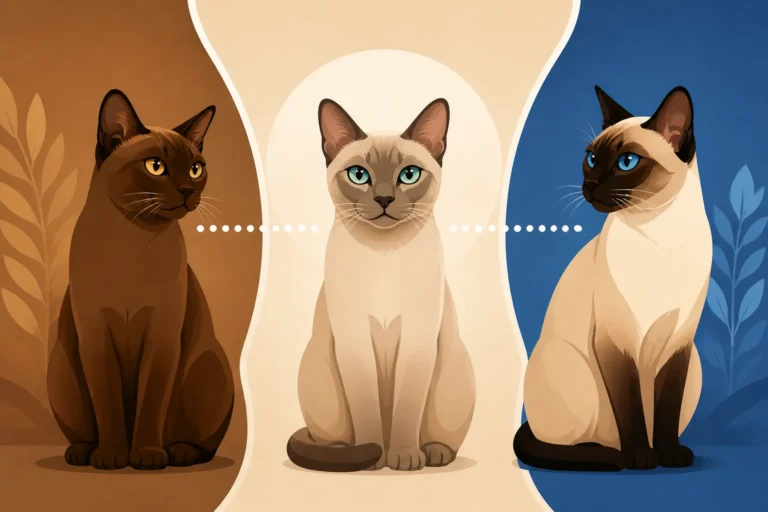
But early Burmese breeding was complicated by the breed’s small foundation. To increase the number of cats available for breeding, Burmese were mated with Siamese. That work helped researchers and breeders understand how coat color was inherited, and it contributed to the development of the Tonkinese. It also meant that some cats being registered as Burmese had Siamese ancestry in their recent pedigrees.
At the time, the distinction between experimenting with crosses and registering cats as purebred Burmese was not always handled consistently. The registry’s records needed to demonstrate that cats entered as Burmese met the breed’s pedigree requirements. As more cats with Siamese ancestry appeared in registration records, CFA faced a question of breed identity: how many generations of Burmese breeding should be required before a cat could be registered as Burmese?
The suspension was about breed standards, not a ban on the cats
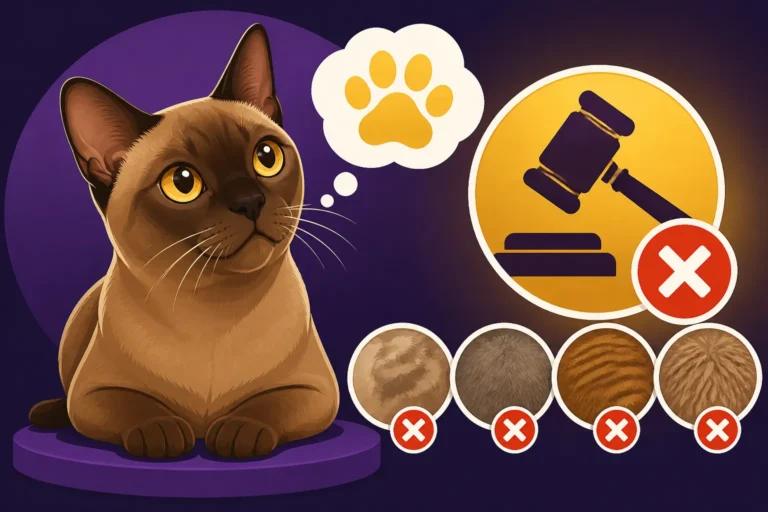
In 1947, CFA suspended Burmese registration. It’s easy to read that as the organization rejecting the Burmese altogether, but that is not quite what happened. The suspension was about whether the cats being submitted could reliably be documented as Burmese under the registry’s rules.
This distinction matters because “recognition,” “registration,” and “championship status” refer to different steps. Recognition acknowledges a breed within the registry. Registration records individual cats and their pedigrees. Championship status allows eligible cats to compete for top show titles under the organization’s rules.
The suspension affected the formal path into CFA records. It did not mean Burmese cats disappeared, that all breeders stopped working with them, or that the breed had ceased to exist. Breeders continued maintaining Burmese lines, while the registry’s rules around acceptable pedigrees needed to be clarified. For more on what led to the decision, see Why CFA Suspended Burmese Registration and CFA Suspended the Burmese in 1947 and Took It Back.
Why the history can sound inconsistent
Many short histories say simply that CFA “recognized” the Burmese in one year and “reinstated” it in another. Those accounts may be describing different registry actions, not disagreeing about the same event.
A useful way to keep the events straight is to treat them as separate milestones:
| CFA milestone | What it means |
|---|---|
| Initial recognition in 1936 | CFA acknowledged the Burmese as a breed |
| Registration suspension in 1947 | CFA stopped accepting Burmese registrations under the rules then in place |
| Registration resumed in 1953 | CFA again accepted Burmese cats meeting the pedigree requirements |
| Championship recognition in 1957 | Burmese became eligible for CFA championship competition |
The exact phrasing in historical accounts can vary, especially when “recognized” is used loosely. When you see a date, check whether the account means registration or permission to compete for championship awards. For the earlier milestone, read When CFA First Recognized the Burmese. For the later competition milestone, see When CFA Recognized Burmese for Championship.
When CFA resumed registering the Burmese
Registration resumed in 1953
CFA resumed registering Burmese in 1953 after the pedigree requirements were tightened. The central standard was that a cat needed three generations of pure Burmese breeding behind it. In practical terms, breeders had to establish a documented Burmese lineage over multiple generations rather than rely on appearance alone.
This was a significant change from simply deciding that a cat looked Burmese. Coat color and body type can help identify a breed, but a registry also needs a record of parentage. A cat might have a rich brown coat and the expected Burmese build, yet still not meet a registry’s requirements if its pedigree could not support the claim.
The three-generation rule gave CFA a way to reopen the registry while protecting the distinction between Burmese and cats with recent Siamese ancestry. It also gave breeders a clear target: produce and document Burmese descendants across the required generations. The rule did not rewrite the breed’s past, but it created a more controlled path for new cats to enter CFA’s records.
For the specific meaning of the pedigree rule, see What Three Generations Pure Meant for the Burmese. The requirement is also central to What CFA Required Before Reinstating the Burmese.
Reopening registration was not the same as restoring every privilege
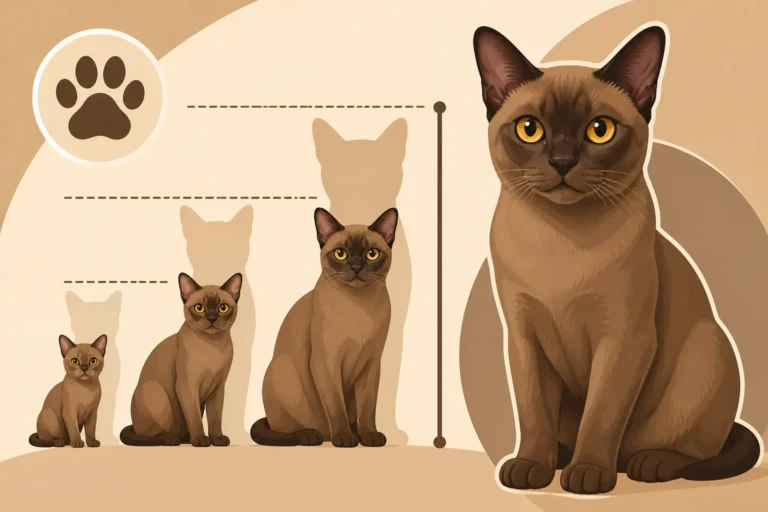
A registration record is not automatically a ticket to championship competition. When registration resumed in 1953, CFA could again record eligible Burmese cats, but the breed’s path through the organization continued in stages. Burmese championship recognition came later, in 1957.
That four-year gap helps explain why some timelines appear to give two different “return” dates. If a history is talking about cats being accepted into the registry, 1953 is the relevant milestone. If it is talking about full championship eligibility, 1957 is the date to look for. Both can be correct, as long as they refer to the right step.
This distinction also mattered to breeders. Registration allowed qualifying cats and their pedigrees to be recorded, supporting the rebuilding of recognized lines. Championship status then gave the breed a place in formal competition under CFA’s show system. One step dealt with documentation; the other dealt with show eligibility.
How the revised rule protected the breed’s identity
The three-generation requirement was a practical response to a difficult early situation. Burmese breeding had involved crosses with Siamese, and the breed was still being established. A registry needed to allow the Burmese to develop without letting recent crossbred ancestry blur the definition of a registered Burmese.
Pedigree rules are not a judgment about whether an individual cat is lovable, healthy, or beautiful. They define what a registry will record as belonging to a particular breed. That distinction is easy to miss when the discussion is framed as “pure” versus “not pure,” but in registry terms the issue is documentation and agreed standards.
For breeders, the requirement encouraged careful recordkeeping and planned matings. For the registry, it created a consistent way to evaluate cats being submitted. And for the breed, it supported a clearer separation between Burmese lines and other related cats. When the Burmese Was Registered Again covers the return to the registry, while What the Suspension Did to Burmese Bloodlines looks at the longer-term effects.
What the 1953 return meant for breeders and the breed
Breeders had to prove ancestry, not just type
Once CFA resumed registration, breeders needed to show that a cat’s lineage met the standard. That meant keeping pedigrees and breeding records that could establish the required generations. In a small breed population, this was not merely paperwork. It influenced which cats could be used in a program and how breeders planned the next generations.
Imagine a breeder with a Burmese-looking cat whose grandparents or great-grandparents were not clearly recorded. The cat might resemble the expected type, but resemblance would not resolve the registry question. The breeder would need reliable lineage documentation to show that the cat qualified under CFA’s rules.
This is one reason registry history can sound technical: a decision that appears to be about a breed’s appearance was also about records. In purebred cat breeding, appearance and pedigree work together, but they answer different questions. A standard describes the type the breed should have; a pedigree traces ancestry.
The decision helped separate Burmese from related breeds
The Burmese and Siamese share historical connections, and their breeding history contributed to further breed development. But by the time CFA reopened registration, maintaining a distinct Burmese identity had become a priority. The revised pedigree threshold gave the registry a way to recognize Burmese cats without treating every related or crossbred cat as interchangeable.
That separation is particularly helpful when reading old accounts. Early breeding experiments may have involved cats that contributed to the development of more than one breed. Later registry rules, however, had to decide how those cats and their descendants would be classified. A shared history does not mean that the breeds have the same registration status or standards today.
If you want to follow the breed’s development beyond the CFA dates, Why the First Burmese Was Bred to a Siamese explains the early breeding context, and How the American and European Burmese Split follows a later chapter in the breed’s history.
Why championship recognition came later
The return of registration in 1953 addressed which Burmese cats CFA could record under its pedigree rules. Championship recognition in 1957 was a separate organizational milestone. Put simply, a registry first needed a dependable way to identify and document eligible cats; then it could grant the breed championship standing within its show structure.
That sequence is common sense once the terms are separated, but it is often flattened into a single sentence in breed histories. If you are checking a pedigree, studying the breed’s timeline, or comparing historical summaries, look closely at the verb being used. “Registered,” “recognized,” and “eligible for championship” are not interchangeable.
So the direct answer is: CFA resumed registering Burmese cats in 1953, after requiring three generations of pure Burmese breeding, and championship recognition followed in 1957. Keeping those dates attached to their specific milestones makes the Burmese timeline much easier to understand.
How to read the Burmese timeline accurately
Check what the date actually describes
When a source gives a date for CFA’s “return” to the Burmese, ask what action the date refers to. Does it describe registration reopening, recognition of the breed, or championship eligibility? If the wording is vague, the date may still be useful, but it does not tell the whole story on its own.
This is especially important when different pages use “recognized” as a catch-all term. One account might use it to mean CFA accepted Burmese cats for registration; another might reserve it for formal competition status. The dates can appear contradictory even when the authors are describing separate steps.
A clear timeline should connect each date to an action: CFA recognized the breed in 1936, suspended registration in 1947, resumed registration in 1953, and granted championship recognition in 1957. That phrasing preserves the distinctions instead of forcing the milestones into one vague “accepted” date.
Keep registry history separate from individual cat quality
A registry’s rules describe whether a cat’s documented ancestry meets its standards. They do not, by themselves, tell you whether an individual Burmese is a good companion, has a particular temperament, or is in good health. Likewise, a cat’s appearance alone cannot establish its pedigree.
That point is useful for anyone encountering claims about old Burmese lines or historical cats. A careful account should distinguish documented ancestry from visual resemblance and explain which registry rule applies. If a breeder discusses pedigrees today, the same habit helps: ask what the paperwork shows, rather than relying only on how a cat looks.
The simplest accurate answer
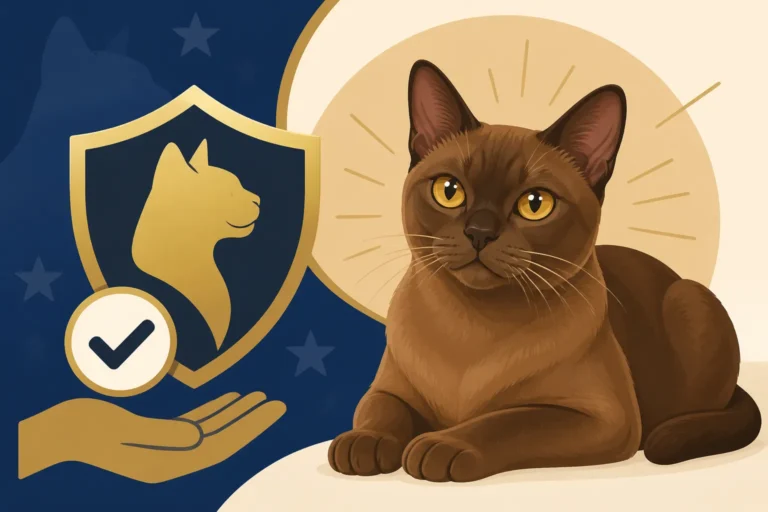
CFA resumed Burmese registration in 1953, with a requirement for three generations of pure Burmese breeding. That restored a formal route into CFA’s records after the 1947 suspension. It was not yet the same as championship recognition, which came in 1957.
Once those milestones are kept separate, the timeline stops looking like a disagreement. It becomes a sequence: early recognition, a pause while pedigree rules were addressed, renewed registration under a clearer standard, and later championship status.
Disclaimer
This article is for general informational purposes only and does not constitute professional advice. Laws, prices and regulations vary by location and change over time. Consult a qualified professional for guidance on your specific situation.