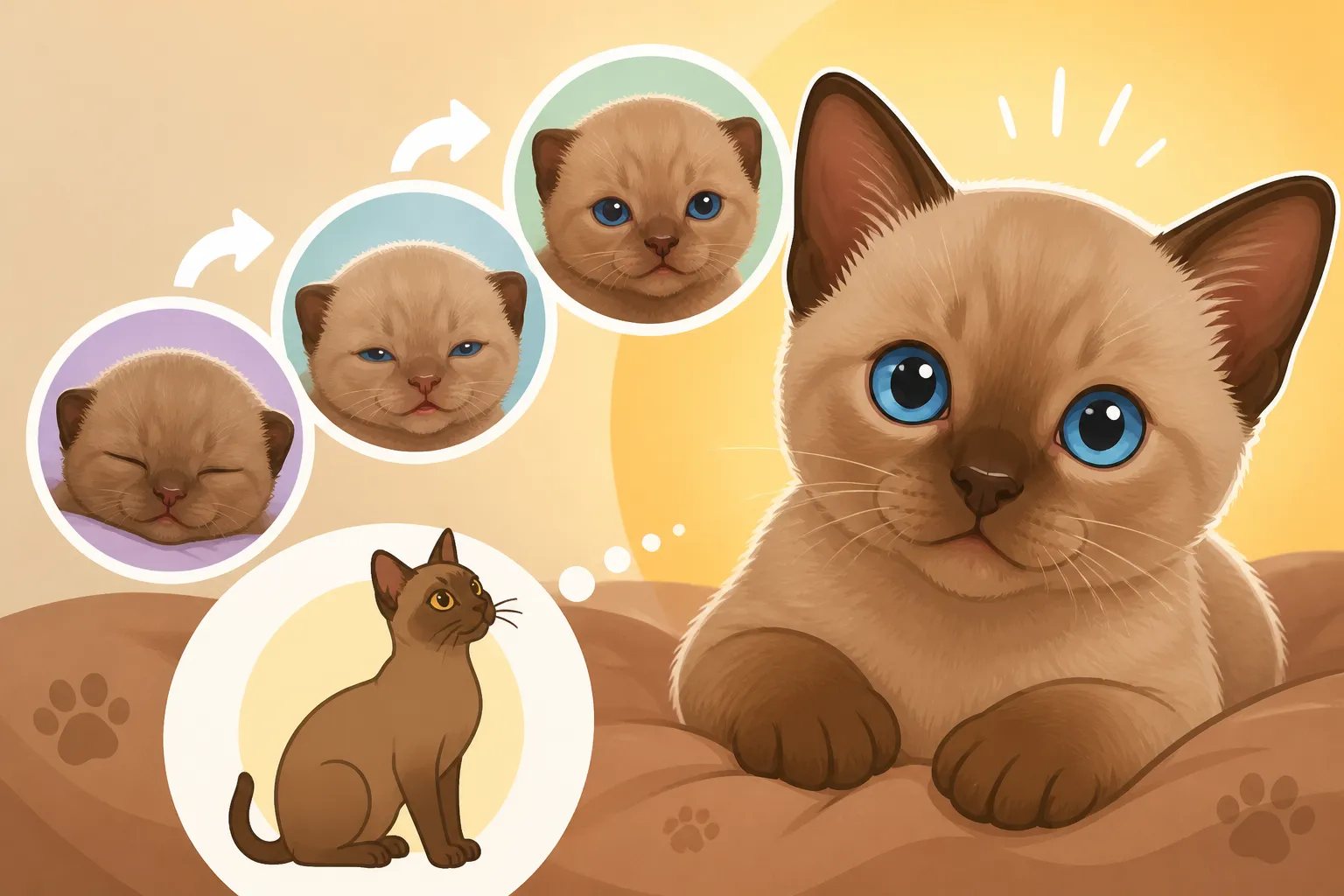
How Early Burmese Kittens Open Their Eyes
Burmese kittens are born with their eyes closed, and it can be unsettling to wait for that first tiny blink when you are caring for a newborn litter. Most kittens begin opening their eyes during their second week, but the timing varies. This guide explains what is normal, what to watch for, and when a kitten’s eyes need a veterinarian’s attention.
When Burmese kittens open their eyes
The usual timeline for a newborn kitten
A Burmese kitten’s eyelids are closed at birth. In most litters, kittens start to open their eyes when they are roughly a week old, with the process commonly happening over the following several days. One kitten may peek out before its littermates; another may take longer. That difference alone does not necessarily signal a problem.
Eyes usually open gradually rather than all at once. You might first notice a narrow slit at the inner or outer corner, then a little more of the eye over the next day or two. It is normal for the two eyes not to open at precisely the same time, and they may look cloudy or blue while the kitten is very young. Their appearance at this stage does not tell you what their mature eye color will be.
There is no reliable reason to expect Burmese kittens to open their eyes earlier simply because they are Burmese. Breed does not give an owner a precise countdown, and kittens within the same litter can develop at slightly different rates. The mother’s care, the kittens’ individual development, and their overall health matter more than trying to match a particular breed-specific day.
If you are following a litter’s milestones, keep the dates in perspective. A kitten who opens its eyes a little later than a sibling but is warm, nursing, gaining weight, and otherwise behaving normally may simply be taking its time. For a broader picture of newborn development, What a Burmese Kitten Looks Like at Eight Weeks describes how different a kitten is by the time it reaches that later milestone.
Why their eyes stay closed at first
Closed eyelids protect a newborn kitten’s developing eyes. Their vision is not ready for the bright, busy world around them at birth, and opening the eyes is only one part of a longer process. Even after the lids separate, a kitten’s sight is still developing. Early eye opening does not mean the kitten can see clearly or move around safely.
This is one reason a nest should be calm and softly lit. Bright direct light, unnecessary handling, and frequent disruption can make an already vulnerable newborn less comfortable. Keep the kittens with their mother in a warm, secure area, and handle them only as needed for care and gentle monitoring. If the mother seems distressed when people approach, give her space while still making sure every kitten is feeding and thriving.
A kitten’s first visible eye color is not its final color. Young kittens often have a blue or blue-gray appearance at first, and the shade may change as they mature. Burmese coloring also develops over time, so the kitten’s coat may look different as it grows. Why a Burmese Kitten Is Born Paler Than It Ends Up explains that separate coat-color change, which should not be confused with eye development.
What to watch for as the eyes open
Normal signs and small differences
A gradual opening is usually what you will see: a narrow gap, followed by a wider opening over the next few days. The eyes may appear slightly unfocused, and a kitten may blink or squint in response to light. It is also common for one eye to get ahead of the other briefly. The important question is not whether every kitten follows the exact same schedule, but whether each kitten appears comfortable and is progressing.
Observe the whole kitten rather than focusing only on the eyelids. Is the kitten warm and settled against the litter? Does it nurse? Is its weight trending upward when you check it consistently? Does it respond to its mother and siblings? These everyday details give useful context. Eye opening is one developmental milestone, not a stand-alone health test.
A simple written log helps prevent normal variation from turning into a source of constant worry. Record each kitten’s birth date, when you first notice a slit in either eye, and when both eyes appear open. If you are weighing kittens, use the same scale and similar conditions each time, and ask a veterinarian or experienced breeder how often to monitor them. A small kitchen or pet scale can be found through retailers such as Chewy, but the important part is using it consistently and not substituting a scale reading for veterinary advice.
| What you notice | What it may mean | What to do |
|---|---|---|
| A small slit appears during the second week | The eyes are beginning to open | Observe without touching or forcing the lids |
| One eye opens before the other | A short-lived difference in development | Keep monitoring both eyes and the kitten’s overall condition |
| The eyes remain closed beyond the usual opening period | The timing may be delayed, or there may be an issue needing assessment | Contact a veterinarian for guidance rather than waiting indefinitely |
| Swelling, discharge, crusting, or a foul smell | Possible irritation or infection | Seek veterinary advice promptly |
| The kitten is weak, cold, not nursing, or losing weight | A broader health concern may be present | Contact a veterinarian urgently |
Signs that deserve a veterinarian’s attention
Do not pry a kitten’s eyelids apart, even if you are worried that they are taking too long to open. The lids are delicate, and forcing them can injure the eye or introduce infection. If the eyes remain closed later than expected, or you are unsure whether the lids are opening normally, call a veterinarian and describe the kitten’s age and what you can see.
Swelling, redness, discharge, thick crusting, or an unpleasant odor are not signs to brush off as ordinary eye opening. A kitten may also seem uncomfortable, cry more than usual, or be less interested in nursing. Eye problems in very young kittens can worsen quickly, so it is safer to ask a veterinary professional rather than trying to clean inside the lids or use drops intended for people or another animal.
The eyes are not the only reason a newborn may need help. A kitten who feels cool, is not nursing, seems unusually limp, or is not gaining weight needs prompt attention. When several concerns happen together, do not wait for the eyes to open before seeking help. Why a Burmese Kitten Needs an Early Vet Check and What a Burmese Kitten's First Exam Should Cover offer useful context for planning veterinary care during kittenhood.
How to care for kittens while their eyes are closed
Keep the nest safe and avoid home treatments
The safest care is usually simple: keep the nest clean, warm, quiet, and close to the mother. Make sure the kittens can reach her and that she has food, water, and a litter area nearby. Avoid bright lights aimed at the nest, strong cleaning products, scented sprays, and unnecessary rearranging. If bedding needs changing, do it calmly and return the kittens to their familiar space.
Do not use cotton swabs, fingers, ointments, or eye drops to try to speed up opening. Even a product that seems gentle can be unsuitable for a newborn. If there is discharge, ask your veterinarian what to do; they can tell you whether any cleaning is appropriate and how to do it safely. A clean, soft cloth kept for general kitten care may be useful, and retailers such as Chewy carry basic pet-care supplies, but no supply replaces an examination when there are signs of illness.
It is also worth limiting visitors and handling during the earliest days. People naturally want to see the kittens, especially when the eyes start to open, but repeated picking up can disrupt nursing and rest. A few careful checks are more useful than constant inspection. If you are concerned, take note of what you see and call the veterinary clinic rather than repeatedly examining the kitten’s face.
Track progress without comparing littermates too harshly
A simple routine makes it easier to notice meaningful changes. Check that each kitten is warm, nursing, and settled. When you inspect the eyes, look for gradual opening and any discharge, swelling, or redness. Weighing and recording each kitten’s progress can also help you spot a broader problem early, especially if a kitten seems less active than its siblings.
Try not to treat the fastest-developing kitten as the standard for the whole litter. A difference of a day or two can feel significant when you are watching closely, but small variations are common. Focus on whether the slower kitten is making progress and doing well in other ways. If a kitten’s development seems stalled or you have a gut feeling something is off, a call to the clinic is a reasonable next step.
Care continues well beyond the first eye-opening milestone. Kittens need ongoing veterinary attention, safe socialization, and careful monitoring as they grow. Why Burmese Kittens Are Sold at Thirteen Weeks explains why responsible kitten care extends well past the newborn period. As the kittens become more active, you can also learn about Why a Burmese Kitten Socializes Itself and the ways early experiences shape a kitten’s comfort with people.
Common questions about Burmese kittens’ eyes
Can I help a kitten open its eyes?
No. Never pull or pry the eyelids apart. They open naturally as the kitten develops. If they are not opening, or there are signs such as swelling or discharge, contact a veterinarian. Home treatment can damage delicate tissue or make an infection worse.
Is it a problem if one eye opens first?
Not necessarily. The eyes may open at different times, including for a short period within the same kitten. Keep watching for steady progress and signs of irritation. If one eye stays closed while the other is fully open, or the closed eye looks swollen or painful, ask a veterinarian for advice.
Do Burmese kittens have blue eyes when they are born?
Newborn kittens’ eyes are closed, so their eye color cannot be assessed at birth. When the eyes first open, they often look blue or blue-gray, but that early color can change as the kitten matures. Do not judge a Burmese kitten’s eventual eye color from its first peek.
When should I call the veterinarian?
Call if the eyes have not begun to open later than expected, if there is redness, swelling, discharge, or crusting, or if the kitten is not nursing or seems weak. If you are uncertain, describing the kitten’s age and symptoms to a veterinary clinic can help you decide how soon it should be seen. For newborns, getting advice early is better than trying to manage an eye concern at home.
Disclaimer
This article is for general informational purposes only and does not constitute professional advice. Laws, prices and regulations vary by location and change over time. Consult a qualified professional for guidance on your specific situation.