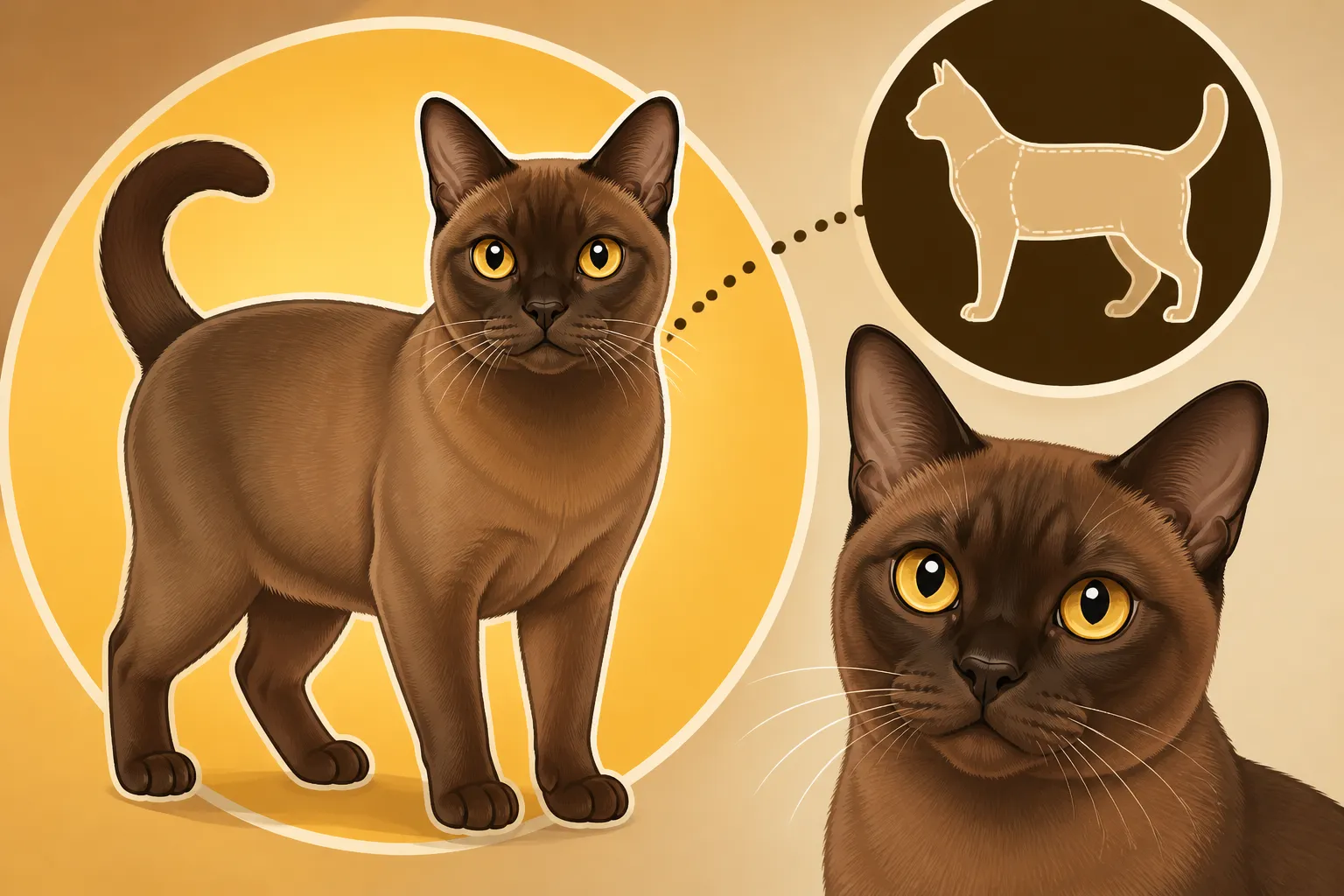
What a Burmese’s Body Type Is Called
A Burmese is best described as medium-sized, compact, and muscular—not simply “small” or “stocky.” That sturdy build can surprise people when they lift one: beneath the smooth, close-lying coat is a surprisingly solid cat. This guide explains the Burmese body type, how it differs between the American and European varieties, and how to tell healthy muscle from excess weight.
The Burmese body type is compact and muscular
What “compact” means for a Burmese
The clearest way to describe a Burmese’s body type is compact and muscular. The breed is medium-sized, with a solid frame and well-developed muscles. “Compact” does not mean tiny or delicate; it describes a body that looks close-knit and substantial rather than long, narrow, or stretched out.
A Burmese should have a balanced outline. Its body, legs, and tail work together without making the cat look unusually tall or low to the ground. The chest is typically rounded, and the body has enough depth and breadth to look sturdy. In everyday terms, a Burmese may look like a neat, athletic cat—but with more substance than its short coat first suggests.
That combination can be easy to misread. A person who is used to lighter-framed cats may assume a healthy Burmese is overweight because it feels heavier when picked up. The coat lies close to the body, so it does not add much visual bulk; the weight comes largely from the cat’s frame and muscle. For a fuller look at the breed’s overall appearance, see What a Burmese Looks Like Against the Standard.
Is a Burmese cobby or athletic
You may hear people describe the Burmese as “cobby,” meaning short-bodied and solid, or as athletic and muscular. Those descriptions can overlap in casual conversation, but compact, medium-sized, and muscular is a more reliable summary than treating “cobby” as a precise label for every Burmese.
A Burmese is not built like an extremely long, fine-boned cat, nor should it look heavy and low-slung. It has a sturdy, close-knit outline, but it should still move comfortably and look proportionate. A healthy cat can be strong without appearing bulky, and its body should not be obscured by a hanging layer of fat.
The phrase “a brick wrapped in silk” captures this contrast particularly well: the coat is short and sleek, while the body underneath is dense and muscular. It is a vivid description rather than a separate technical body-type category. Read more about the phrase in Why a Burmese Is Called a Brick Wrapped in Silk.
| Feature | Typical Burmese impression | What not to assume |
|---|---|---|
| Overall build | Medium-sized, compact, and muscular | That “compact” means tiny |
| Weight in your arms | Solid for the cat’s visible size | That a heavy-feeling cat must be overweight |
| Coat | Short and close-lying | That a smooth outline reveals body condition on its own |
| Movement | Sturdy but agile | That muscular means bulky or sluggish |
| Shape | Balanced, with a rounded, substantial impression | That every Burmese must have precisely the same outline |
Why a Burmese feels heavier than it looks
Muscle and frame create the solid feel
A Burmese’s weight can seem surprising because the coat does not conceal the outline in the way a long or fluffy coat might. The cat may look sleek and moderate in size, then feel remarkably solid when lifted. That is one reason owners sometimes describe the breed as weighing more than its appearance suggests.
Muscle contributes to that impression, as does the cat’s underlying frame. But body size varies from one individual to another, and sex, age, and general build can all affect what feels typical. A single number on a scale cannot establish whether a particular Burmese is in good condition. A vet can assess the cat’s frame alongside its muscle, fat cover, and overall health.
If you are trying to understand why a Burmese seems so substantial in your arms, Why a Burmese Weighs More Than It Looks explores that contrast. For general size expectations, How Big an Adult Burmese Gets is a useful companion read.
How to distinguish muscle from excess weight
The smooth, close coat can make it difficult to judge body condition from across the room. A rounded outline might reflect the cat’s natural build, a full meal, relaxed posture, or extra body fat. Looking only at the silhouette—especially while the cat is curled up or lounging—can lead to guesswork.
Instead, gently feel along the ribs and waist. You should be able to feel the ribs under a light covering, without needing to press firmly. Viewed from above, there should generally be some narrowing behind the ribs; viewed from the side, the abdomen should not hang heavily. These are broad observations rather than a diagnosis, and a veterinarian can show you what is appropriate for your individual cat.
Keeping a simple weight log helps reveal gradual change that is easy to miss day to day. A household scale may be enough for some cats, while others are easier to weigh on a pet scale. If you are shopping for a scale, Chewy is one place owners may look for pet-care supplies; compare the scale’s capacity and readability with your cat’s needs. The routine matters more than the retailer: use the same scale when possible and record measurements consistently. For a practical body-condition guide, see How to Score a Burmese's Body Condition.
American and European Burmese builds
The American Burmese outline
American Burmese are commonly associated with a rounded, substantial appearance. The head shape is a major part of the overall impression, but the body is also expected to look strong and balanced rather than elongated or delicate. A cat’s outline should be considered as a whole: head, chest, body, legs, and tail all contribute to the silhouette.
That rounded impression does not mean a healthy American Burmese should be spherical or heavy with fat. Roundness in breed type and excess body weight are different things. A cat can have a broad, muscular look while still having a visible waist and ribs that can be felt gently. Equally, a cat that appears less rounded is not automatically underweight; individual variation and the applicable breed standard matter.
If you are comparing the two Burmese varieties, it helps to look beyond one feature in a photograph. A head viewed straight on, for instance, can make a cat seem more or less compact than it appears in a full-body view. What an American Burmese's Head Should Look Like gives more context on one part of that overall type.
The European Burmese outline
The European Burmese is also muscular and medium-sized, but its overall impression may appear more moderate or less rounded than that of an American Burmese. That does not mean it is a different kind of cat in everyday terms. Both varieties share the breed’s recognizable solidness beneath a sleek coat, while their standards and preferred outlines differ.
When comparing cats, avoid using a single photograph as a definitive guide. Camera angle, posture, age, and the cat’s current body condition can all change the apparent shape. A standing side view can show body length and proportions more clearly than a close-up, while a top view may make the waist easier to assess. Pedigree and registry information can also help clarify which type a cat is represented as.
The details of the head and expression can influence how the whole body reads, too. For a closer look at the European variety, see What a European Burmese's Head Should Look Like. If you are evaluating a particular cat, compare the full outline against the relevant standard rather than deciding from a label such as “round” or “stocky” alone.
How to assess a Burmese’s shape at home
Use touch and routine, not appearance alone
A quick visual check is helpful, but touch gives you more information. With your cat standing comfortably, run your hands lightly along the rib cage and down toward the waist. You are not trying to squeeze or restrain the cat; the aim is to notice whether the ribs are easy to feel beneath a modest covering and whether the body narrows behind them.
Repeat the check periodically under similar conditions. A Burmese may look different after a meal, while stretched out, or when photographed from a low angle. Consistent checks make it easier to notice a slow change in body condition. If the ribs become difficult to feel, the waist disappears, or your cat’s weight changes unexpectedly, ask your vet to assess the change rather than making a restrictive diet plan on your own.
A weight record can make those observations more useful. Chewy may be a convenient place to browse for pet scales or other basic care supplies, but the important part is choosing a tool you can use accurately and regularly. If your Burmese resists being placed on a scale, ask your veterinary clinic to help establish a reliable weighing routine. More on tracking gradual changes is available in Why a Burmese's Weight Should Be Recorded Monthly.
When to ask a veterinarian
A naturally solid build is not a reason to ignore a noticeable change. Arrange a veterinary check if your Burmese gains or loses weight unexpectedly, seems less active, struggles to jump, or develops a pronounced belly or a suddenly prominent backbone. Changes in appetite, thirst, or litter-box habits can also deserve attention, especially when they appear alongside a change in weight.
It can be tempting to reduce food because a Burmese feels heavy, or to increase portions because the cat seems slimmer than expected. Both choices can miss the real issue. The cat may have a naturally muscular frame, may be gaining fat, or may be losing muscle; those possibilities call for different responses. A veterinarian can assess body condition and help decide whether feeding, activity, or further investigation is appropriate.
If you are considering a feeding adjustment, weigh portions rather than estimating them by eye, and make changes with veterinary guidance. Chewy is another place some owners use to look for measuring and feeding supplies, but equipment does not replace an individual assessment. The goal is not to make every Burmese match one ideal silhouette. It is to understand your cat’s own frame well enough to notice when something changes.
Disclaimer
This article is for general informational purposes only and does not constitute professional advice. Laws, prices and regulations vary by location and change over time. Consult a qualified professional for guidance on your specific situation.