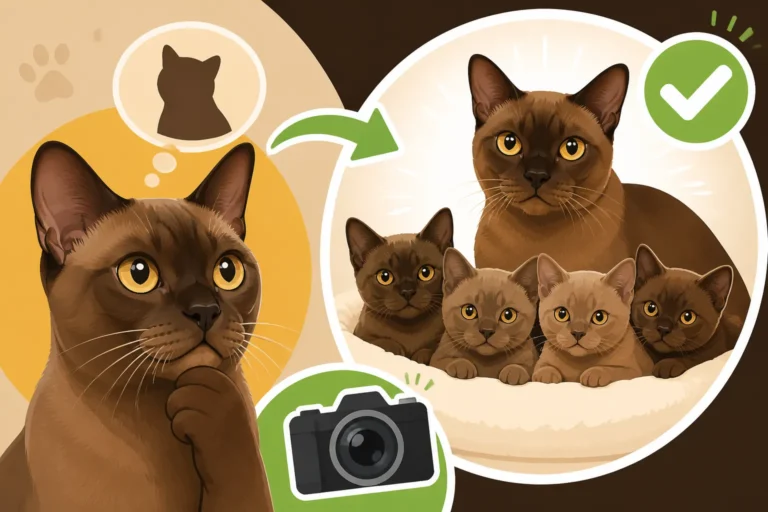
Whether CFA Judges Both Burmese Types
It’s a common scenario: you’re falling head over heels for the charismatic Burmese cat, but as you delve deeper, you discover there are two distinct types—the American Burmese and the European Burmese. Suddenly, you're left wondering if these beautiful variations are both recognized and judged by the same organizations, particularly a big name like the Cat Fanciers' Association (CFA). This guide will help unravel the history of this split and clarify exactly where CFA stands on judging both Burmese types.
The Historical Split: Why There Are Two Burmese Types to Begin With
The story of the Burmese cat is a fascinating journey that began with one special feline, and it’s a tale that quickly branched into two distinct lineages. Understanding this initial divergence is key to grasping why the world of cat fancy has different approaches to their recognition.
Wong Mau and the Early Days of the Burmese Breed
Our beloved Burmese breed traces its origins back to a single cat named Wong Mau, brought from Burma (now Myanmar) to San Francisco in 1930 by Dr. Joseph C. Thompson. Wong Mau wasn't just any cat; she was a unique, walnut-brown feline with a distinctive short coat and captivating golden eyes. Dr. Thompson, intrigued by her appearance, embarked on a deliberate breeding program to understand her genetics. He chose to breed Wong Mau with a Siamese cat, a common practice at the time for establishing new breeds and understanding colorpoint genetics.
The initial litters from Wong Mau and her Siamese mate were incredibly telling. They produced kittens with three distinct coat patterns: some resembled pure Siamese with blue points, some were solid sable brown like Wong Mau, and others displayed an intermediate pattern, a warm brown with slightly darker points, which we now know as the Tonkinese pattern. This groundbreaking work proved that Wong Mau herself carried both the Burmese color gene (responsible for her rich sable coat) and the Siamese color gene. Her unique appearance was, in essence, a transitional form. This meticulous early breeding laid the foundation for the Burmese as a distinct breed, and its story is wonderfully captured in The Burmese Began With One Cat Called Wong Mau and Dr Joseph Thompson and the Burmese He Bought in 1930. The decision to use a Siamese in those early matings, detailed further in Why the First Burmese Was Bred to a Siamese, was pivotal in isolating the unique Burmese genetic trait.
Divergence Across the Atlantic: American vs. European Standards
While the Burmese breed was taking root in America, it wasn't long before its charm captivated enthusiasts across the pond. British breeders imported Burmese cats from America, and it was here, after World War II, that the distinct paths of the American and European Burmese began to truly diverge. Post-war breeding efforts in the UK focused on a slightly different interpretation of the Burmese ideal. The gene pool was smaller, and breeders, driven by their own aesthetic preferences, began to select for different traits.
The result was a gradual but definite split in physical characteristics. American breeders continued to favor a more compact, cobby body with a rounder head and a distinctly short muzzle, often described as having a "sweet expression." In contrast, European breeders leaned towards a more moderate body type—still muscular and heavy for its size, but less extreme in its cobby nature—with a slightly longer muzzle, a wedge-shaped head, and wider-set ears. These differing ideals, nurtured by distinct breeding programs and judge preferences in each region, led to the development of two separate breed standards. This fascinating divergence is at the heart of the confusion today and is further elaborated in How the American and European Burmese Split.
CFA's Stance on Burmese Recognition: A Singular View
When it comes to the major cat registries, their approach to the two Burmese types isn't uniform. The Cat Fanciers' Association (CFA) holds a very specific position, which is crucial for any owner or breeder hoping to show their beloved feline.
CFA's Unified Burmese Standard
The simple answer to whether CFA judges both Burmese types is: no, not as two separate types or breeds. CFA recognizes and judges only one Burmese breed, and that breed adheres exclusively to the American Burmese standard. For CFA, there is no "European Burmese" as a distinct breed in their championship classes. Any cat entered in a CFA show must conform to the breed standard that CFA has established, which very clearly describes the American type.
This means that if you have a beautiful European Burmese, with its slightly longer muzzle and different head shape, it would not be eligible to compete in the championship categories under the CFA standard. It might be shown in household pet classes, but it wouldn't be competing as a recognized Burmese breed. This singular focus by CFA means breeders and owners must be acutely aware of which type of Burmese they possess or are breeding if their goal is success in CFA shows. The overall appearance of a Burmese, as described by CFA, is a hallmark of the American type, which you can read more about in What a Burmese Looks Like Against the Standard.
Physical Differences That Judges Look For
The differences between the American and European Burmese types are subtle but significant, especially when a judge is comparing a cat to a breed standard. For the CFA, the ideal Burmese possesses a decidedly rounded, short head with full cheeks and a short, broad, well-developed muzzle. The ears are medium in size, set well apart, and rounded at the tips, tilting slightly forward. The eyes are large, rounded, and expressive, set far apart, and typically golden in color. The body is compact and muscular, described often as "cobby" and surprisingly heavy for its size, often referred to as a "brick wrapped in silk."
In contrast, the European Burmese, while still a powerfully built cat, presents a more refined and elongated appearance. Its head is a modified wedge, longer than it is wide, with a distinct break at the muzzle. The ears are medium to large, set further apart, and often have a broader base. The eyes are typically more almond-shaped or oval, with a slightly slanted set, and they can come in various shades of green, yellow, or gold. The body is more lithe, not as extreme in its cobby nature, with a slightly longer back and legs. These distinctions in head shape, muzzle length, and eye shape are primary differentiators for judges. You can explore the specific requirements for an American Burmese head in What an American Burmese's Head Should Look Like and compare it with What a European Burmese's Head Should Look Like to truly appreciate the visual split.
Here's a quick comparison of the key features under the American (CFA-recognized) and European standards:
| Feature | American Burmese (CFA Standard) | European Burmese |
|---|---|---|
| Head Shape | Rounded, broad, full-cheeked | Modified wedge, slightly longer than wide |
| Muzzle | Short, broad, well-developed | Longer, more refined, with a distinct break |
| Eyes | Large, rounded, set far apart, typically golden/yellow | Oval to almond-shaped, set at a slight slant, various golden/green |
| Ears | Medium, set well apart, rounded tips, tilted slightly forward | Medium to large, set further apart, broader at base |
| Body Type | Compact, cobby, heavily muscled ("brick in a silk pillowcase") | Moderate cobby, muscular, slightly more elegant |
| Overall Impression | Sweet, rounded, substantial | Elegant, athletic, foreign |
Implications for Owners and Breeders of Both Types
The fact that CFA has a single standard for the Burmese has significant ramifications, not just for show enthusiasts, but for anyone who owns or plans to acquire one of these wonderful cats. It shapes breeding goals, registration processes, and even how potential owners approach their decision.
Registration and Showing Challenges for European Burmese Owners
For breeders and owners of European Burmese cats, the CFA's singular standard presents a clear challenge if their aspirations include showing within that particular association. European Burmese cats simply do not meet the American standard for head shape, muzzle, and sometimes eye shape or body type. This means they would be disqualified or heavily penalized if entered in CFA championship classes. Instead, European Burmese are typically shown and registered with other international cat registries that do recognize their specific standard, such as The International Cat Association (TICA) or the Governing Council of the Cat Fancy (GCCF) in the UK.
These other registries have distinct standards for the European Burmese, allowing breeders to pursue and refine those specific traits without conflict. It underscores the importance of understanding Which Registries Separate the Two Burmese Types and how each organization approaches breed recognition. If you're passionate about showing a European Burmese, you'll need to choose a registry like TICA, whose approach to registering both types is covered in How TICA Registers the Two Burmese Types, that celebrates its unique characteristics rather than judges them against a different ideal. This separation highlights the need for due diligence when acquiring a kitten, especially if showing is on your horizon.
The Importance of Knowing Your Burmese's Lineage
For potential cat owners, the existence of two distinct Burmese types and CFA's position on them is more than just a matter for show halls; it's about knowing what kind of companion you're bringing into your home. While both types share the affectionate, "dog-like" personality that the Burmese is famous for, their physical appearances are different. If you have a strong preference for the very round-headed, cobby American type, you need to ensure your breeder is indeed producing cats to that standard. Conversely, if you appreciate the more elegant, wedge-shaped head of the European Burmese, you'll need to seek out breeders who specialize in those lines and are registered with organizations that support that standard.
It's absolutely vital to ask a breeder about their lines and which standard they adhere to. A reputable breeder will be transparent about their cats' heritage and which type they represent. Asking to see pedigree papers and understanding the difference, as discussed in How to Tell Which Burmese Type You Are Buying, is paramount. If a breeder is vague or cannot clearly state the type or the registry affiliation, that should be a significant red flag, as detailed in Why a Burmese Sold Without a Type Is a Warning. Understanding the lineage also helps you anticipate certain breed-specific health predispositions, as some lines might carry different genetic markers, making responsible ownership about much more than just looks.
The Future of Burmese Recognition and Breed Harmony
The world of cat fancy is dynamic, with ongoing discussions and evolving perspectives on breed standards and recognition. The two Burmese types represent a fascinating case study in how a single founding cat can lead to diverse interpretations and distinct breeds.
Ongoing Debates and the Global Cat Fancy
While CFA maintains its singular standard for the Burmese, the global cat fancy continues to grapple with the existence of two distinct types. In many international registries, the American and European Burmese are recognized as separate breeds, or at least as distinct varieties under a broader Burmese umbrella. This creates an interesting challenge for international breeders and for the overall harmony of the breed worldwide. There are continuous debates about whether a more unified approach is possible, or if the genetic and phenotypic differences are now so ingrained that they warrant permanent separation. The discussion around Whether the Two Burmese Types Are Separate Breeds is a testament to this ongoing conversation.
For now, the distinct standards reflect the rich history and differing breeding preferences that emerged over decades. Whether these two types will ever fully converge or diverge further remains to be seen, but the passion of breeders and owners on both sides ensures the continued health and vitality of both Burmese lineages.
Choosing the Right Burmese for Your Home
Ultimately, for most pet owners, the question of whether CFA judges both Burmese types might feel distant from the day-to-day joy of owning one of these incredible cats. The most important decision is choosing a Burmese that fits your lifestyle and preferences, regardless of its showring potential in a specific association. Both American and European Burmese share that signature affectionate, outgoing personality, their deep love for human companionship, and their enduring playfulness well into old age. They thrive on interaction and famously dislike being left alone for long periods.
When you're ready to bring a Burmese into your life, focus on finding a reputable breeder who prioritizes health, temperament, and ethical practices. Discuss with them whether their lines lean towards the American or European type, and understand what that means for physical appearance. Regardless of type, all Burmese cats benefit immensely from a high-quality, low-carbohydrate diet, which is crucial for a breed predisposed to diabetes. Online retailers like Chewy offer an extensive selection of premium wet foods that align with these dietary needs, making it easier to manage their health from home. And for any cat, especially one with known genetic predispositions, robust pet insurance from providers such as Healthy Paws can offer invaluable financial protection against unexpected health issues throughout their long, loving lives. The key is to embrace the unique traits of whichever Burmese steals your heart and commit to providing a lifetime of loving, informed care.
Disclaimer
This article is for general informational purposes only and does not constitute professional advice. Laws, prices and regulations vary by location and change over time. Consult a qualified professional for guidance on your specific situation.