Which Three Burmese Met the Standard in 1956
The phrase “the three Burmese that met the standard in 1956” can be confusing because it sounds as though a famous trio of cats was formally named. The better-supported historical point is about pedigree: Burmese breeders had to demonstrate several generations of Burmese breeding after CFA suspended registrations. This guide explains what the 1956 milestone is often taken to mean, what the record does—and does not—identify, and how it fits the breed’s early history.
What the 1956 Burmese milestone means
It is not a reliably established list of three famous cats
The commonly repeated history of the Burmese breed does not consistently identify three individual cats as the Burmese that met a standard in 1956. Instead, accounts of the breed’s return to recognition focus on breeding records and the requirement for cats to have multiple generations of Burmese ancestry. That distinction matters: “three Burmese” and “three generations of Burmese” are easy to confuse, but they describe different things.
So if you have seen a claim that three specific cats met the standard in 1956, it is sensible to ask which registry record, show result, or historical document names them. A registry’s breed-history summary may describe a policy change without listing the individual cats that qualified. Naming a trio without a verifiable record risks turning a complicated registration history into a neat but unreliable anecdote.
The background reaches back to Wong Mau
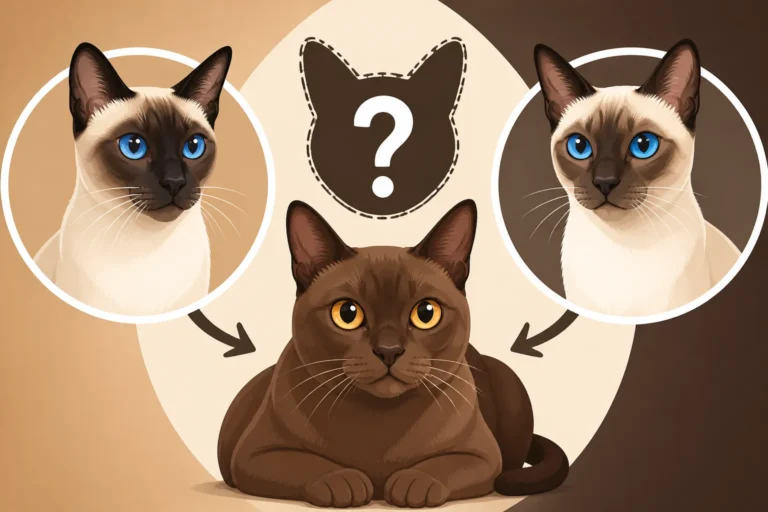
The modern Burmese story begins in the United States with Wong Mau, a cat brought from Burma to San Francisco in 1930. Breeder and physician Joseph Thompson developed a breeding program around her, using Siamese cats as part of the early work. The kittens and their descendants helped establish the Burmese type, but the early pedigrees did not all represent generations of breeding within a clearly defined Burmese population.
That history helps explain why the breed’s registration became contentious. Early breeders were establishing a new breed from a very small foundation, and the line between Burmese, Siamese, and cats with mixed ancestry was not always as straightforward as a modern pedigree chart might suggest. The Burmese Began With One Cat Called Wong Mau gives more background on the cat at the center of that early program, while Dr Joseph Thompson and the Burmese He Bought in 1930 explores Thompson’s role.
Why CFA’s requirements shaped the answer
Registration and recognition are not quite the same thing
A breed may be accepted by a registry, have registrations paused, and later return under revised rules. Those steps are related, but they are not interchangeable. A statement that Burmese cats were “recognized again” does not necessarily tell you which individual cats were shown, registered, or judged during a particular year.
That is why a date such as 1956 can become attached to several different parts of the story. It may refer to a point in the breed’s renewed development, to cats qualifying under a pedigree rule, or to a later stage in registration or show recognition. When reading a historical claim, check what the date is actually attached to rather than assuming it marks the day three named cats received a particular award. For the earlier part of the timeline, see CFA Suspended the Burmese in 1947 and Took It Back and When CFA First Recognized the Burmese.
The pedigree rule is the key to the “three” wording
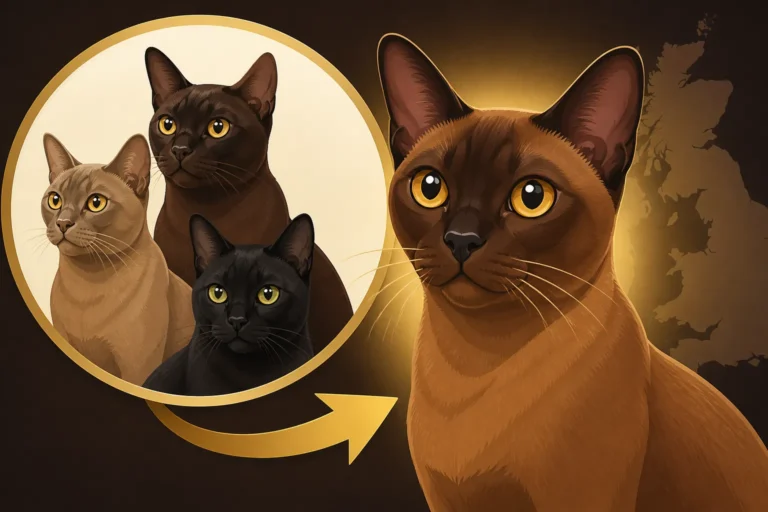
After concerns arose about Siamese ancestry in Burmese pedigrees, CFA suspended Burmese registrations in 1947. The point of the pause was to strengthen the distinction between Burmese and Siamese and to ensure that cats presented as Burmese came from sufficiently consistent Burmese lines. The commonly discussed requirement involved three generations of pure Burmese breeding.
That is likely where confusion about “three” enters the question. Three generations is a pedigree measure, not a count of three cats. Each generation contains individual cats, and the rule concerns ancestry across those generations. It does not, by itself, produce a single named trio that can be described as the cats that “met the standard.” What CFA Required Before Reinstating the Burmese and What Three Generations Pure Meant for the Burmese explain those requirements in more detail.
| Historical phrase | What it refers to | What it does not establish on its own |
|---|---|---|
| Three generations of Burmese breeding | A pedigree requirement intended to demonstrate consistent Burmese ancestry | The names of three individual cats |
| CFA suspended registrations | A pause connected to concerns about pedigrees and breed definition | That the Burmese breed disappeared |
| Burmese returned to registration or recognition | A later registry decision under renewed requirements | The identity of every cat involved in meeting those requirements |
| A cat met the Burmese standard | A cat judged against a written description of the breed | That it was one of a unique, universally documented trio in 1956 |
How Burmese breeders established a distinct breed
Early breeding involved more than appearance
A breed standard describes the desired type, but a registry also needs confidence that cats entered under a breed name have appropriate ancestry. In the Burmese’s early years, breeders were working with limited numbers of cats and trying to produce a consistent population. Appearance was part of the work, but recordkeeping and controlled breeding were equally important.
The early program also helps explain why the Burmese should not be treated as a color variation of the Siamese. Wong Mau’s descendants included cats with different appearances, and breeding choices were used to understand how those traits were inherited. What Thompson's Program Proved About the Burmese discusses the significance of the early breeding work, and Why the First Burmese Was Bred to a Siamese provides context for the crosses involved.
The standard gave breeders a shared description
A written standard gives judges and breeders a common framework for assessing a cat’s type. It describes features such as body, head, coat, and eye color, but it does not replace pedigree documentation. A cat might resemble the desired Burmese type and still require the appropriate ancestry records for registration under a registry’s rules.
This is another reason not to infer the identities of three cats from a phrase about meeting the standard. “Met the standard” could mean that cats were judged to conform to a physical description; it could also be an informal shorthand for qualifying under a broader registration process. Without the underlying record, those interpretations should not be collapsed into one.
Burmese history changed as the breed developed
The breed’s history did not stop once the Burmese returned to registry recognition. Breeding populations developed on different sides of the Atlantic, and breeders followed differing preferences for type. Over time, those differences contributed to the American and European Burmese forms familiar to cat fanciers today. That later split is separate from the 1956 question, but it shows why “the Burmese standard” can depend on which registry and tradition a writer is discussing. How the American and European Burmese Split explains how those paths diverged.
How to assess a claim about the three Burmese
Look for the record behind the date
If a book, website, or social post names three cats, check whether it provides full registered names and identifies the source of the information. Useful records might include a registry’s historical account, a period show catalog, a pedigree, or an official registration announcement. A list of names without that context may be repeating an unsupported version of the story.
Also check the wording carefully. Does the record say the cats were registered, accepted for championship competition, judged at a show, or used to demonstrate three generations of breeding? These are different milestones. A one-line summary may blur them, especially when the breed’s development stretched across years rather than happening in a single event.
Keep the short answer precise
A careful answer to “Which three Burmese met the standard in 1956?” is that the phrase should not be treated as a confirmed list of three uniquely identified cats without a source that names them. The familiar historical account points instead to a pedigree requirement involving three generations of Burmese breeding and to the restoration of the breed’s standing after registrations had been suspended.
That distinction preserves what is historically meaningful without inventing names. It also gives the reader a useful way to evaluate conflicting timelines: separate the pedigree rule from show judging, and separate registry decisions from claims about specific cats. If a source does provide a trio, its names and the registry record behind them are essential parts of the claim—not optional detail.
Disclaimer
This article is for general informational purposes only and does not constitute professional advice. Laws, prices and regulations vary by location and change over time. Consult a qualified professional for guidance on your specific situation.