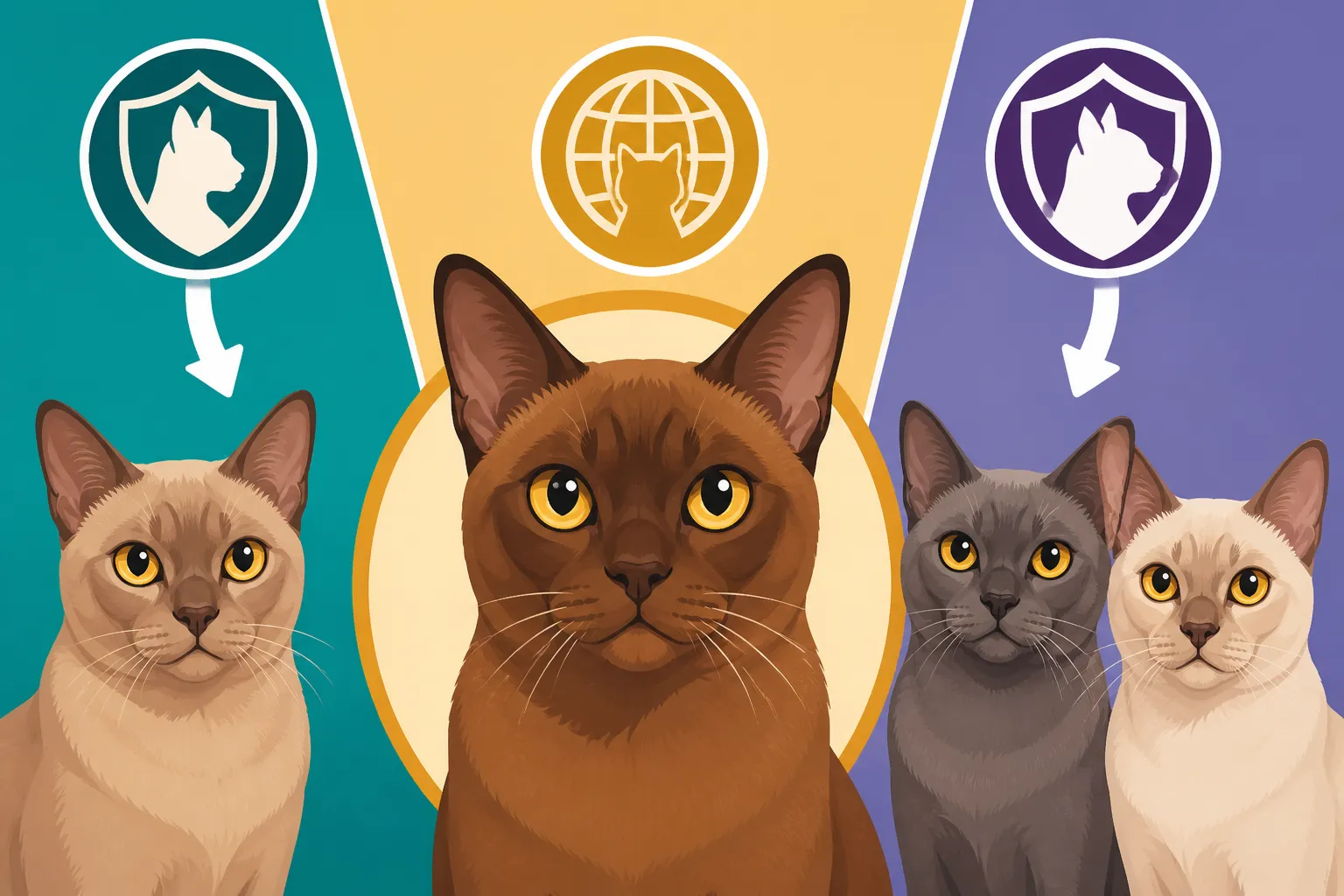
Which Registry Records Which Burmese Type
It can be incredibly confusing when you're diving into the wonderful world of Burmese cats, especially when you start hearing about "American Burmese" and "European Burmese." You might think, "A Burmese is a Burmese, right?" But the reality is that these two types, while sharing a common ancestor, have evolved into distinct breeds with differing appearances and standards. This guide will help demystify which major cat registries recognize and record each type, clearing up the paperwork puzzle for potential owners and breeders alike.
The Tale of Two Burmese: Understanding the Split
The journey of the Burmese cat began with a single cat named Wong Mau, brought from Burma to the United States in the 1930s. From this initial feline, a breeding program was established, and the American Burmese as we know it today started to take shape. However, as the breed spread, particularly to the United Kingdom, breeders across the Atlantic began to select for slightly different characteristics. Over time, these preferences led to a significant divergence, creating two distinct types that are now recognized as separate breeds by various international cat registries. This historical split is fundamental to understanding why recording practices vary so much. How the American and European Burmese Split is a fascinating story of differing ideals and breeding philosophies.
A Shared Origin, Divergent Paths
While both American and European Burmese trace their lineage back to Wong Mau, the emphasis on certain physical traits in each region caused them to evolve differently. In America, the focus gravitated towards a more compact, cobby body type with a distinctly rounded head, shorter muzzle, and full, round eyes. This "pushed-in" look became the hallmark of the American Burmese. Meanwhile, in Europe, breeders favored a slightly more oriental, elegant cat with a wedge-shaped head, longer muzzle, and larger, expressive eyes. The European breeders maintained what they considered to be closer to the original, less exaggerated form of the breed.
This divergence wasn't accidental; it was a deliberate selection process over decades, driven by breed standards and individual breeder preferences. As a result, if you put an American Burmese and a European Burmese side-by-side, even to an untrained eye, the differences are quite clear, especially in their head shape and overall body structure.
The Distinct Standards
Because of these differing physical ideals, both the American and European types have their own unique breed standards, meticulously detailing what constitutes an ideal representative of that type. These standards cover everything from head shape, ear placement, eye shape and color, body conformation, tail length, and even coat texture and color.
For instance, the American Burmese standard calls for a distinctly rounded head, with full, round eyes that are set far apart. The body is described as being muscular and compact. What an American Burmese's Head Should Look Like is a topic of specific interest for anyone aiming to understand the nuances. In contrast, the European Burmese standard emphasizes a moderately wedge-shaped head, with large, expressive eyes that are slightly slanted. Their body is generally longer and more svelte. To truly appreciate the differences, it helps to delve into What a European Burmese's Head Should Look Like and compare it directly. These distinct standards are why registries need to have clear classifications.
Navigating American Registries for Your Burmese
In the United States, the two most prominent cat registries that breeders use are the Cat Fanciers' Association (CFA) and The International Cat Association (TICA). Their approaches to recording the American and European Burmese types are quite different, which can be a point of confusion for new owners.
The Cat Fanciers' Association (CFA) Approach
The Cat Fanciers' Association (CFA) is arguably the largest registry of pedigreed cats in the world and has a long history with the Burmese breed. However, CFA only recognizes one type of Burmese – the American Burmese. If you have a cat bred to the European standard, CFA will generally not recognize it as a Burmese in their championship classes. They might classify such cats as "Foreign Burmese" or not accept them for registration if they do not conform to their established American Burmese standard. This stance stems from the initial establishment of the breed in the US and the specific direction American breeders took.
For CFA, the term "Burmese" is the American Burmese. This means that if you are looking to purchase a CFA-registered Burmese kitten, you can be confident it will conform to the American type. For breeders, adhering to CFA standards ensures their lines are recognized within this specific framework. Historically, CFA has been quite firm on maintaining distinct breed lines, as evidenced by earlier issues leading to What CFA Objected To in Burmese Pedigrees in 1947.
The International Cat Association (TICA) Perspective
The International Cat Association (TICA) takes a more inclusive approach, which can be a relief for those interested in both Burmese types. TICA recognizes both the American Burmese and the European Burmese as separate and distinct breeds. This means that if a cat meets the physical standard for an American Burmese, it's registered as such, and if it meets the European standard, it's registered as a European Burmese. TICA even has a specific category for the European Burmese, making it clear in their registration and show systems.
This dual recognition by TICA reflects a global perspective and acknowledges the divergent evolution of the breed. For a breeder, this flexibility allows them to work with either or both types, ensuring that the specific characteristics of each are preserved. For owners, it means that a TICA pedigree will clearly state whether their cat is an "American Burmese" or a "European Burmese," removing ambiguity. Understanding How TICA Registers the Two Burmese Types is essential for anyone dealing with cats from different lines.
European Registries: Guardians of Their Type
Just as American registries have their primary focus, European registries likewise champion the type of Burmese developed on their continent. These organizations are crucial for maintaining the breed standards and pedigrees for the European Burmese.
Governing Council of the Cat Fancy (GCCF) in the UK
In the United Kingdom, the Governing Council of the Cat Fancy (GCCF) is the primary registry. Like CFA, GCCF recognizes only one type of Burmese, but in their case, it is the European Burmese. Within the GCCF system, the cat is simply referred to as "Burmese," and their breed standard reflects the characteristics of the European type. Cats that conform to the American standard are generally not recognized as "Burmese" by GCCF and cannot be shown in championship classes or registered within that designation.
This singular focus on the European type by GCCF reflects the strong influence of British breeders in establishing and refining that particular standard. For owners in the UK, a GCCF-registered "Burmese" is, by definition, a European Burmese. This streamlined approach, while clear within its own system, can contribute to the international confusion when comparing it to registries like TICA or CFA. For specific details on their classification, one might look into How GCCF Registers the Burmese.
The Feline Federation Europe (FFE) and Others
Beyond the UK, other European registries, such as the Fédération Internationale Féline (FIFe), also largely recognize only the European type of Burmese. FIFe is an international organization that encompasses many national federations across Europe, Asia, and South America. Within FIFe, the "Burmese" breed standard aligns with the European type, and cats conforming to the American standard are typically not recognized under this designation.
This means that across much of Europe, if you encounter a "Burmese" from a reputable breeder registered with a local or international federation linked to FIFe, you can expect it to be of the European type. The clarity within their own spheres is generally good, but it becomes complex when breeders or owners try to cross-reference or import cats between continents. The key takeaway is that these European registries explicitly support and record the specific attributes that define the European Burmese.
Why Registry Pedigrees Matter to Owners
Understanding which registry records which Burmese type isn't just a technicality for breeders; it has real implications for owners, impacting everything from the health of your cat to your ability to participate in cat fancy activities.
Assuring Breed Purity and Health
A cat's pedigree, backed by a reputable registry, is your assurance of its lineage and breed purity. For Burmese cats, this is particularly vital because of the breed's susceptibility to certain genetic health conditions, such as diabetes and hypokalemia. Reputable breeders work diligently to screen their breeding stock for these conditions, and registry papers provide a traceable history. When a breeder adheres to the strict standards and ethics of a recognized registry, they are more likely to prioritize the health and well-being of their kittens. This diligence can significantly reduce the risk of inheriting serious conditions. Which Tests Belong on a Burmese DNA Panel are often mandated or highly recommended by reputable registries.
Knowing your cat's type and its registered lineage allows you to make informed decisions about its care. A well-bred Burmese from a responsible breeder, whose practices are overseen by a major registry, is more likely to live a long, healthy life. This also means that if you choose to get pet insurance, providers like Healthy Paws might have clearer guidelines for breed-specific conditions if the lineage is well-documented.
Breeder Credibility and Kitten Papers
When you acquire a Burmese kitten, its registration papers from a recognized registry are more than just fancy certificates; they are proof of its heritage and the breeder's commitment to ethical practices. These papers should clearly state the kitten's type (American or European, if the registry differentiates) and its full registered name, along with its parents' information. A breeder unwilling or unable to provide these papers from a reputable registry should be a significant red flag.
Reputable breeders will be transparent about their cats' pedigrees and the specific registry they use. They'll also be upfront about why Why the Two Burmese Types Are Not Crossed in their breeding programs, reinforcing the importance of maintaining distinct lines. This transparency is a cornerstone of breeder credibility and helps ensure you're getting a genuine Burmese kitten of the type you desire. It also ensures that the breeder has taken steps to verify the health and lineage of their breeding animals.
Navigating Breed-Specific Care and Resources
Having a clearly identified Burmese type through registration helps you connect with appropriate resources and communities. Whether you're seeking advice on diet, grooming, or behavioral quirks, knowing if you have an American or European Burmese can lead you to more accurate information. For example, specific breed clubs or online forums dedicated to one type or the other can offer invaluable support.
Furthermore, if your vet needs to look up breed-specific information, the clarity provided by registry papers can be very helpful. It ensures that any care recommendations are tailored to the correct type. When purchasing food or supplies, knowing your cat's specific breed type can sometimes help in selecting diets optimized for their particular build and potential health predispositions. It's all about ensuring your beloved feline receives the most targeted and effective care possible throughout its life. What Burmese Owners Wish They Had Known often includes the importance of understanding their cat's specific lineage and needs.
Key Registry Differences for Burmese Cat Types
To summarize the often-confusing landscape of Burmese cat registration, here's a quick overview of how the major registries typically categorize and record the two distinct types. This table should help clarify which organization you'll likely be dealing with depending on the Burmese type you're interested in.
| Registry | American Burmese Recognition | European Burmese Recognition | Primary Focus & Naming Convention |
|---|---|---|---|
| Cat Fanciers' Association (CFA) | Yes (as "Burmese") | No (not in championship) | American Type. Calls it "Burmese." |
| The International Cat Association (TICA) | Yes (as "Burmese") | Yes (as "European Burmese") | Both Types. Differentiates clearly. |
| Governing Council of the Cat Fancy (GCCF) – UK | No | Yes (as "Burmese") | European Type. Calls it "Burmese." |
| Fédération Internationale Féline (FIFe) – Europe | No | Yes (as "Burmese") | European Type. Calls it "Burmese." |
| Australian National Cats Inc. (ANCATS) – Australia | No | Yes (as "Burmese") | European Type. Calls it "Burmese." |
As you can see, TICA is the only major international registry that clearly separates and recognizes both the American and European Burmese as distinct breeds under different names. Other major registries tend to recognize only one type, referring to it simply as "Burmese" within their system.
Navigating the world of Burmese cat registries can feel a bit like learning a new language, especially with the subtle but important distinctions between the American and European types. However, understanding which registry records which type is crucial for ensuring you're getting a healthy, well-documented kitten that matches your expectations. It empowers you to choose a reputable breeder and confidently provide your feline friend with the best possible care throughout its life.
Disclaimer
This article is for general informational purposes only and does not constitute professional advice. Laws, prices and regulations vary by location and change over time. Consult a qualified professional for guidance on your specific situation.