Whether a Burmese Suits a Family With Toddlers
A Burmese can be an affectionate, people-focused companion, which sounds ideal when a toddler is eager to make a new friend. But closeness is not the same as patience: a small child may grab, chase, or crowd a cat without meaning harm. This guide explains what family life with a Burmese and a toddler can realistically look like, and how to make it safer for both.
What Burmese temperament means in a home with toddlers
Affectionate does not mean endlessly tolerant
Burmese cats are often social, playful, and keen to be near their people. A toddler may enjoy having a cat follow them from room to room or curl up beside a parent during story time. That people-oriented nature can make a Burmese feel more present in family life than a cat who prefers to watch from across the room.
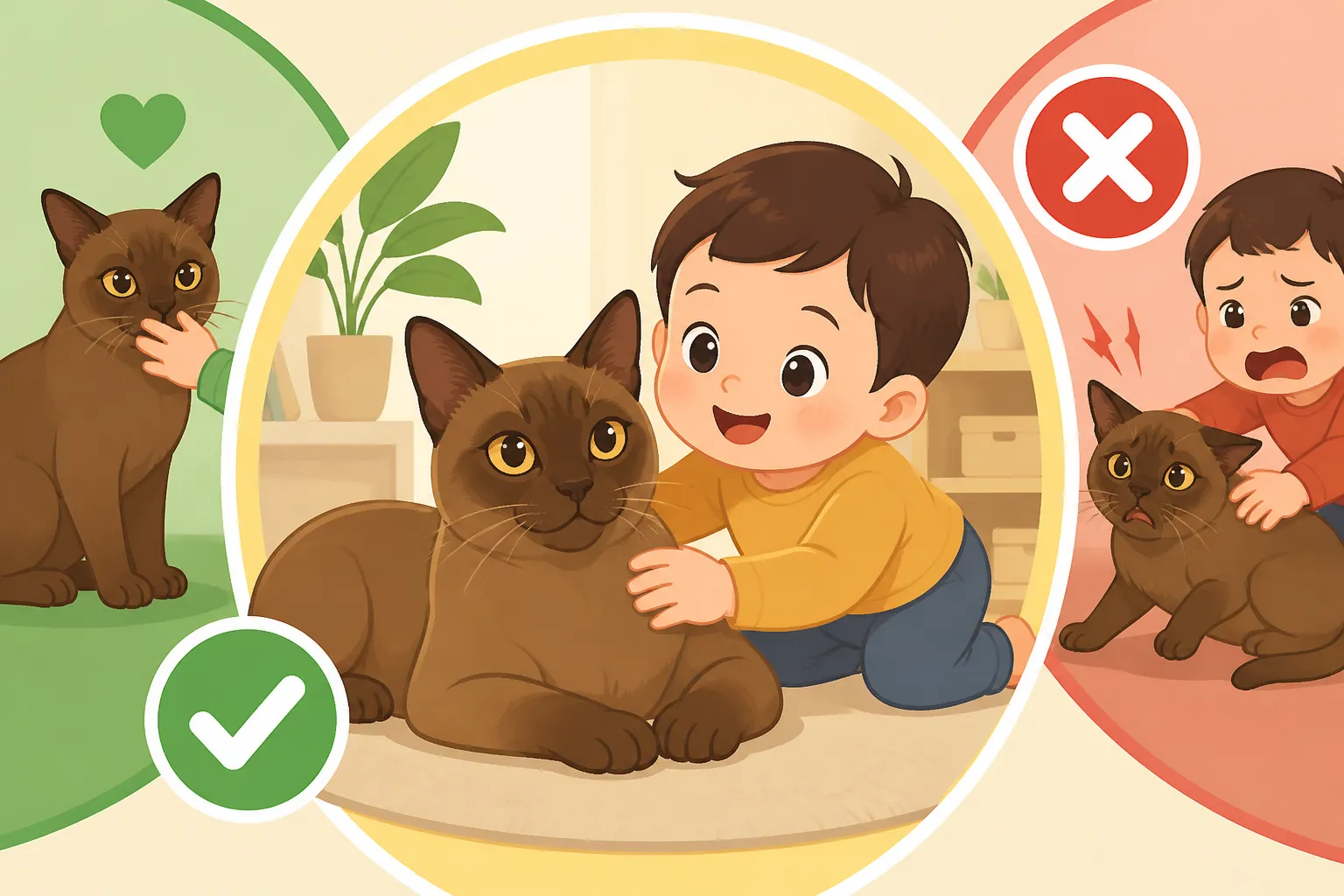
Still, no breed comes with a guarantee that an individual cat will enjoy being touched, carried, or approached by a small child. A sociable Burmese may seek attention from the family and still need a quiet place when the house is noisy. If a child hugs too tightly, blocks the cat’s escape, or reaches for its tail, even a friendly cat may hiss, scratch, or run away.
That distinction matters because toddlers are still learning impulse control. They may understand “gentle hands” one minute and forget it the next, especially when excited. Adults need to treat supervision as part of owning the cat, not as something that is only needed until the child has had a few successful cuddles.
Burmese cats are sometimes described as especially companionable with children. You can read more about that tendency in Why a Burmese Treats Children and Dogs as More Company, while keeping in mind that the behavior of a particular cat matters more than a breed reputation.
Expect a cat that wants to join in
Many Burmese like being involved in whatever their people are doing. One might investigate a toy being played with on the floor, settle beside a parent folding laundry, or come over when a child is eating a snack. This can be charming, but a cat weaving around a toddler’s feet can also cause a stumble.
Their social nature can make a quiet, empty home difficult for some Burmese. That does not mean a toddler is automatically the right companion: a young child’s presence is not a substitute for calm adult attention, safe play, and appropriate company. If your family is out for long stretches, think carefully about how the cat’s social needs will be met. Why a Burmese Cannot Be Left Alone All Day explains why extended isolation can be a challenge for this breed.
It also helps to expect playfulness. A Burmese may chase a wand toy, bat at a moving object, or try to join a child’s game. Keep play between the cat and a toddler indirect: an adult can move a wand toy while the child watches or takes a turn under close guidance. Avoid letting a child use their fingers or toes as toys, because that teaches the cat that hands are fair game.
A Burmese’s lively, people-focused reputation is explored in Why a Burmese Is Called a Dog in a Cat's Body. For a family with toddlers, the useful takeaway is not that the cat will behave like a dog, but that it may actively seek interaction and need adults to shape those interactions safely.
Personality varies from cat to cat
A kitten raised around gentle handling may be comfortable with ordinary household activity, but early socialization does not make a cat immune to fear or pain. A rescue or adult Burmese may have an unknown history with children. Some individuals may warm up quickly; others may need weeks or longer to feel secure.
Pay attention to the cat in front of you. Does it approach people voluntarily? Does it stay relaxed when there is everyday household noise? Can it leave a situation without being followed? These observations give you more useful information than expecting every Burmese to be outgoing in the same way.
If you are choosing a kitten, ask the breeder how the kittens respond to normal household sounds and gentle handling, and whether they have been introduced to children in a controlled way. A kitten’s early experiences can be helpful context, not a promise about how it will behave with your toddler. What a Burmese Kitten Has Already Learned by Twelve Weeks offers more context on what early learning can and cannot tell you.
The main risks for the child and the cat
Toddlers can hurt a cat without intending to
Small children may squeeze, pull fur, grab a tail, or pick a cat up under the front legs. They may also chase a cat that is trying to leave. These actions can frighten or injure a Burmese, even if the child is trying to show affection.
A cat’s warning signals are easy for a busy adult to miss. Turning away, flattening the ears, flicking the tail, crouching, or trying to move off are signs that the interaction should stop. Hissing or swatting is not a reason to punish the cat; it is a signal that the cat needs space and that an adult should step in.
There is risk in both directions. A startled cat may scratch or bite, and a toddler’s eyes, face, and hands are particularly vulnerable. Avoid putting a child’s face close to a cat’s face, and do not let a toddler carry the cat. Even a cat that usually enjoys being held can wriggle suddenly.
Cats need escape routes and child-free resting places
A Burmese should have places to retreat where a toddler cannot follow. This might be a gated room, a tall cat tree, a perch, or a quiet area with food, water, bedding, and a litter box. The cat needs to be able to reach those spots without being cornered.
Use a sturdy baby gate or closed door to separate the cat when an adult cannot supervise. A gate that a toddler can climb or open is not a reliable barrier. Make sure the cat has a safe route away from the child, and do not let the child enter the cat’s quiet room to “visit” without an adult.
A safe room should never become a punishment area. It is the cat’s retreat, where it can sleep or decompress without being handled. This is especially useful during lively moments such as playdates, meal preparation, or a child’s bedtime routine.
Adult supervision is the deciding factor
A friendly cat and a kind child can still have a bad interaction if no adult is watching closely. Stay within reach during contact, rather than supervising from another room. If you need to answer the door, prepare food, or help another child, separate them first.
Use a simple household rule: the child can invite the cat to approach, but cannot chase, grab, or pick it up. Adults can show the child how to stroke gently along the back if the cat chooses to stay. Keep sessions brief, and end them while both the cat and child are still calm.
For many toddlers, “pet once, then pause” is easier to practice than a long list of rules. Let the cat decide whether to come back for more. A cat walking away should be treated as a clear answer, not an invitation to follow.
How to make the introduction safer
Prepare the home before the cat arrives
Set up the cat’s essentials before bringing it home: a litter box in a quiet place, scratching surfaces, food and water away from the box, and comfortable resting spots. Put breakable items and small toys out of reach; a child’s toy that looks interesting to a cat may be chewed or swallowed.
Plan for physical separation from day one. A secure room or gated area gives the cat time to settle and gives the toddler a clear boundary. If you need toys or other enrichment supplies, Chewy is one place families may look for options; choose sturdy items suited to the cat and use them with adult supervision.
Tell the toddler what will happen before the cat arrives. Use simple language: “The cat can come to you, and we let it walk away.” A picture book or toy cat can help practice gentle strokes, but the real lesson will need patient repetition once the cat is home.
Introduce them gradually
Start with the cat in its safe room. Let it explore and become familiar with the household sounds before expecting it to meet the toddler. An adult can bring in a blanket or cloth carrying the child’s scent and let the cat investigate at its own pace.
For the first face-to-face meeting, keep the toddler seated and calm, with an adult between the child and cat. Let the cat approach, sniff, or leave. Do not carry the cat over to the child or hold it in place for a greeting. If the cat seems tense, end the meeting and try another time.
Keep early interactions short and predictable. A few calm minutes are more valuable than a long, overwhelming introduction. Some cats adjust quickly; others need repeated low-pressure meetings. If the cat hides, refuses food, or seems unusually distressed, slow the process down and ask a veterinarian or qualified feline behavior professional for guidance.
Teach touch and play one small skill at a time
Toddlers can learn to offer a hand for the cat to sniff, then wait. If the cat stays nearby, an adult can help the child stroke the cat gently along its back once or twice. Avoid head, paws, belly, and tail unless the individual cat clearly welcomes that kind of touch.
Do not teach a toddler to pick up a Burmese. Even children who are careful may not have the strength or coordination to support a cat’s body securely. If the cat enjoys being held, an adult can do the lifting while the child watches or gently strokes it. Why a Burmese Asks to Be Picked Up discusses the breed’s interest in being held, but that preference should never be assumed for every cat.
For play, let the child help toss a soft toy or move a wand while an adult controls the game. Keep the toy between the cat and child, not the child’s fingers. Put toys away after play so the cat does not start treating hands, socks, or moving feet as prey.
Is a Burmese a good fit for your family
A Burmese may suit a family with toddlers if the adults have time to supervise, the home can provide cat-only spaces, and everyone accepts that the cat must be allowed to leave. A sociable cat can bring warmth and fun to family life, but it still needs respect, routine, and calm handling.
| Your household situation | What it may mean for a Burmese |
|---|---|
| An adult can stay within reach during child-cat interactions | Safer opportunities for calm, guided contact |
| The home has a quiet room or high retreat for the cat | The cat can rest without being followed |
| Your toddler is learning to use gentle hands | Adult reminders and short interactions will still be needed |
| The family is away for long periods | Plan for the cat’s social and enrichment needs |
| You expect the cat to tolerate hugs or being carried | This expectation is risky; cats should be able to opt out |
| Your toddler is currently rough with pets or cannot follow simple boundaries | Wait, use strict separation, or consider whether this is the right time |
Before deciding, think about your actual week rather than an ideal quiet afternoon. Who will supervise when dinner is being made? Where will the cat go during a playdate? Can the family keep the toddler out of the litter area and the cat’s resting space? Those practical details often matter more than the breed label.
If your child is not yet able to follow basic boundaries, a Burmese may still be possible only with careful separation and constant adult oversight. Some families may prefer to wait until the child is older. Others may have a calm adult cat whose history and temperament are well understood. There is no need to rush the decision: choosing the right time is kinder to both the child and the cat.
For a broader look at which homes tend to suit the breed, see Which Household a Burmese Fits. If your family chooses a Burmese, make the goal a relationship built on choice: the child learns to invite, the cat is free to approach or leave, and an adult stays responsible for keeping both safe.
Disclaimer
This article is for general informational purposes only and does not constitute professional advice. Laws, prices and regulations vary by location and change over time. Consult a qualified professional for guidance on your specific situation.