How Much an Adult Male Burmese Weighs
An adult male Burmese often weighs about 8 to 12 pounds, but the number alone cannot tell you whether he is at a healthy size. These cats are compact and muscular, so they can feel surprisingly heavy when you lift them. This guide explains the typical range, how to judge body condition, and how to track weight without mistaking muscle for excess fat.
Typical weight for an adult male Burmese
The usual range and what it means
Many adult male Burmese weigh roughly 8 to 12 pounds, or about 3.6 to 5.4 kilograms. That is a useful reference range, not a pass-or-fail test: two healthy males can have different builds and sit at different points within it. Some may fall a little outside the range while still being in good condition, so it is best to interpret the number alongside body shape, muscle, age, and your veterinarian’s assessment.
A Burmese is often described as a “brick wrapped in silk.” The phrase captures why the scale can surprise new owners: this is a short-coated, muscular cat, not a delicate-looking cat whose weight is easy to guess from appearance. If your boy feels heavier than he looks, that may simply reflect his build. Why a Burmese Weighs More Than It Looks explains this dense, solid feel in more detail.
| What you’re assessing | Helpful starting point | What to keep in mind |
|---|---|---|
| Adult male weight | Often around 8 to 12 pounds | A reference range, not a target for every cat |
| Body shape | A visible waist from above and a slight abdominal tuck from the side | The coat and posture can make these features subtle |
| Ribs | Should be possible to feel with light pressure | They should not be buried under a thick layer of fat or sharply prominent |
| Weight trend | Compare repeat weigh-ins under similar conditions | A steady trend is more informative than one isolated reading |
| Concerns | Sudden gain or loss, or a change in appetite or thirst | Contact your veterinarian rather than trying to diagnose from weight alone |
The right weight for an individual cat depends on more than sex. A larger-framed male may be healthy near the upper end of the range, while a smaller-framed cat may be carrying excess weight at a lower number. Age and activity matter, too: a growing youngster, an adult in his prime, and an older cat losing muscle should not all be judged by the same visual impression. For a broader look at frame and size, see How Big an Adult Burmese Gets.
Why the scale can mislead
A Burmese may feel substantial without being overweight. Muscle adds weight, and a short, close-lying coat can make a cat look sleek while concealing changes around the abdomen. At the same time, a firm, muscular body does not make weight gain impossible. These cats can gain fat just like any other cat, especially when portions, treats, and activity are out of balance.
That is why it helps to combine the scale with a hands-on check. Run your fingers gently along your cat’s sides and see whether you can feel his ribs without pressing hard. Look down at him while he is standing naturally: there should generally be some narrowing behind the ribs. From the side, look for a slight upward tuck behind the rib cage rather than a rounded underside. These checks are not a substitute for a veterinary exam, but they give you more context than a number by itself. Why a Muscular Burmese Is Mistaken for a Fat One and How to Score a Burmese's Body Condition are useful next reads if you are unsure what you are feeling.
How to tell whether your Burmese is at a healthy weight
Check body condition, not just pounds
A body-condition check is a practical way to assess whether your cat’s weight is working for his frame. Start by viewing him from above when he is standing comfortably. Look for a waist behind the ribs. Then view him from the side: a modest abdominal tuck is common, though it may be difficult to see in some cats. Finally, feel his ribs with the flat pads of your fingers. They should be easy to locate under a thin covering, but they should not feel sharply exposed.
Be gentle and repeat the check when your cat is relaxed. A Burmese who twists away, tenses his belly, or is sitting in a curled position can be hard to assess. Don’t squeeze or press hard enough to make him uncomfortable. If you are uncertain, ask your veterinarian to show you what a healthy body condition feels like on your own cat. That hands-on demonstration is often more useful than comparing him with photographs of cats that may have different frames.
Look for changes in the whole picture
Weight is most useful when you consider it alongside other signs. Notice whether your cat’s waist is becoming less visible, whether his ribs are harder to feel, or whether his abdomen seems fuller than it did before. Also pay attention to everyday changes: Is he less eager to jump onto a favorite perch? Is he moving more slowly, or do his usual play sessions seem shorter? Those changes can have many causes, so they do not automatically mean that weight is the problem.
A change in weight can also be a sign of illness rather than a feeding issue. Unexplained loss, rapid gain, changes in appetite, vomiting, or increased thirst and urination deserve a conversation with a veterinarian. Avoid putting your cat on a restrictive diet simply because he looks rounder to you. A veterinary team can assess body condition, check for other health concerns, and help decide whether a weight plan is appropriate. For a broader health context, read Why a Burmese's Weight Should Be Recorded Monthly.
How to weigh an adult male Burmese at home
Make repeat weigh-ins easier
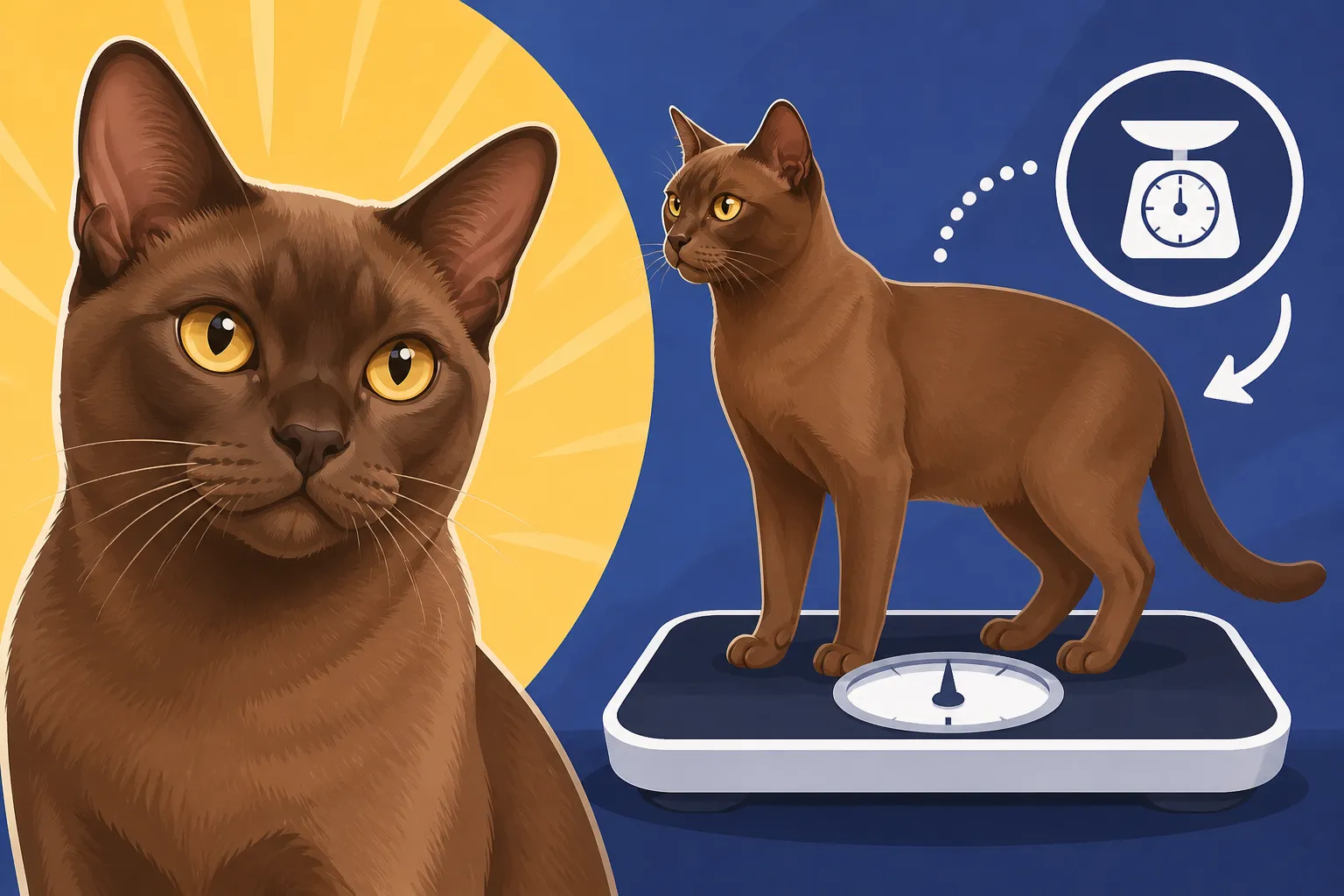
A calm, repeatable routine makes home weighing more useful. If your cat will stand still on a household scale, weigh yourself first, then weigh yourself again while holding him. Subtract your weight from the combined number. This method is not as precise as a suitable pet scale, but it can help you follow a general trend if you use the same scale and technique each time.
For a more direct reading, use a stable pet or baby scale with a surface large enough for your cat to stand or sit comfortably. Put the scale on a firm, level floor rather than carpet, and let your cat inspect it before expecting him to stay still. You might place a familiar towel on the platform, but check whether it affects the reading and use the same setup each time. If you are shopping for a scale, Chewy is one place to compare pet-care supplies; check the scale’s specifications and suitability for your cat before choosing one.
Try to weigh your Burmese at a consistent time and under similar conditions—for example, before a meal, if that is easy to do. Record the date and result in a notebook or phone. Repeat the reading if your cat moved, the scale shifted, or the result seems far from what you expected. A single reading can be thrown off by movement or setup; a pattern across several readings is more useful.
Keep a simple weight log
A weight log does not need to be elaborate. Write down the date, the number, and any relevant context, such as a food change, a recent illness, or a change in activity. If the number shifts, the notes may help you and your veterinarian see whether it lines up with a change in routine. For practical weighing advice, see How to Weigh a Burmese Accurately at Home.
If you need a small kitchen scale to weigh your cat’s food portions, Chewy may be a convenient place to look for pet-feeding supplies, but choose a scale that measures the amount you need and is easy to use consistently. A food scale and a body-weight scale serve different purposes; don’t assume one can replace the other. Whatever equipment you use, consistency matters more than having a complicated setup.
What to do if your Burmese is above or below the usual range
If he seems heavier than expected
First, confirm the weight and assess his body condition rather than reacting to one number. Check that you weighed him on a level surface, using the same scale and method as before. Then review what he eats across the whole day, including treats, food offered by other family members, and any chance he is finishing another pet’s leftovers. A Burmese’s persistent interest in food can make unmeasured extras easy to overlook.
If your cat appears to be carrying excess fat, ask your veterinarian to help set a suitable target and feeding plan. Do not sharply reduce food or try to make him lose weight quickly. Cats need a carefully managed diet, and rapid weight loss can be dangerous. Portion changes should account for the food’s calorie content, your cat’s health, and whether more than one pet shares the home. Chewy can be useful for browsing food and feeding supplies, but product selection should follow your veterinarian’s guidance rather than a label’s marketing claims.
If he is lighter than expected or losing weight
A male Burmese below the usual range is not automatically unhealthy. He may be small-framed, young, or simply lean. What matters is whether his body condition is appropriate and whether his weight is stable for him. A cat with prominent ribs or spine, reduced muscle, or an ongoing downward trend needs attention even if he still seems cheerful and affectionate.
Unplanned weight loss is especially worth checking if it comes with a change in appetite, thirst, urination, energy, or grooming. Cats can hide discomfort, and a friendly Burmese may continue seeking company even when something is wrong. Contact your veterinarian if you notice a persistent change; don’t wait for him to look visibly ill before asking for help. The same applies to an unexpected gain: a vet can help determine whether it reflects diet, reduced activity, a medical issue, or a combination.
The most useful answer to “How much should my adult male Burmese weigh?” is therefore a range plus an individual assessment. Around 8 to 12 pounds is a reasonable general reference, but your cat’s frame, body condition, and weight history matter more than reaching a particular number. If you want a breed-wide comparison, What an Adult Burmese Should Weigh offers another perspective.
Disclaimer
This article is for general informational purposes only and does not constitute professional advice. Laws, prices and regulations vary by location and change over time. Consult a qualified professional for guidance on your specific situation.