What CFA Objected To in Burmese Pedigrees in 1947
If you're delving into the fascinating history of the Burmese cat, you might have stumbled across a curious footnote: the Cat Fanciers' Association (CFA) actually suspended the breed's registration back in 1947. This wasn't a minor administrative hiccup; it was a foundational crisis that threatened the very definition of the Burmese, stemming from complex breeding practices and a struggle to maintain genetic integrity. This guide will walk you through exactly what CFA found objectionable in those early pedigrees and how the breed ultimately recovered its standing.
The Early Days of the Burmese: A Breed in the Making
Imagine the cat fancy in the 1930s, a time when many of today's beloved breeds were still finding their footing, often with mysterious origins. The Burmese story truly begins with a captivating little cat named Wong Mau, brought from Burma to the United States in 1930 by Dr. Joseph Thompson. She was unlike anything seen before – a rich, dark brown feline with a distinct body type and an incredibly affectionate personality. Thompson, a U.S. Navy doctor, was immediately intrigued by her unique appearance, especially her eye color and the subtle darkening of her points, less stark than a Siamese but clearly not a solid color.
Wong Mau and Dr. Thompson's Vision
Dr. Thompson didn't just admire Wong Mau; he had a scientific curiosity. He suspected she represented a new, distinct breed, or at least carried unique genetic traits worth exploring. To understand her genetic makeup, he embarked on a deliberate breeding program. His initial challenge was that there were no other cats exactly like Wong Mau to breed her with. To unravel the secrets of her genetics, he made a crucial decision: to breed her to a Siamese. This might seem counterintuitive for establishing a new breed, but it was a common practice in early cat genetics to understand how traits were passed down. Dr Joseph Thompson and the Burmese He Bought in 1930 tells more of this fascinating start.
This crossbreeding was not done haphazardly. Thompson was meticulously documenting every litter, every kitten's appearance, and every inherited trait. He was working with geneticists, pioneering the scientific study of cat breeding. The goal was to prove that Wong Mau carried a unique gene for her specific "sepia" coloration and body type. The first generation of kittens from Wong Mau and a Siamese produced a mix: some looked like Siamese, some looked like Wong Mau, and some were an intermediate chocolate color, exhibiting traits from both parents. This confirmed Wong Mau's unique genetic contribution. The Burmese Began With One Cat Called Wong Mau is a must-read for anyone interested in the foundational story.
The Necessity of Outcrossing: Siamese Influence
The decision to outcross Wong Mau to a Siamese was born of necessity, but it also became the root of the later controversy. In the early days, there was no established "Burmese" population to draw from for breeding. To increase the number of cats carrying Wong Mau's distinctive genes and to understand their expression, breeders needed to expand the gene pool. The Siamese, with its similar body type and point-restricted coloring (albeit more extreme), was the closest genetic relative available. Why the First Burmese Was Bred to a Siamese explains the reasoning in greater detail.
However, this practice of using Siamese, while vital for the breed's initial development and understanding of its unique cb allele (the gene responsible for Burmese coloration), eventually led to a situation where many cats being presented as "Burmese" were, in fact, several generations removed from Siamese, but perhaps not enough generations to be considered entirely "pure" by strict registry standards. The challenge lay in ensuring that subsequent generations were consistently producing the desired Burmese type without reverting to Siamese or intermediate appearances, particularly as more breeders joined the effort and not everyone adhered to the same rigorous documentation and selection.
A Pedigree Puzzle: The Rise of Intermediate Cats
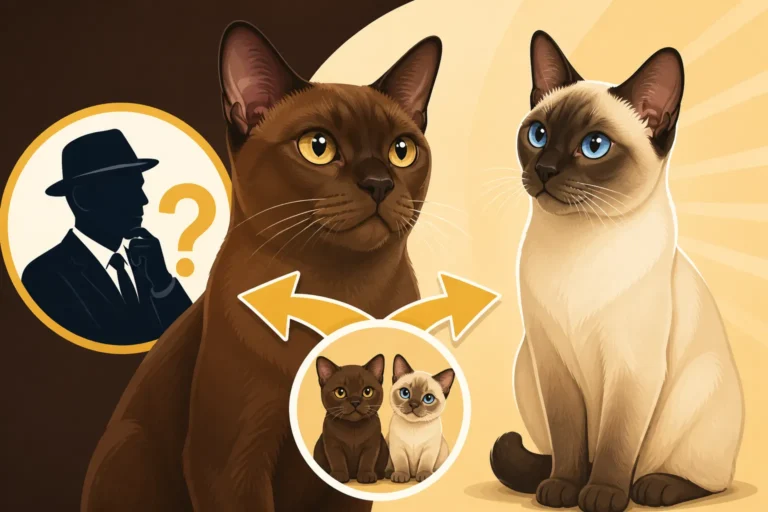
As the breeding programs expanded, and the numbers of "Burmese" cats grew, not all offspring were perfectly aligned with the nascent breed standard. The very nature of the initial crosses, breeding a Burmese (genetically homozygous for the Burmese gene, cb/cb) with a Siamese (genetically homozygous for the Siamese gene, cs/cs), resulted in first-generation kittens that were heterozygous (cb/cs). These cats expressed an intermediate phenotype – a color warmer and richer than a Siamese point but not as dark and solid as a true Burmese. Today, we know these cats as Tonkinese.
Understanding the "Tonkinese" Type
The cats resulting from the Burmese-Siamese cross, often called "Tonkinese" or "Golden Siamese" in those early days, presented a real challenge for breed registration. They weren't quite Burmese, and they certainly weren't Siamese. While beautiful and affectionate in their own right, their existence highlighted the genetic mixing that was occurring. For some breeders, these intermediate cats were seen as part of the genetic journey, a necessary step in expanding the Burmese gene pool and refining the breed. However, for a registry like CFA, whose mandate was to ensure the purity and distinctness of each recognized breed, these cats were problematic if their presence in a pedigree diluted the definition of a Burmese. Whether the First Burmese Was Really a Tonkinese delves into this identity crisis.
The challenge was that some breeders, eager to produce more "Burmese-like" cats, might have inadvertently (or perhaps intentionally, due to limited understanding of genetics at the time) allowed these intermediate cats to be used in breeding programs, or even registered them as Burmese if they leaned more towards the Burmese appearance. This blurred the lines and made it difficult for CFA to confidently state that a registered Burmese cat was indeed a pure Burmese, free from recent Siamese influence. It truly was a puzzle for the budding cat fancy, trying to categorize and define these stunning, yet genetically complex, felines.
The Challenge of Defining "Pure" Burmese
Defining "pure" in a newly developing breed, especially one that began with an outcross, is inherently difficult. Thompson's initial scientific approach was to prove Wong Mau's unique genetic contribution, not necessarily to create a "pure" line instantly in the way we understand it today. However, for a registry, purity is paramount. When cats from various breeders started entering the CFA registration process, the lack of strict adherence to breeding only "Burmese to Burmese" for several generations became apparent. What the First Burmese Litter Told Thompson gives us a glimpse into the early genetic revelations.
The core of the problem was the presence of the Siamese colorpoint allele (cs) in the pedigrees of cats being presented as Burmese. A truly "pure" Burmese should only carry two copies of the Burmese allele (cb/cb). Any cat with one Siamese allele (cb/cs, making it a Tonkinese phenotype) or two Siamese alleles (cs/cs, making it a Siamese phenotype) was, by CFA's strict definition, not a Burmese. The existence of these mixed genotypes within the registered Burmese lines created a crisis of confidence for the association, leading them to question the integrity of the entire Burmese breed registry.
CFA's Firm Stance: The 1947 Suspension
The Cat Fanciers' Association, a stalwart guardian of purebred cat standards, eventually reached a breaking point. In 1947, after years of observing the inconsistencies in Burmese pedigrees and the persistent appearance of Siamese-like and intermediate-type cats, they took drastic action. They suspended the registration of the Burmese breed. This was a monumental decision, reflecting a deep concern about the direction the breed was taking and the potential for its unique characteristics to be lost or diluted. CFA Suspended the Burmese in 1947 and Took It Back highlights this critical period.
Why Mixed Pedigrees Were a Problem
For CFA, the issue with mixed pedigrees wasn't just aesthetic; it was about the very foundation of what a purebred cat represented. Every recognized breed had a standard, a blueprint of ideal traits that breeders were expected to work towards. When Siamese genes were still actively appearing in Burmese pedigrees, it meant that the breed's distinct characteristics—its rich, warm brown coat, its specific body type, and its golden eyes—were not reliably reproducible. This lack of consistency undermined the integrity of the breed and made it difficult for judges to assess cats fairly. Why Siamese Hybrids Flooded Burmese Registration explains the extent of the problem.
The problem wasn't that the cats weren't lovely; many of them were. The issue was classification. If a cat was clearly a Tonkinese-type, it shouldn't be registered as a Burmese. The breeders were faced with the challenge of proving that their lines were truly Burmese, free from this recent genetic "contamination." The stakes were high: without CFA recognition, the Burmese breed's legitimacy and appeal in the burgeoning American cat fancy would be severely hampered, making it challenging for breeders to sell kittens and for the breed to grow.
The Three-Generation Rule
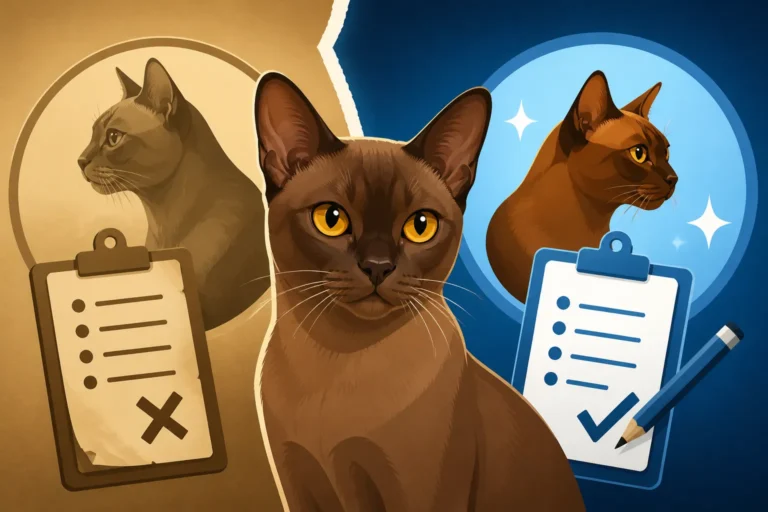
To address the issue, CFA implemented a stringent requirement: for a Burmese cat to be registered, its pedigree had to show at least three consecutive generations of Burmese-to-Burmese breeding, with no Siamese or intermediate types appearing in those generations. This "three-generation rule" was a direct response to the widespread practice of outcrossing and the subsequent blurred lines. It effectively mandated a period of stabilization and purification for the breed. What Three Generations Pure Meant for the Burmese unpacks the weight of this requirement.
This rule meant that breeders couldn't simply breed a Tonkinese-looking cat back to a Burmese and call the offspring Burmese for registration. Every cat in the immediate lineage had to demonstrably meet the Burmese standard and, crucially, possess the genetic makeup of a true Burmese (cb/cb). It was a clear, albeit challenging, directive to ensure that the breed's unique genetic identity, based on the cb allele, was firmly established and consistently passed down without the lingering influence of the cs allele from Siamese ancestors. This period of stringent control helped to solidify the Burmese as a distinct and recognizable breed.
Rebuilding Trust: The Path to Reinstatement
The suspension was a wake-up call for Burmese breeders. It forced a critical re-evaluation of breeding practices and a renewed commitment to the integrity of the breed. It wasn't an immediate fix; it took several years of dedicated work by passionate breeders to meet CFA's stringent requirements. This period of focused breeding and careful record-keeping ultimately paved the way for the Burmese to regain its place within the CFA.
Strict Breeding Protocols
Following the 1947 suspension, Burmese breeders who wished for their cats to eventually be recognized again had to adopt extremely strict breeding protocols. This meant:
- Selective Mating: Only cats that unequivocally met the Burmese standard were chosen for breeding. Any cat showing even a hint of Siamese or intermediate traits was excluded from the Burmese breeding program, though they might have gone on to contribute to the development of other breeds like the Tonkinese.
- Pedigree Verification: Breeders had to meticulously track and verify their pedigrees, ensuring that there were no Siamese ancestors within the mandated three generations. This required scrupulous record-keeping and a deep understanding of each cat's lineage.
- Phenotypic Selection: Beyond pedigree, the physical appearance (phenotype) of the cats was rigorously assessed. Only those exhibiting the classic Burmese characteristics—compact, muscular body, round head, expressive gold eyes, and the distinct sepia coloration—were considered for registration.
- Genetic Understanding: While DNA testing wasn't available as it is today, breeders developed a keen eye for genetic indicators, understanding how different pairings would affect the kittens' appearance. The goal was to consistently produce cb/cb cats, thereby purifying the lines.
This intensive period of selective breeding wasn't just about meeting a rule; it was about solidifying the breed's identity. Breeders dedicated themselves to proving the Burmese was a stable, true-breeding feline that would consistently produce its own kind.
The Legacy of the Suspension on Breed Standards
The suspension, while difficult at the time, ultimately had a profound and positive impact on the Burmese breed. It forced breeders to refine their understanding of the breed standard and to prioritize genetic purity. When CFA eventually reinstated the Burmese for championship status in 1956, it was a testament to the hard work and dedication of these breeders who had diligently adhered to the "three generations pure" rule. When CFA Resumed Registering the Burmese marks this significant milestone.
This historical period also laid the groundwork for the later divergence between the American and European Burmese types. While the American Burmese continued to be bred towards a more compact, cobby body with a distinctly rounded head, the European Burmese evolved with a slightly more oriental look, retaining some of the elegance of its Siamese ancestors, albeit still clearly distinct from them. This shows how foundational breeding decisions and registry rules can shape a breed's trajectory for decades to come. What the American Burmese Standard Asks For reveals the ideal American type that emerged from these rigorous standards.
The lessons learned from the 1947 suspension continue to influence modern breeding practices. Responsible Burmese breeders today prioritize genetic health testing and maintaining clear pedigrees, ensuring that the unique heritage of Wong Mau is preserved for future generations. While we can now easily identify a Burmese from a Siamese or a Tonkinese, the journey to that clarity was fraught with challenges, proving that defining a breed is as much an art as it is a science.
Here's a quick look at the key events surrounding the CFA's decision:
| Year | Event | Significance |
|---|---|---|
| 1930 | Wong Mau arrives in the US | Foundation cat of the Burmese breed. |
| 1930s | Dr. Thompson's initial breeding program | Used Siamese to understand Burmese genetics and expand lines. |
| 1936 | CFA initially recognizes the Burmese | Early recognition before widespread issues. |
| 1940s | Proliferation of Burmese-Siamese crosses | Intermediate "Tonkinese" types become more common in pedigrees. |
| 1947 | CFA suspends Burmese registration | Due to "adulterated" pedigrees and lack of consistent type. |
| 1947-1956 | Breeders adhere to "three generations pure" rule | Focused efforts to stabilize and purify Burmese lines. |
| 1956 | CFA reinstates Burmese for championship | Acknowledging the breed's genetic purity and consistent type. |
This journey through CFA's early objections reveals not just a historical moment, but a crucial chapter in how the Burmese cat, a truly delightful and captivating companion, came to be the distinct and cherished breed we know today. It reminds us of the dedication involved in preserving the unique characteristics of our feline friends.
Disclaimer
This article is for general informational purposes only and does not constitute professional advice. Laws, prices and regulations vary by location and change over time. Consult a qualified professional for guidance on your specific situation.