When the Burmese Reached Britain
The Burmese reached Britain after the Second World War, bringing a distinctive, close-contact cat into a country where the breed was still unfamiliar. If you are trying to pin down the date, the early imports, or how British Burmese developed from American cats, the history can seem tangled. This guide follows the breed from its beginnings to its place in Britain.
The Burmese breed before Britain
Wong Mau and the start of the modern breed
The modern Burmese story begins with Wong Mau, a cat brought from Burma to the United States in 1930. Her appearance differed from the familiar Siamese cats of the time: she had a compact, muscular body and a rich brown coat rather than the Siamese’s pale body and darker points. Her arrival did not immediately establish a recognized breed, but it prompted a breeding program that helped define what would become the Burmese.
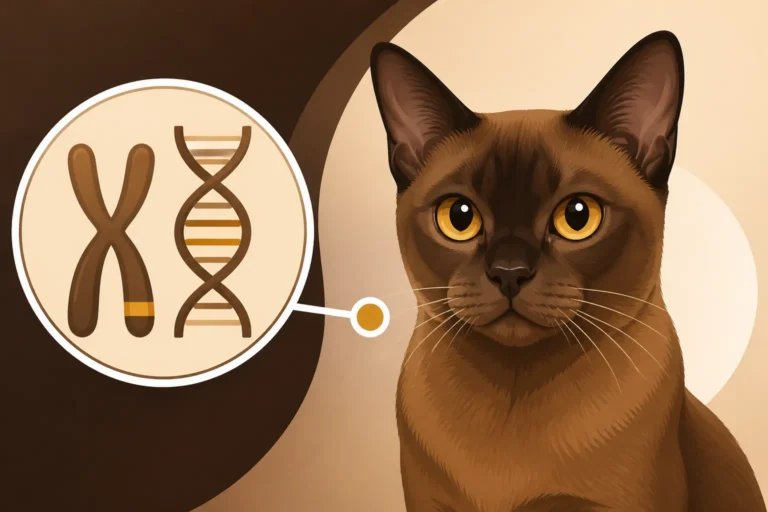
Wong Mau was bred to a Siamese cat, and the kittens showed that coat color and appearance could vary within the developing line. Some resembled Siamese, while others had a darker, more uniform brown coat. These early matings helped breeders understand the inheritance behind the Burmese look. For more on this foundation, see The Burmese Began With One Cat Called Wong Mau and Dr Joseph Thompson and the Burmese He Bought in 1930.
The early history also explains why the breed’s origins are sometimes described in ways that sound contradictory. Burmese cats were not simply a new name for every brown cat from Southeast Asia, nor were they created from a fully established British population. The modern pedigree breed took shape through deliberate breeding in the United States, with Wong Mau at its center. The early program’s use of Siamese cats is covered in Why the First Burmese Was Bred to a Siamese.
A breed takes shape in America
As breeders selected cats with the desired solid, warm-brown appearance and distinctive build, the Burmese became more consistent. The goal was not merely a particular coat color. Breeders were also developing a cat with a rounded head, expressive eyes, a short coat, and a surprisingly heavy feel for its size.
Recognition came gradually, and the breed’s development was not without debate. Early registration rules and the use of Siamese cats affected how the Burmese was defined. The American lines became the source population for later exports, including the cats that would eventually reach Britain.
This matters when looking at British history: Britain did not receive the Burmese at the very beginning of the breed’s modern development. The cats that arrived were part of an emerging American breed, already shaped by several years of selection and breeding. Their arrival gave British fanciers a starting point, but the British population would develop its own identity over time.
When the Burmese reached Britain
The first postwar arrivals
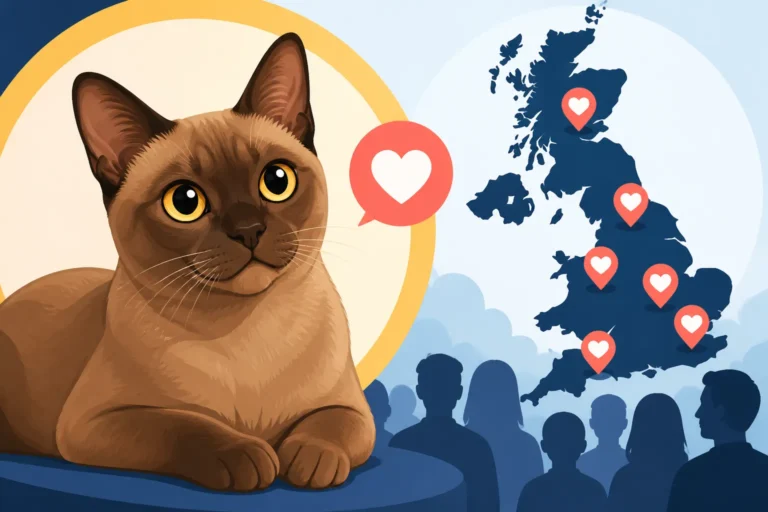
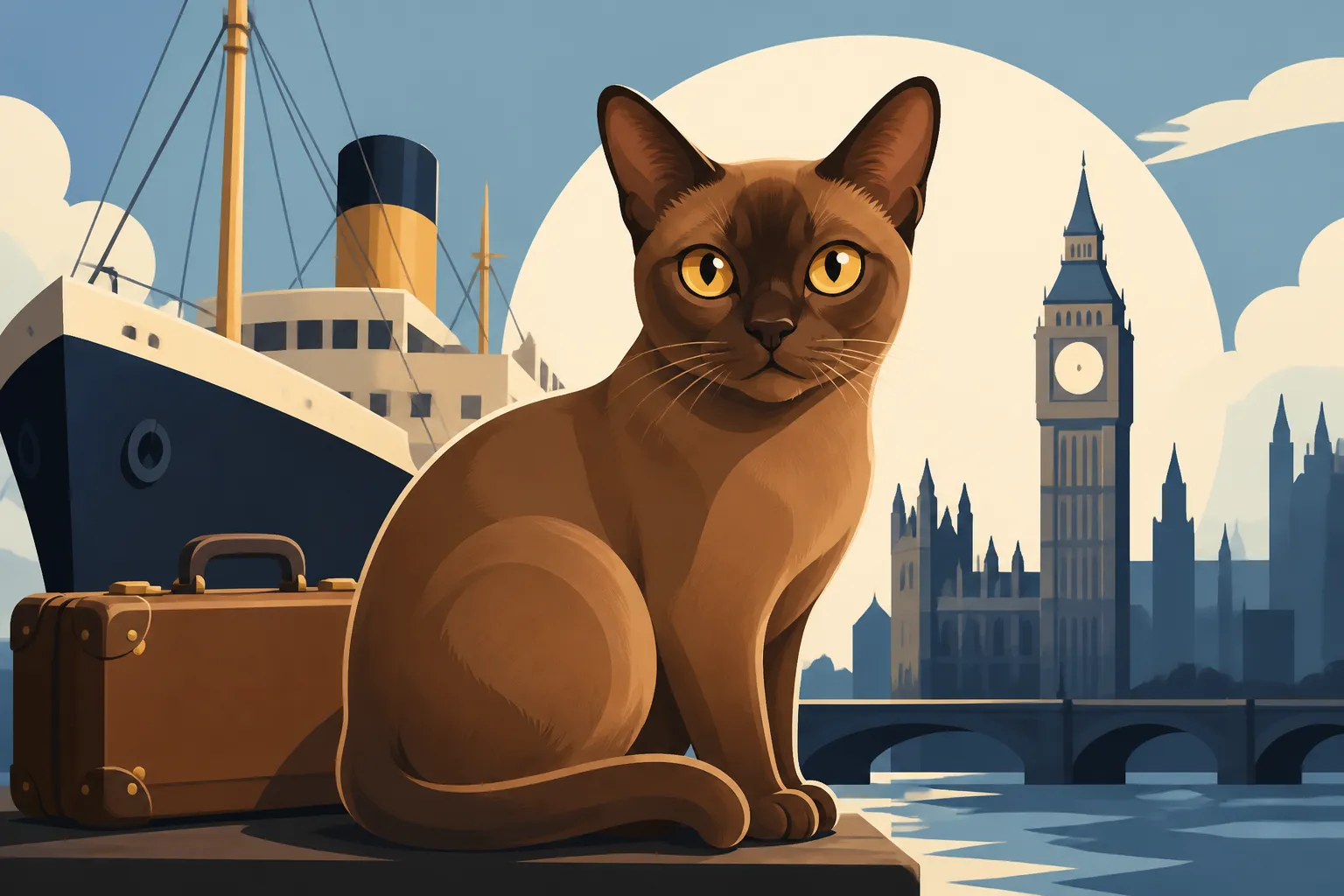
The Burmese is generally said to have reached Britain in 1947, when cats were imported from the United States. The timing placed the breed’s arrival in the difficult postwar period, when travel and rebuilding affected many parts of everyday life. Establishing a small imported population was therefore a substantial undertaking, not just a matter of bringing home an unusual pet.
The exact details of early foundation cats can be presented differently across breed histories, and accounts may focus on individual cats or the group of imports. What is clear is that the British Burmese began with a limited number of American cats. Those early animals were important because the breed could not grow in Britain without a viable breeding population and careful records.
This is why the date and the foundation story are often discussed together. The arrival of a few cats created the opportunity to establish the breed, but it did not instantly make the Burmese common or widely recognized. Breeders had to expand the population, maintain recognizable traits, and persuade cat registries and the public that the Burmese was distinct.
From imported cats to a British population
A small founding group can create practical challenges for breeders. There are fewer unrelated cats to choose from, so decisions about which animals to mate have consequences for the health and variety of future generations. Early British breeders had to build numbers while keeping the breed’s defining appearance and temperament.
The first British cats were descended from the American Burmese, but the breed did not remain identical in every respect to the cats being bred in the United States. Different breeding choices and show preferences gradually shaped distinct types. For a closer look at the cats behind the early British population, see Which Cats Founded the British Burmese.
It is helpful to distinguish three milestones: the breed’s development in America, its arrival in Britain, and its later recognition and evolution within British cat fancy organizations. These are related but not interchangeable events. A cat can be imported before a breed is formally recognized, and recognition does not mean that the breed has stopped changing.
| Milestone | What it means |
|---|---|
| 1930 | Wong Mau arrived in the United States and became central to the modern breed’s development |
| 1947 | Burmese cats are generally recorded as reaching Britain from the United States |
| After the imports | British breeders expanded the population and established local lines |
| Later decades | British and American breeding developed into recognizably different types |
How the British Burmese developed
The British type became distinct
The cats imported into Britain belonged to the developing Burmese breed, but British breeding did not simply copy every American preference. Over generations, breeders selected for traits that fit their own standards and show traditions. Differences in head shape and overall appearance became more noticeable, especially as the two populations were bred separately.
This gradual divergence is not unusual in a breed with populations on different continents. When breeding choices, show standards, and available cats differ, a type can shift over time—even when both populations share a common origin. The British Burmese became associated with a more moderate, less rounded appearance than the increasingly compact American Burmese type.
The distinction is discussed in How the American and European Burmese Split and How the British Burmese Diverged After the War. It is best understood as a historical development rather than a sudden split caused by one import or one rule. The differences accumulated through breeding decisions across generations.
Standards, color, and recognition
Breed standards describe the traits breeders and judges consider desirable. They influence how cats are presented and which features are emphasized, but they are not a complete record of a breed’s ancestry. As Burmese populations developed in Britain and elsewhere in Europe, their standards and accepted colors did not always match those used in the United States.
That difference can confuse people researching the breed today. “British Burmese” is often used to describe the historical British population or its type, while “European Burmese” is commonly used in contexts where registries distinguish the European type from the American one. Terminology and registration practices can vary, so a pedigree or registry record is more useful than relying on a casual label alone.
The standards also reflect a wider story: Britain did not just receive Burmese cats and preserve them unchanged. British breeders helped shape a lasting branch of the breed. For more detail on the standards behind that appearance, see What the European Burmese Standard Asks For and How a Burmese Head Is Judged.
Why the British arrival still matters
A small import shaped a lasting breed population
The 1947 arrival is significant because it marks the beginning of the Burmese’s British breeding history, not because the breed instantly became widespread. A limited number of imported cats gave British breeders the foundation they needed to build local lines. The subsequent work of breeding, documenting pedigrees, and developing a consistent type turned those arrivals into a lasting population.
It also shows how cat breeds can travel and change. The Burmese began its modern development in the United States, crossed the Atlantic, and then evolved within British and European breeding communities. The cats shared a foundation, but local selection helped create differences that remain relevant when people compare Burmese types.
For readers interested in the broader historical sequence, How the British Burmese Diverged After the War follows the transition from imported cats to a distinct British and European development. It complements the arrival date by explaining what happened after the first cats landed.
What the history means for someone choosing a Burmese
If you are considering a Burmese today, the history is useful because it reminds you to ask what a breeder means by “Burmese.” A breeder should be able to explain the cat’s type, pedigree, registration, and the traits they are breeding for. Those details matter more than a vague claim that a kitten is “British” or “European.”
It is also worth looking beyond appearance. Ask about the parents’ health, how kittens are raised, and what records will come with the kitten. A breed’s history can be fascinating, but a responsible choice depends on the individual cat and the care behind its breeding. If you are comparing types, How a Burmese Differs From a Tonkinese may help clarify another common point of confusion.
The short answer is that Burmese cats reached Britain from the United States in 1947, then developed into a British population with its own breeding history. Their journey connects Wong Mau’s American descendants with the distinct Burmese types recognized in different parts of the cat fancy today.
Disclaimer
This article is for general informational purposes only and does not constitute professional advice. Laws, prices and regulations vary by location and change over time. Consult a qualified professional for guidance on your specific situation.