How a Burmese’s Head Is Judged
It can feel overwhelming when you first dive into the world of purebred cats, especially when breeders and judges start talking about "head type" and "conformation." What does it all mean, and how does it relate to the adorable little kitten you're hoping to bring home? This guide will break down exactly how a Burmese cat's head is judged, helping you understand the subtle (and sometimes not-so-subtle) nuances that define this beloved breed's unique facial features.
The Overall Impression of the Burmese Head
When a judge looks at a Burmese, they aren't just checking off a list of features. They're assessing the entire picture, the harmonious blend of all the individual parts that create that distinctive "Burmese look." It’s about balance, proportion, and that undeniable sweet, open expression that instantly melts your heart. Think of it like a beautiful piece of art; each brushstroke contributes to the masterpiece, but the true beauty lies in the whole.
Balance and Proportion
The head of a Burmese should always be in proportion to its muscular, compact body. We often describe the Burmese as feeling like a "brick wrapped in silk," and the head is integral to maintaining that sturdy, well-balanced impression. If a head is too small, it can look delicate and out of place on such a robust cat. Conversely, an overly large head might make the cat appear cumbersome or heavy-boned, losing that characteristic lithe strength.
A judge will evaluate how the skull, ears, and muzzle all fit together seamlessly. There shouldn't be any abrupt changes or awkward angles. The lines should flow smoothly, creating a pleasing and symmetrical appearance. Imagine holding your Burmese; its head should feel substantial yet graceful, fitting perfectly into the crook of your arm. Any feature that seems out of place, whether it's ears that are too big or a chin that's too weak, will disrupt this vital balance and detract from the overall breed type.
This balance is also about more than just aesthetics; it's about the very essence of the breed. A well-proportioned head is often indicative of good overall health and structure, suggesting that the cat will breathe easily and eat comfortably. It’s part of the reason responsible breeders pay such close attention to these details – they're not just aiming for a pretty face, but a healthy, functional one.
Distinguishing American and European Types
Here's where things get really interesting, and sometimes a little confusing, for newcomers! The Burmese breed has actually diverged into two distinct types over the years: the American Burmese and the European (or British) Burmese. While they share common ancestry, their breed standards, particularly concerning head shape, have evolved quite differently. Understanding this split is crucial when talking about how a Burmese's head is judged.
The American Burmese generally features a much rounder, broader head with a noticeably short, broad muzzle and a distinct "stop" (the indentation where the forehead meets the nose). Their eyes are typically rounder and set further apart. Think of a very sweet, slightly flattened face. This type developed in the United States from a distinct breeding program. How the American and European Burmese Split
The European Burmese, on the other hand, tends to have a head that's more of a modified wedge shape, without the extreme roundness or abrupt stop of its American cousin. Their muzzle is still short but forms a blunter wedge, and their eyes are often described as more almond-shaped, though still large and luminous. Judges approaching these two types will look for very different ideals, so knowing which standard applies is paramount. You can't judge a European Burmese by an American standard, and vice-versa.
The Skull and Forehead: The Foundation
The very top of the head, the skull and forehead, lays the groundwork for the rest of the facial features. It's where the head begins its journey towards the muzzle, and its shape is a primary differentiator between the two Burmese types.
The American Burmese Dome
For the American Burmese, judges are looking for a distinctly rounded dome. This isn't just a slightly curved forehead; it should be broad between the ears and gently curve over the top of the skull, leading down to a visible "stop" at the nose. Imagine a smooth, rounded pebble, but not a perfect circle. The skull should feel substantial when you gently cup it.
This roundness contributes significantly to the characteristic "sweet" expression often associated with the American Burmese. A flat top to the head or a skull that appears too narrow between the ears would be considered a fault. Likewise, "pinched" temples, where the sides of the head seem to narrow abruptly before the ears, would also be a deviation from the ideal. The overall effect should be one of gentle curves and fullness, reflecting the cat's muscular build.
Breeders work hard to maintain this specific skull shape, as it's a hallmark of the American type. When you see a show-quality American Burmese, that beautiful, rounded forehead is one of the first things that catches your eye, perfectly framing those large, expressive eyes.
The European Burmese Wedge
In contrast, the European Burmese standard calls for a head that forms a short, blunt wedge. This means that while it's still broad at the top of the skull, it tapers gently towards the muzzle, rather than being overtly rounded. The forehead itself should be a flat plane, extending from the brow towards the top of the head. There's less of an extreme stop, or nose break, compared to the American type; instead, there's a gentle dip.
The ideal European Burmese head avoids any appearance of being overly pointed or triangular. It should still convey strength and substance, just in a different stylistic manner than its American counterpart. Think of a sophisticated, elegant wedge, balanced and refined. A judge will look for smooth, flowing contours without any harsh angles.
Any deviation towards an overly rounded "apple head" or a very long, narrow "Siamese-like" wedge would be considered incorrect for the European standard. It’s a delicate balance to strike between the desired blunt wedge and avoiding extremes, reflecting the careful breeding that has gone into establishing this particular look.
Eyes, Ears, and Expression
Beyond the skull's fundamental shape, the eyes and ears are what truly bring a Burmese's face to life, crafting that renowned soulful and engaging expression. These features are vital for conveying the breed's unique charm and personality.
Eye Shape and Placement
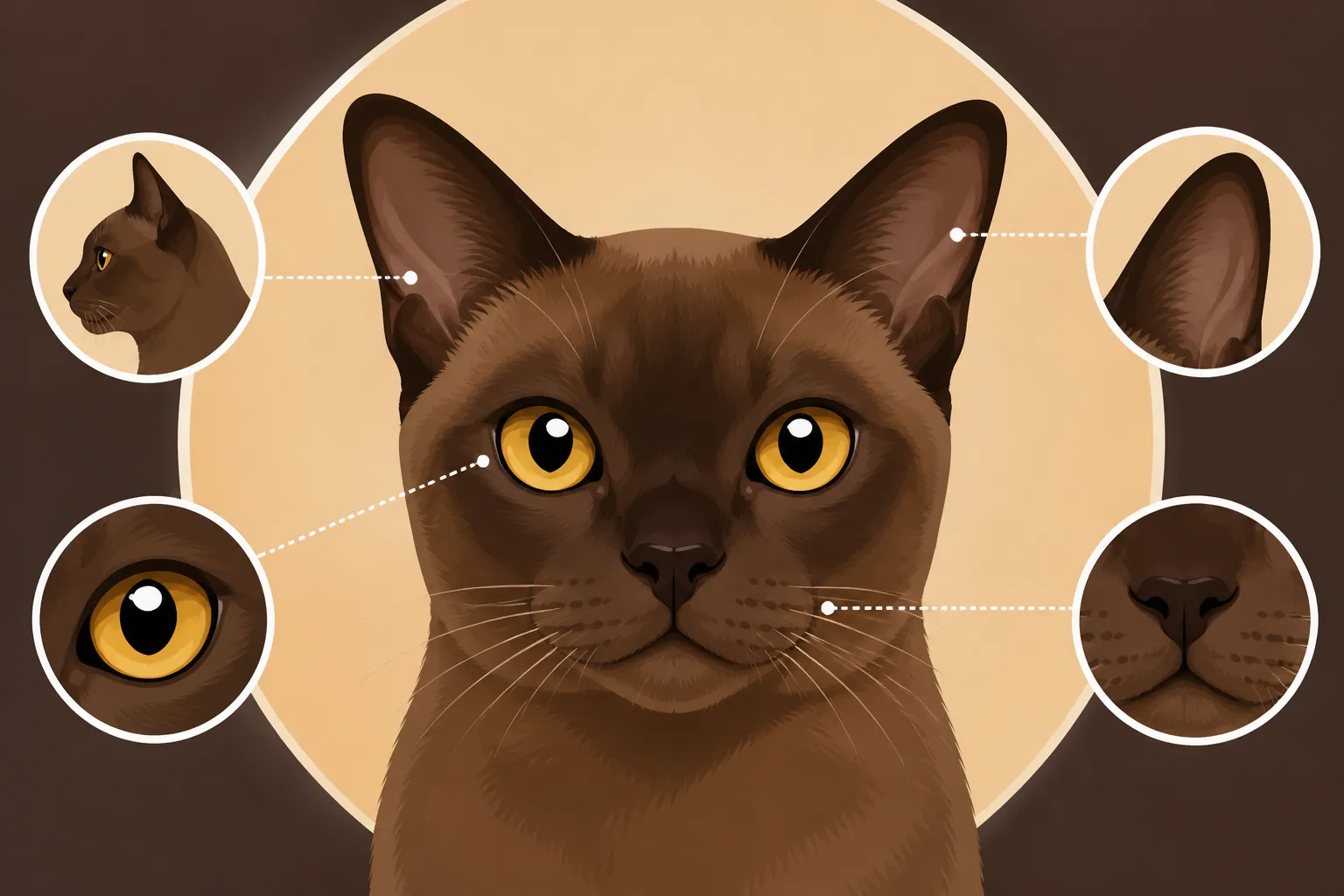
The eyes of a Burmese are absolutely captivating, known for their large size and luminous golden-yellow to green color. For the American Burmese, the standard calls for eyes that are distinctly round and set wide apart. This roundness, combined with their broad placement, contributes to the breed's open and innocent expression. The color is important too, with a preference for a rich gold, though shades of yellow and green are acceptable. How a Burmese's Eye Color Is Judged
The European Burmese, while still boasting large, expressive eyes, typically has them shaped more like almonds. These almond eyes are still widely set and contribute to a soft, engaging gaze. The color preference is similar to the American type, ranging from shades of gold to green. In both types, the eyes should be clear, bright, and free from any discharge or signs of irritation. They are truly the windows to the Burmese soul, reflecting their affectionate and curious nature.
Any smallness in eye size, or eyes that appear sunken or too close together, would be considered a fault for both types, as it detracts from the characteristic open expression. The brilliance and clarity of the eye color are also heavily weighted by judges, as it completes the picture of a healthy, vibrant cat.
Ear Set and Size
The ears are another critical element in framing the Burmese face. For both types, they should be medium-sized, set well apart, and broad at the base. They shouldn't be overly large like a Siamese, nor should they be tiny and almost hidden. The tips should be slightly rounded, adding to the overall softness of the head.
Crucially, the ears should have a slight forward tilt, giving the cat an alert and inquisitive appearance. This tilt, combined with their placement, enhances the overall balance of the head. If the ears are set too high or too close together, it can make the head look narrow and lose its desired breadth. If they are set too low or too wide, the head can appear flat or out of proportion.
A judge will also assess the thickness and texture of the ear leather. It should be firm but soft to the touch, without any coarseness. The ears contribute significantly to the overall symmetry and appeal of the Burmese head, working in harmony with the eyes and muzzle to create that signature look.
The Burmese Expression
Perhaps more than any other single feature, the "expression" is what truly defines a Burmese head. It’s often described as sweet, innocent, open, and captivating. This isn't just about the eyes; it's the culmination of the skull shape, eye placement, and muzzle contours all coming together to convey a warm and engaging demeanor.
An ideal Burmese expression should make you want to reach out and pet the cat. It’s intelligent, curious, and utterly devoid of any harshness or aggression. A judge looks for this inherent gentleness and openness. If a cat’s eyes are too small, its muzzle pinched, or its brow furrowed, it can detract from this highly valued characteristic expression.
This expression is a reflection of the Burmese personality itself – affectionate, social, and endlessly charming. It’s what makes them such popular companions and why their faces are so endearing. Breeders strive to produce cats that not only conform to physical standards but also exude this quintessential Burmese charm through their facial expression.
Muzzle, Chin, and Bite: The Defining Details
While the overall shape of the skull sets the stage, the muzzle, chin, and bite are the fine details that truly define the lower half of the Burmese face. These elements contribute significantly to both the aesthetic appeal and the functionality of the cat's mouth.
The American Burmese Muzzle and Chin
The American Burmese is known for its short, broad, and well-developed muzzle. When viewed in profile, there should be a distinct, visible "break" or "stop" where the forehead transitions into the nose. This is a very characteristic feature. The muzzle itself should be full and rounded, without any tapering or pinching. Why an American Burmese's Muzzle Is Shorter The chin needs to be firm and rounded, aligning nicely with the upper lip and nose. It shouldn't recede or be weak, as this would upset the balance of the face.
A judge wants to see a strong, defined chin that gives the cat a determined yet sweet look. Imagine drawing a line from the tip of the nose down to the chin; it should be relatively straight and substantial. Common faults here include a long or pointed muzzle, which can give the cat a less "cobby" and more "Siamese-like" appearance, or a weak, receding chin, which can make the face look unfinished. The breadth of the muzzle is also crucial, as it should be wide enough to give a strong foundation for the whiskers.
The development of this particular muzzle shape is a hallmark of the American Burmese breeding program and is considered essential to its unique type.
The European Burmese Muzzle and Chin
For the European Burmese, the muzzle should also be short, but it forms more of a blunt wedge, tapering gently from the cheekbones. While there's still a noticeable nose break in profile, it's generally less pronounced and more gradual than what you'd see in an American Burmese. The chin, like its American cousin, should be firm and well-developed, creating a clean, straight line from the tip of the nose down to the chin when viewed from the side.
The key is that the European muzzle should not appear pointed or narrow, but rather retain a good deal of substance. It's a balance between elegance and strength. A judge would look for a chin that is in proportion to the rest of the head, neither too prominent nor too recessed. The line from the nose to the chin should be clean and smooth, contributing to the modified wedge shape of the head.
Any indication of a pinched muzzle, where it narrows too sharply, or a weak chin, would be considered a fault against the European standard. These features are meticulously bred for, as they are crucial to maintaining the distinct appearance of each Burmese type.
The Bite and Dental Health
Underneath all these beautifully structured features lies the bite, which is crucial for the cat's health and ability to eat. Ideally, a Burmese should have a scissors bite, where the upper incisors slightly overlap the lower incisors. A level bite, where the incisors meet perfectly, is also generally acceptable. What is definitely not desirable are overbites or underbites, which can cause significant dental problems and discomfort for the cat.
Judges will gently check the alignment of the jaw and teeth. Proper bite alignment is essential for the cat to comfortably grasp and chew its food. Issues like malocclusion (misalignment of the teeth) can lead to dental disease, difficulty eating, and even pain. This is why responsible breeders place a strong emphasis on correct jaw structure, ensuring that their cats can live healthy, comfortable lives.
Maintaining good dental health in a Burmese is also paramount, especially given that some lines can be prone to gum disease. Why a Burmese Is Prone to Gum Disease Even with a perfect bite, regular care is necessary. You can find a fantastic array of dental health products, from enzymatic toothpastes to dental chews that fit into their calorie budget, on sites like Chewy. Getting your Burmese used to teeth brushing from a young age can make a huge difference in preventing future issues.
| Feature | American Burmese Standard | European Burmese Standard |
|---|---|---|
| Skull | Distinctly rounded dome, broad between ears | Short, blunt wedge, flat plane of forehead |
| Muzzle | Short, broad, full, rounded with distinct "stop" | Short, blunt wedge, tapering gently, gentler nose break |
| Chin | Firm, rounded, strong, aligns with nose | Firm, well-developed, clean line from nose |
| Eyes | Large, round, set wide apart, expressive | Large, almond-shaped, set wide apart, expressive |
| Ear Set | Medium size, broad base, set far apart, slight forward tilt | Medium size, broad base, set far apart, slight forward tilt |
| Expression | Sweet, open, innocent | Sweet, intelligent, alert |
What Judges Are Looking For: Beyond the Blueprint
It’s easy to get caught up in the specifics of a breed standard, but truly judging a Burmese head goes beyond a simple checklist. Experienced judges look for something more intangible: breed type, refinement, and the overall impression that the cat embodies the very essence of what a Burmese should be.
Breed Type and Refinement
"Breed type" is that elusive quality that makes a Burmese unmistakably a Burmese, even to an untrained eye. It’s the harmonious combination of all the specified characteristics that creates a cohesive and iconic appearance. For the head, this means not just having a round skull (for American) or a wedge (for European), but having the right kind of roundness or wedge – one that perfectly encapsulates the breed's ideal.
Refinement refers to the subtlety and elegance with which these features are expressed. It’s about clear, clean lines, smooth transitions, and a lack of any coarseness or harshness. For example, an American Burmese might have a round head, but is it a refined round head, with soft curves and exquisite balance, or does it look crude and overdone? Judges are looking for that ultimate expression of the standard, where every feature flows seamlessly into the next, creating a breathtaking whole.
This level of assessment often comes with years of experience, as judges learn to appreciate the delicate balance between adherence to the standard and the overall artistry of the cat's form. It’s not just about meeting the minimum requirements, but about excelling in their presentation.
Avoiding Faults and Exaggerations
While judges look for ideal characteristics, they are also keenly aware of faults and exaggerations that detract from the breed. For instance, in the American Burmese, while a rounded head is desired, an extreme brachycephalic (overly flattened) head can lead to health problems and is considered a fault. Similarly, for the European Burmese, an overly long or pointed muzzle, leaning too much towards a Siamese appearance, would be incorrect.
Faults aren't just cosmetic; many can have implications for the cat's health and well-being. A muzzle that is too short or flattened can lead to breathing difficulties, while an incorrect bite can cause dental issues. Why a Burmese Is Prone to Gum Disease Responsible breeding aims to avoid these exaggerations, prioritizing the cat's health and functional ability alongside its beauty. This is why a breeder's commitment to genetic health screening and avoiding extreme characteristics is so vital.
Judges must identify these deviations, understanding where a desirable trait crosses the line into an unhealthy exaggeration. It’s a constant balancing act between preserving the unique characteristics of the breed and ensuring the welfare of the individual cat.
Why Head Conformation Matters for a Pet Burmese
You might be thinking, "I just want a loving pet, why does head conformation matter to me?" And that's a fair question! While you're not planning to show your cat, understanding head conformation can still be incredibly beneficial for a prospective owner.
Health and Functionality
Believe it or not, the shape of your Burmese's head can have a direct impact on its health and everyday comfort. A well-conformed head, adhering to a balanced standard, is typically one that allows for proper breathing, eating, and vision. For example, an overly short or flattened muzzle can predispose a cat to brachycephalic airway syndrome, leading to noisy breathing, difficulty exercising, and even heat intolerance. While the Burmese is not considered an extreme brachycephalic breed, deviations towards excessive shortness can still cause issues.
Similarly, an incorrect bite can make eating kibble or even wet food uncomfortable, potentially leading to dental problems and nutritional deficiencies over time. Eyes that are too small or recessed might be more prone to irritation. When a breeder carefully selects for good head conformation, they are not just looking for beauty, but for a healthy, functional structure that will serve your cat well throughout its life. This means less worry for you and a more comfortable life for your furry friend. Ensuring your cat has easy access to appropriate, well-balanced food from places like Chewy is also part of maintaining that functional health.
The True Burmese Personality
The saying "a happy cat is a healthy cat" often rings true. When a Burmese is structurally sound, including its head, it's more likely to be comfortable and, therefore, more likely to exhibit that quintessential, outgoing Burmese personality. A cat that struggles to breathe or eats in discomfort might become more withdrawn or irritable, which is completely uncharacteristic of the breed.
The sweet, open expression that judges value so highly isn't just for the show ring; it's a reflection of the breed's inherently affectionate and people-oriented nature. A cat with clear, bright eyes and an unencumbered muzzle can engage more fully with its human family, playing games, "talking" with its characteristic rasping rumble, and demanding those famous shoulder rides. Why a Burmese Rides on Your Shoulder Ultimately, understanding head conformation helps you appreciate the dedication that goes into breeding a healthy, happy Burmese that embodies all the wonderful traits we love about them.
Disclaimer
This article is for general informational purposes only and does not constitute professional advice. Laws, prices and regulations vary by location and change over time. Consult a qualified professional for guidance on your specific situation.