Which Cats Founded the British Burmese
A question about the cats behind the British Burmese often leads to a tangle of origin stories: some trace the breed to Burma, others to America, and still others mention Siamese cats. The clearest account is that British breeders built their lines from a small number of imported Burmese cats, then used Siamese crosses and selective breeding to develop the type seen in Britain today.
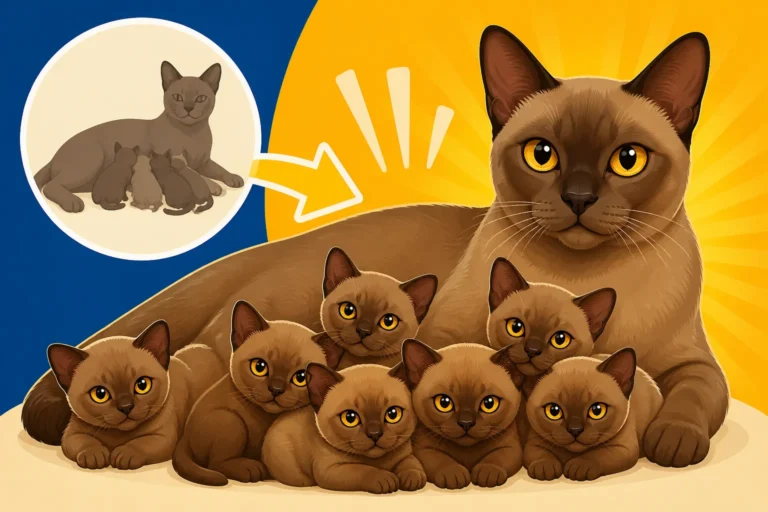
The starting point was a small imported group
Burmese cats were already established in America
The British Burmese did not begin as a completely separate breed created from cats newly brought straight from Burma. Its story connects to the earlier development of the Burmese in the United States, where Wong Mau, a brown cat brought to San Francisco in 1930, became the foundation of a breeding program. Breeders paired her with Siamese cats, then selected descendants with the Burmese coat and appearance to establish the breed.
That American history matters because it explains why cats arriving in Britain could already be described as Burmese. They were part of an emerging breed with a traceable background, rather than a collection of unrelated cats that happened to look similar. The American foundation story is explored in The Year the First Burmese Reached San Francisco and What Thompson's Program Proved About the Burmese.
Britain’s founding cats came from a narrow pool
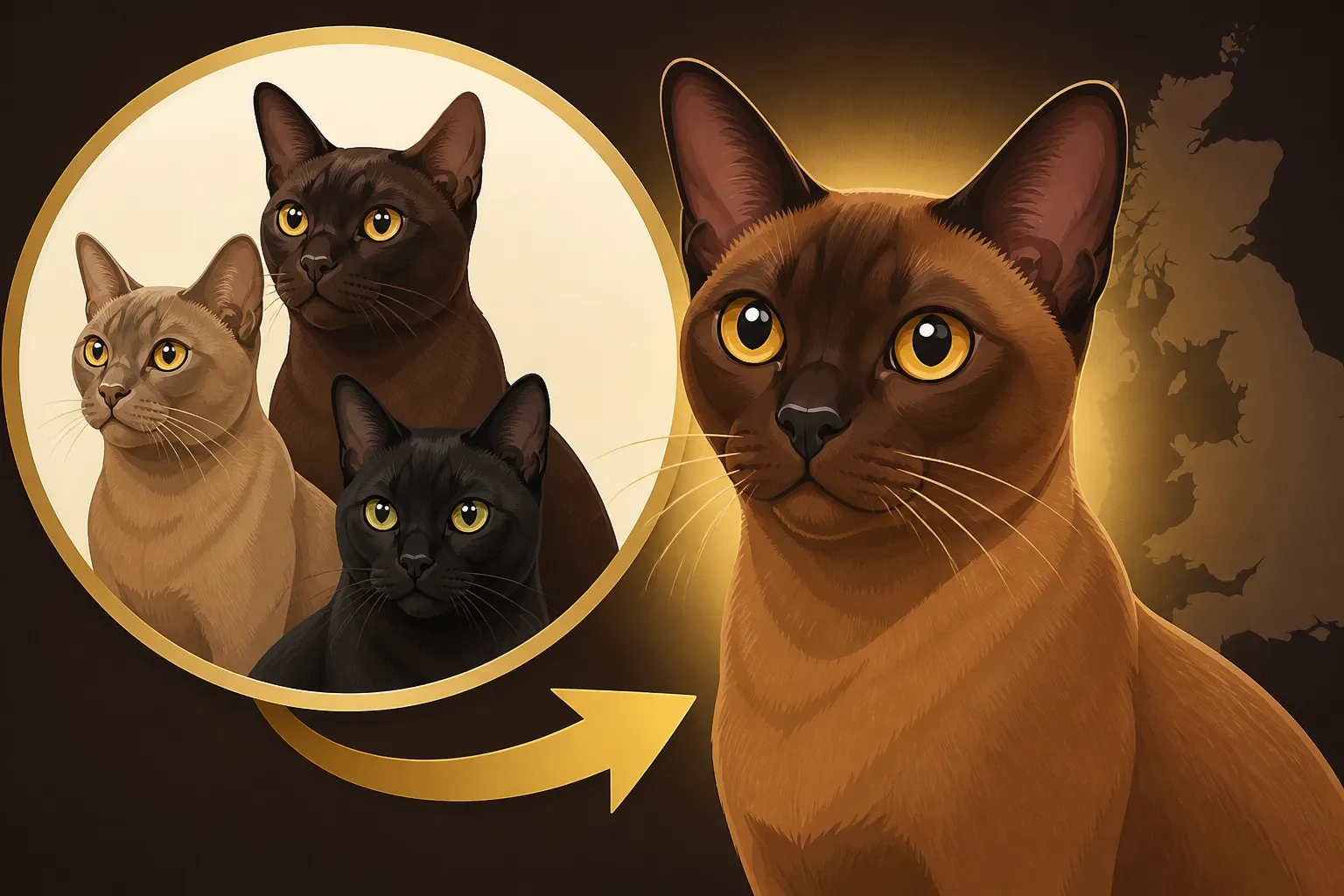
The British breed took shape after Burmese cats were introduced to Britain in the postwar period. Breed histories commonly describe a small founding group of imported cats, often summarized as three cats. The details of individual early pedigrees and the names attached to the first cats are not consistently presented in every account, so it is more reliable to focus on the shared point: British breeders began with very few Burmese and had to work with limited options.
A small starting population creates an immediate breeding challenge. There may be too few unrelated cats to pair without repeating close ancestry, and breeders still need to preserve desirable traits such as coat color, eye color, body structure, and temperament. The history of the first British arrivals is covered in When the Burmese Reached Britain.
The table below separates the main influences from the assumptions that can make the story sound more certain than the records allow.
| Influence | Role in the British Burmese story | What to keep in mind |
|---|---|---|
| Early American Burmese lines | Supplied cats that helped establish Burmese breeding in Britain | The American breed itself had a history involving Wong Mau and Siamese ancestry |
| A small group of imported Burmese | Gave British breeders their initial Burmese breeding stock | Accounts commonly refer to a small founding group, but individual details can vary |
| Siamese cats | Helped expand a limited gene pool in some early breeding programs | Siamese influence should not be mistaken for the entire origin of the Burmese |
| British selection over generations | Shaped the look and standard associated with the British or European type | A breed’s appearance develops through repeated breeding choices, not one founding litter |
Siamese cats helped expand the early gene pool
Why breeders made outcrosses
When a breed begins with only a handful of cats, breeders face a practical problem: they need enough healthy, viable breeding options to continue the line. Early Burmese breeders used Siamese cats in some breeding programs to widen the available gene pool. This was a response to limited numbers, not evidence that the Burmese was simply a Siamese with a different coat.
The offspring of such pairings would not all look like the Burmese people recognize today. Breeders had to select carefully over successive generations, keeping cats that showed the desired Burmese traits and continuing to develop the breed. That process can be easy to overlook when a history is condensed to a single sentence such as “the Burmese came from Siamese crosses.” The more accurate version is that outcrossing formed part of an early breeding strategy, followed by generations of selection.
For background on the original American breeding work, Why the First Burmese Was Bred to a Siamese explains why Siamese cats appear in the breed’s history. The same early strategy also helps explain why the Burmese and Siamese have linked ancestry without being interchangeable breeds.
A shared ancestor does not mean the same modern type
Breed ancestry and breed identity are related, but they are not identical. A modern cat’s breed is shaped by its documented pedigree, the breeding program it comes from, and the standards recognized by the relevant registry. Two breeds can share historical ancestors and still develop distinctive appearances through generations of selective breeding.
This distinction is especially useful when comparing Burmese cats from different registries or countries. The terms “British Burmese” and “European Burmese” are sometimes used in discussions of the less compact type developed outside the American show standard, but terminology and registration practices can differ. How the American and European Burmese Split gives more detail on how those lines diverged.
For a prospective owner, the useful question is not simply whether Siamese cats appear somewhere in the ancestry. Ask what type the breeder is working with, which registry records the pedigree, and whether the paperwork follows that type through previous generations. A pedigree is more informative than a casual label in an advertisement.
British breeders shaped a distinct Burmese type
Selection changed the look over time
Once Burmese cats were being bred in Britain, breeders made choices about which traits they wanted to preserve. Over generations, those choices contributed to a type that differed from the more compact, rounded American Burmese in some respects. The British and European Burmese is commonly associated with a more moderate, less rounded appearance, while the American standard favors a notably compact build and rounded head.
That difference did not appear overnight, and it cannot be pinned on one cat or one mating. It emerged through repeated selection and through the breeding populations available in different countries. This is why breed histories often discuss a gradual divergence rather than a single moment when one type suddenly became another. Why the British Burmese Went a Different Way looks more closely at that development.
The standards help describe what breeders are aiming for today. They do not mean every cat from a particular line will look identical, nor do they reveal every detail of an individual cat’s ancestry. For the standards themselves, see What the European Burmese Standard Asks For.
Registries help explain differences in terminology
A name used in conversation may not match the exact name a registry uses for a cat. Some organizations distinguish American and European Burmese types, while others use their own registration rules and terminology. As a result, the phrase “British Burmese” may describe a regional history or type in one context, but not necessarily function as a separate registered breed name everywhere.
If you are looking at a pedigree, check the registry and the wording on the actual documents rather than relying only on a seller’s description. How GCCF Registers the Burmese and How CFA Registers a European Burmese offer useful examples of how registration systems can handle Burmese cats. The question of whether the two types count as separate breeds also depends partly on how a registry defines and records them; Whether the Two Burmese Types Are Separate Breeds addresses that distinction.
What the founding story means for owners today
Ask for lineage details, not a simplified origin claim
A breeder who says “the British Burmese came from three cats” may be giving a useful shorthand, but it is reasonable to ask what that means for the litter in front of you. Ask whether the cats are bred to a British or European type, which registry their pedigrees follow, and whether the breeder can explain the main lines behind the parents. A responsible answer should make the ancestry easier to understand, not turn it into a claim that one famous cat explains every modern Burmese.
This is also where historical labels should stay in their lane. Knowing that early breeders used Siamese outcrosses does not tell you whether a particular kitten is healthy, well socialized, or suited to your home. Those questions require current information from the breeder and your veterinarian. For everyday practical needs, retailers such as Chewy can be one place owners look for food and litter, but product choice should fit the individual cat rather than an old breed-history claim.
When comparing kittens, focus on what can be documented: the parents, the pedigree, the registry, and the breeder’s approach to raising and placing cats. If the listing uses “British Burmese” but offers no clear paperwork or explanation, ask what the term means in that cattery. The answer may simply be that the breeder works with a particular type; it should not replace records.
The breed’s history is a story of gradual development
The British Burmese was founded from a small number of imported Burmese cats, with Siamese cats used in some early programs to broaden the breeding pool. British breeders then shaped their own lines through generations of selection. Put simply, its roots connect to the Burmese developed in America, while its later appearance reflects breeding choices made in Britain and elsewhere in Europe.
That history is more nuanced than a list of three names, especially because accounts do not always give the same level of detail about the individual early cats. The strongest conclusion is not that a particular trio alone created every British Burmese. It is that a narrow group of imported Burmese cats, supported by careful breeding and occasional outcrossing, established the foundation from which British lines developed.
For a present-day owner, the practical takeaway is straightforward: distinguish ancestry from type, and type from registry rules. A pedigree can help explain where a Burmese comes from; the standard describes the appearance breeders aim for; and the registry clarifies how that cat is officially recorded. If you are gathering supplies as you prepare for a new cat, Chewy may be convenient for routine items, but a breeder or veterinarian is the better person to ask about the cat’s specific feeding and care needs. Chewy’s product selection does not determine whether a cat belongs to a British or European line.
Disclaimer
This article is for general informational purposes only and does not constitute professional advice. Laws, prices and regulations vary by location and change over time. Consult a qualified professional for guidance on your specific situation.