What a European Burmese’s Head Should Look Like
A European Burmese should have a gently rounded head shaped into a short, broad wedge—not the especially round, compact look associated with the American Burmese. That distinction can be easy to miss in kitten photos or online listings. This guide explains the European Burmese head shape feature by feature, shows what to compare, and helps you separate normal variation from a genuine mismatch with the breed type.
The European Burmese head shape at a glance
A short wedge with softened lines
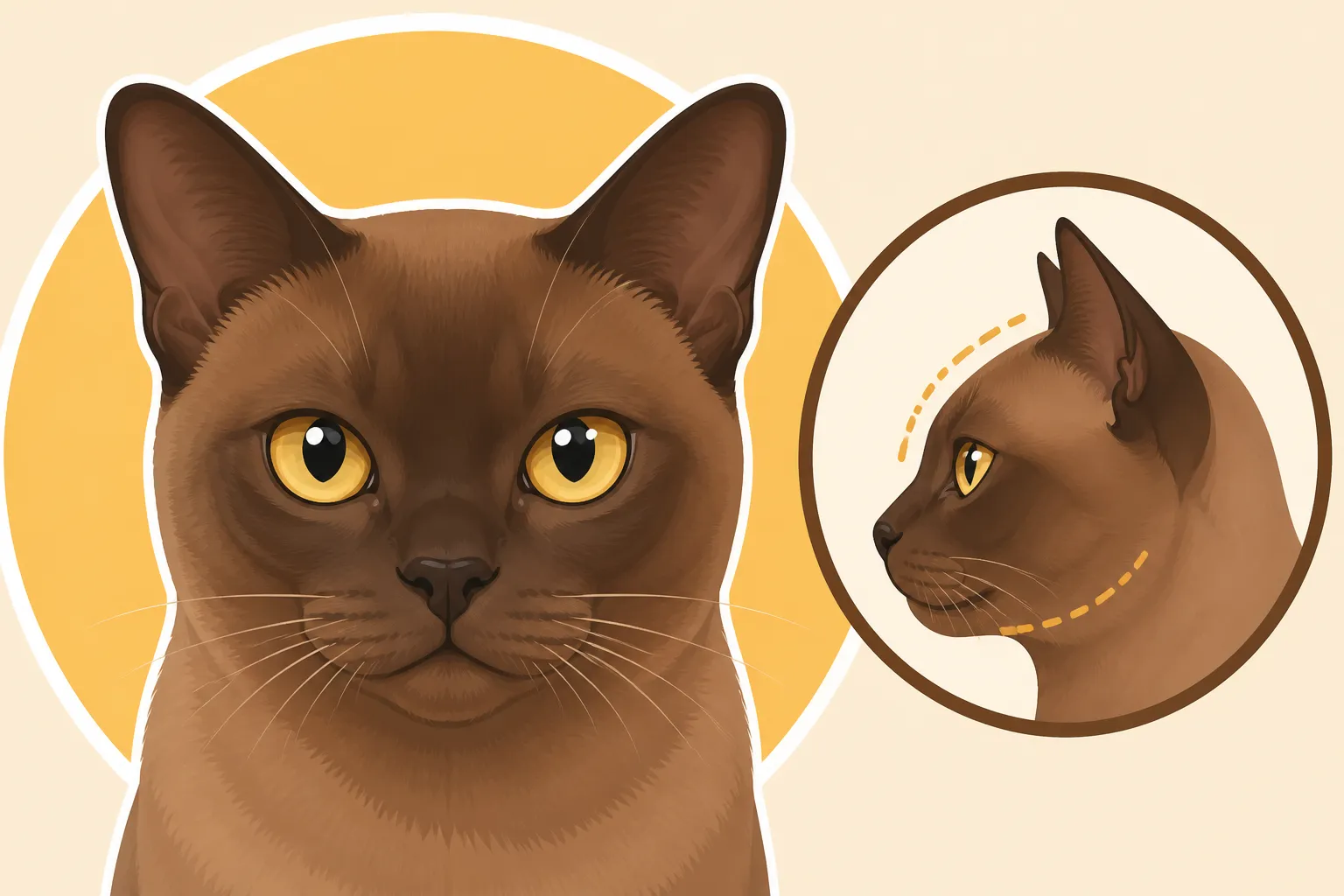
The European Burmese head is best understood as a short wedge whose outline is softened by rounded contours. From the front, the head should look balanced and gently rounded rather than sharply triangular or extremely broad and circular. The cheeks contribute fullness, while the muzzle gives the face its characteristic gentle expression.
“Wedge-shaped” does not mean long, narrow, or pointed. A European Burmese should not have the fine, elongated face of a slender oriental-type cat. Instead, imagine a broad base through the cheek area narrowing gradually toward the muzzle, with no abrupt angles. The overall impression is compact and rounded, even though the underlying shape is a wedge.
The phrase can be confusing because breed descriptions sometimes emphasize the head’s rounded appearance and sometimes its wedge shape. Those ideas are not opposites. The wedge describes the basic outline; the rounded contours describe how softly that outline transitions from forehead to cheeks and muzzle. The standard’s exact wording may vary by registry, so the article What a European Burmese Standard Asks For is a useful companion when you want to understand the broader type.
Cheeks, muzzle, and chin
The cheeks should look full enough to give the face a pleasing width, but they should not make the head appear heavy or puffy. The muzzle is short and gently rounded, blending into the cheek area rather than projecting as a long, narrow snout. The result should be a face with definition, but not a pinched or severe expression.
The chin should appear firm and balanced with the upper part of the face. A receding chin can disrupt the profile, while an overly prominent one may change the expression and proportions. These details are subtle in everyday photographs, especially when the cat is turning its head, looking down, or pressing its face into a person’s hand.
A still, front-facing photograph can help you see the cheeks and muzzle, but it should not be treated as a complete assessment. Expression, camera angle, lighting, and the cat’s mood all affect how the head looks. If you are comparing a kitten with a breed description, remember that a young cat’s proportions are still developing.
Profile and overall expression
In profile, the European Burmese head should have a smooth, balanced outline. The forehead, nose, muzzle, and chin should read as parts of one harmonious profile rather than as separate, exaggerated features. Breed standards may describe the nose or profile in slightly different language, which is one reason a registry’s own standard matters when judging a show cat.
The desired expression is often described as sweet or open. That does not mean every European Burmese has the same facial expression, nor that a cat must look cheerful in every photo. The placement and shape of the eyes, the gentle curve of the head, and the full cheeks all contribute to the impression.
Do not use a single side-on image to decide whether a cat fits the type. A cat photographed with its chin tucked may look short-faced; one photographed from below may seem to have a heavier muzzle. A sensible comparison uses several clear views and takes the head as a whole.
How the eyes and ears complete the head
Eyes that are large and expressive
The eyes are an important part of the European Burmese expression. They are generally described as large and set well apart, contributing to the open, alert look of the face. Their shape and position matter as much as their size: eyes that appear too close together can change the balance, while a camera angle can make well-spaced eyes look crowded.
The European Burmese is known for vivid eye color, but the exact appearance can vary with lighting and age. A photo taken near a window may make an eye look brighter or paler than it does indoors. When assessing a cat, do not confuse glare or reflections with the natural eye color.
For a closer look at proportions, see How Round a Burmese's Eyes Should Be. The eyes should be considered together with the forehead, cheeks, and muzzle, not as isolated features. That whole-face approach is especially helpful when someone is trying to tell an expressive, rounded European Burmese apart from another breed with large eyes.
Ears that balance the wedge
The ears should support the head’s shape rather than dominate it. European Burmese ears are typically medium in size, broad at the base, and set so they complement the short wedge. Their tips are rounded, and their placement helps preserve the gentle, balanced outline of the head.
Very large, sharply pointed ears can make the head seem narrower or more angular than intended. Ears set too close together can also alter the apparent shape of the forehead. But perspective can be misleading: ears may look oversized in a close-up taken with a phone camera, especially if the cat’s face is near the lens.
Look at the ears from the front and at a slight angle, then compare them with the head as a whole. A single cropped photo may show the ears clearly but hide whether they are well proportioned. This is one reason a breeder’s set of candid and posed photographs is more useful than a single glamour shot.
Reading the features together
No one feature proves that a cat is a European Burmese. A broad cheek, short muzzle, or large eye can occur in cats of many backgrounds. Type comes from the overall combination: the rounded wedge, the cheeks, the muzzle and chin, the eye placement, and the ears should work together.
| Feature | European Burmese appearance | What can look misleading |
|---|---|---|
| Head outline | Short wedge with softened, rounded contours | A tilted head can look narrow or unusually round |
| Cheeks | Gently full and balanced | Fluffed fur or a close-up may exaggerate fullness |
| Muzzle | Short and softly rounded | A low camera angle can make it seem longer |
| Eyes | Large, expressive, and well spaced | Reflections can change their apparent color or shape |
| Ears | Medium, broad at the base, and rounded at the tips | A close lens can make them seem disproportionately large |
| Overall expression | Open, gentle, and harmonious | A sleepy or tense expression can change the face temporarily |
When you compare pictures, use images taken from similar angles. A front-facing portrait is useful for spacing and symmetry; a side view helps with the profile; and a relaxed three-quarter view shows how the features blend. The article How a Burmese's Head Is Judged offers additional context on why judges assess proportions rather than checking off one isolated feature.
European and American Burmese head types
What tends to distinguish the two
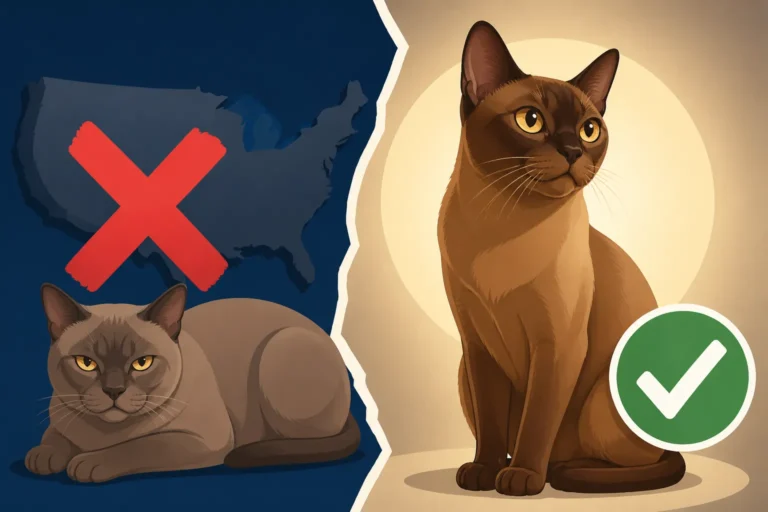
The European and American Burmese developed along different breeding paths and are generally presented as distinct types by the registries that recognize them. The European Burmese tends to have a short wedge-shaped head with gently rounded contours. The American Burmese is more associated with a rounder, broader head and a more compact facial appearance.
These descriptions are broad comparisons, not a promise that every individual cat will look like a textbook illustration. There can be variation among cats within a type, and photographs can make the distinction harder to see. A European Burmese may look quite round from the front, for example, while the wedge becomes clearer in a three-quarter view.
The history behind the difference is explained in How the American and European Burmese Split. If a breeder or seller uses “Burmese” without specifying type, ask what registry and standard the cat is bred to. For a buyer trying to identify the type from documents, Which Registries Separate the Two Burmese Types and How to Tell Which Burmese Type You Are Buying cover why the name alone may not settle the question.
Avoiding common comparison mistakes
One common mistake is treating “round” and “wedge” as a simple either-or test. The European Burmese can have a rounded appearance while still showing a short wedge structure. Looking only at the silhouette of the forehead, or only at the muzzle, can lead to a mistaken conclusion.
Another mistake is comparing a kitten with an adult cat and assuming the difference is entirely type. Young cats change as they grow, and their cheeks and facial proportions may not yet have reached adult form. Coat, posture, and expression also influence how substantial the head appears. A careful comparison should involve cats of similar ages where possible.
Online searches can add to the confusion. A search on Chewy or another general pet retailer may surface broad breed descriptions, while a product listing or seller’s short caption may not explain which standard is being used. Treat those results as starting points for questions, not as proof of a cat’s pedigree or show type. For a more complete breed picture, What a Burmese Looks Like Against the Standard is useful alongside the specific European Burmese standard.
What photographs can and cannot tell you
Photos are helpful for narrowing down questions, but they cannot reliably establish pedigree. A headshot might show the eyes and muzzle well while concealing the profile. A side view may show the nose line but make the eyes appear smaller. If you are looking at a kitten, ask for several naturally lit images and, if available, pictures of the parents.
Be cautious about judging from extreme close-ups, heavily edited images, or photos taken from above. A wide-angle phone lens can distort proportions, making the nearest feature look larger and the rest of the head seem smaller. The cat’s expression matters, too: a relaxed, forward-looking face is easier to assess than one caught mid-yawn or while turning away.
If you are asking a breeder about head type, frame the question specifically: “Which registry’s European Burmese standard are you breeding to, and can I see a side profile and a front-facing photo of the parents?” If a listing on Chewy or elsewhere has prompted your interest, use it as a reason to learn more about the breed rather than as confirmation of a particular cat’s type.
How to assess a European Burmese head responsibly
Use the whole cat and the right standard
Begin with the cat’s registration or pedigree information, then identify the registry and standard relevant to that cat. The wording of a breed standard matters because registries may differ in how they describe or register Burmese types. A general breed description cannot replace the standard used for a particular show or pedigree.
Next, assess the head from more than one angle. From the front, consider the head’s width, eye spacing, cheek fullness, and ear placement. From the side, look at the flow from forehead through nose and muzzle to chin. In a three-quarter view, check whether the parts appear balanced together.
Finally, step back. The head should suit the cat’s overall proportions and expression. Breed type is not a contest to find the most exaggerated feature. A cat with a very round face is not automatically a better European Burmese, and a short muzzle on its own does not establish type.
Ask useful questions when choosing a kitten
If you are choosing a kitten, ask the breeder which type they breed and what registry records the litter. Request to see the parents, their paperwork, and clear photographs of the kittens as they grow. A responsible breeder should be able to explain the type they are aiming for without relying on vague labels such as “European-looking.”
Ask whether the kitten is being sold as a pet or for showing, because expectations and placement decisions may differ. A pet kitten can be a wonderful companion without matching every detail of a show ideal. The important thing is that the seller is clear about what they are offering and does not present a photo-based impression as a guarantee.
A buyer may come across Chewy while researching cat breeds or supplies, but a retail search cannot verify a breeder’s registry records. Keep those tasks separate: use retailer information for general orientation, and ask the breeder or registry for documents that establish the cat’s recorded type. That simple distinction can prevent a lot of frustration when a listing’s wording is vague.
Separate breed type from health concerns
Head shape alone is not a health diagnosis. A face that looks different from a standard may reflect age, individual variation, ancestry, angle, or simply a poor photograph. If a cat has trouble breathing, eating, closing its mouth, or showing other signs of discomfort, contact a veterinarian rather than trying to interpret the issue through breed photographs.
For breeders, health screening and informed mating decisions matter alongside appearance. The head standard is about conformation; it does not replace veterinary care or health documentation. Similarly, a kitten’s attractive face does not prove that its parents have been appropriately screened.
When you are evaluating a breeder, ask clear, practical questions about registration, parentage, health records, and the kitten’s care. Chewy may be part of a new owner’s broader shopping research, but no retailer listing can substitute for a breeder’s records or a veterinarian’s assessment. Keeping those sources in their proper roles makes it easier to focus on what each can actually tell you.
Disclaimer
This article is for general informational purposes only and does not constitute professional advice. Laws, prices and regulations vary by location and change over time. Consult a qualified professional for guidance on your specific situation.