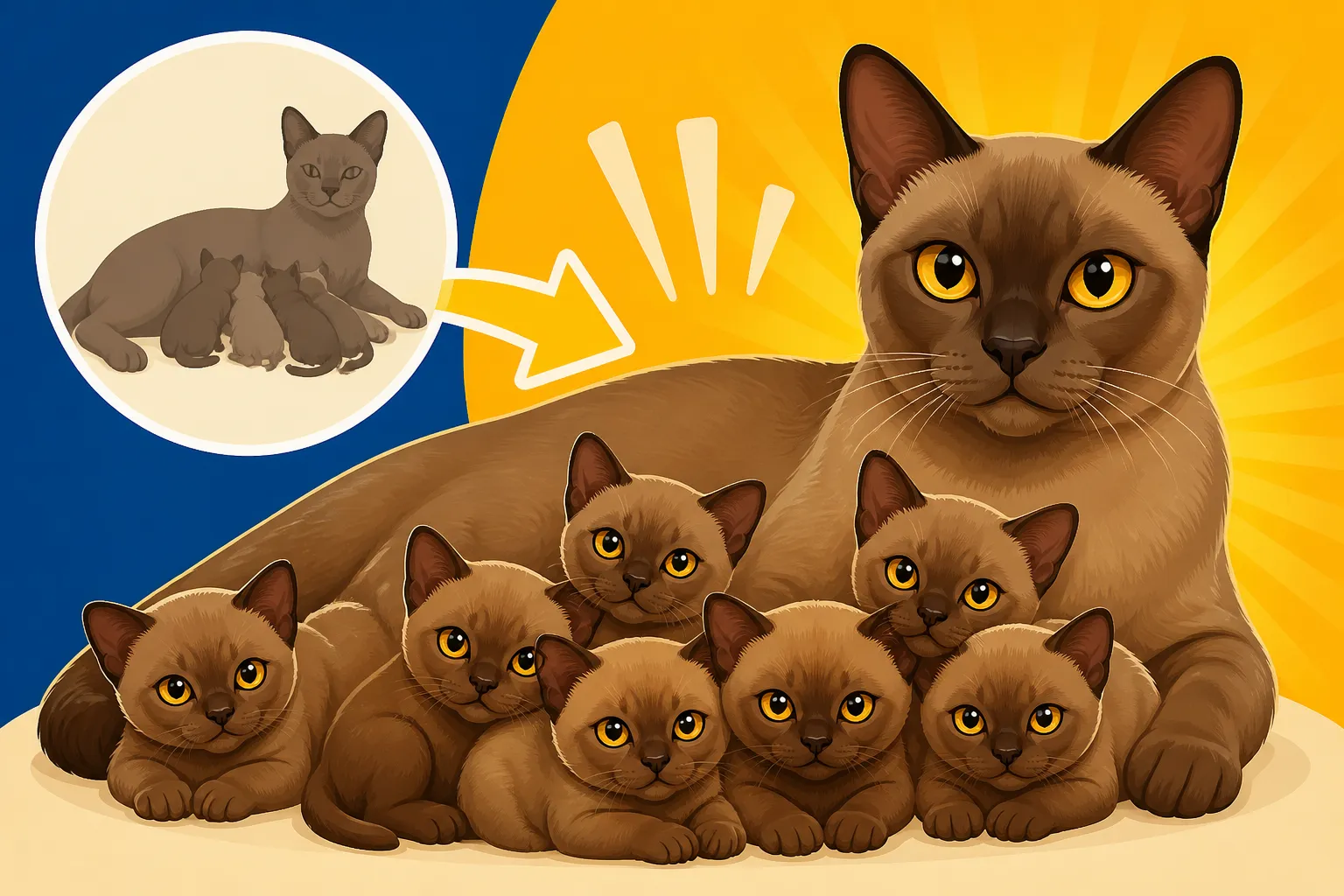
Why Burmese Litters Are Larger Than Most
A Burmese queen can surprise a first-time breeder with a busy nest, but a large litter is not guaranteed just because she is Burmese. Litter size varies with age, health, genetics, timing and chance. This guide explains why Burmese litters may be bigger than expected, what influences kitten numbers, and how to prepare for the practical demands of a crowded litter.
Why Burmese litters can be larger than expected
Burmese cats have a reputation for being prolific
Burmese breeders sometimes describe their queens as prolific, and some lines do produce generously sized litters. That reputation can make sense when breeders repeatedly see larger litters in their own cats. But it is not a promise about every Burmese queen, and it does not mean the breed always has more kittens than other cats.
A litter is the result of several factors coming together. A queen has to release eggs, the mating has to occur at a fertile time, and enough eggs have to be fertilized and implant successfully. Even among related cats, those conditions can differ from one pregnancy to the next. One Burmese queen may have a small litter in her first pregnancy and a larger one later; another may consistently have modest litters.
It also helps to remember that breeders are more likely to talk about unusually large litters than ordinary ones. A particularly full nest is memorable, and those stories can make larger litters sound universal. For a more grounded idea of variation, see How Many Kittens a Burmese Queen Has. The useful takeaway is that Burmese cats may be associated with large litters, but there is no fixed Burmese litter size.
Individual lines matter as much as breed reputation
A queen’s family history can offer clues, though it cannot predict an exact number of kittens. If her mother and close female relatives regularly had larger litters, that may be relevant when discussing breeding plans. The tom’s fertility and the pairing also matter: conception depends on both parents, not just the queen.
Responsible breeders keep records of matings, pregnancy outcomes, litter sizes and kitten health. These notes help them understand patterns in their own lines rather than relying on breed folklore. A breeder can tell you what has happened in a particular family, while being honest that a past litter is not a guarantee for the next one.
For anyone planning a mating, kitten numbers should never be the main measure of a successful pregnancy. A smaller litter of healthy, thriving kittens is preferable to a very large litter that leaves the queen exhausted or makes it difficult for every kitten to nurse well. Health screening, sound pairings and good care matter more than producing a record-breaking nest. What a Burmese Breeder Must Test Before Any Mating is a useful companion topic for understanding the health questions that belong in that conversation.
What affects the number of kittens in a Burmese litter
Age and reproductive history can play a role
A queen’s age and reproductive history can influence litter size, but there is no simple rule that applies to every cat. A first litter may be smaller than a later one for some queens, while others have similar numbers throughout their breeding years. Age, general health and the timing of the mating all contribute to the picture.
That uncertainty is one reason responsible breeders avoid treating a queen as a production schedule. Repeated pregnancies can place demands on her body, and she needs time to recover and maintain good condition. A queen’s wellbeing should guide breeding decisions—not the assumption that a Burmese can comfortably manage a large litter just because the breed has a reputation for being fertile.
When a pregnancy is confirmed, a veterinarian can advise on appropriate monitoring and care. The queen may need adjustments to her food intake as pregnancy progresses, but changing her diet or adding supplements without professional guidance is not a safe shortcut. A sound plan accounts for her condition, the stage of pregnancy and any health concerns.
Fertility and timing affect how many eggs are fertilized
A cat’s reproductive cycle and the timing of mating influence the chance of conception. Cats are induced ovulators, meaning mating commonly triggers ovulation. If mating and ovulation do not align as expected, fewer eggs may be fertilized. Even when fertilization occurs, not every embryo necessarily develops into a kitten.
These biological steps help explain why litter size can vary so much. A difference of a few days in timing, the queen’s reproductive response, or the fertility of either cat can change the outcome. It is not possible to look at a queen’s appearance or breed and reliably count the kittens before veterinary assessment.
Breeders and veterinarians may use examination or imaging to assess a pregnancy, but the timing and method matter. A scan can help identify a pregnancy and assess development, while later imaging may help estimate kitten numbers. Counts are not always exact, so it is sensible to prepare for some uncertainty rather than buying supplies for precisely one predicted litter size.
Nutrition supports pregnancy but does not determine litter size
Good nutrition supports the queen’s health and the growth of her kittens, but feeding more does not create a larger litter. Overfeeding can leave a queen carrying excess weight, while inadequate nutrition can compromise her condition. Her diet should be appropriate for pregnancy and nursing, with a veterinarian helping guide any transition.
If you are preparing for a litter, make practical arrangements early: a quiet, clean nesting area; washable bedding; a way to monitor the queen and kittens; and a plan for veterinary advice if something seems wrong. A small digital scale can help you track each kitten’s weight consistently. Chewy may be one place to look for basic supplies such as a scale or washable bedding, but ask your veterinarian or breeder what is suitable before buying specialized feeding products.
Avoid giving a newborn kitten milk intended for people or assuming that a commercial milk replacer is needed. A kitten that is not nursing well may need prompt assessment, and feeding support should follow veterinary guidance. For broader preparation around feeding and growth, What a Burmese Kitten Should Eat can help you think through the needs of kittens at different stages.
| Factor | How it may influence litter size | What an owner or breeder can do |
|---|---|---|
| Family history | Some lines may show recurring patterns, but they do not predict an exact number | Review records from the queen’s close relatives |
| Queen’s age and condition | Reproductive stage and overall health can affect pregnancy outcomes | Discuss her fitness for breeding and pregnancy care with a veterinarian |
| Mating and fertility | Timing and fertility in both cats influence how many eggs are fertilized | Use responsible breeding practices and keep accurate records |
| Nutrition | Supports the queen’s health and kitten development, but does not set kitten numbers | Feed an appropriate diet with veterinary guidance |
| Chance and embryo development | Not every fertilized egg develops into a kitten | Prepare for uncertainty and monitor the pregnancy professionally |
Why a large litter needs extra attention
More kittens mean more competition at the nest
In a large litter, kittens may compete more for access to the queen and her milk. The smallest kitten may be nudged away or have a harder time finding a comfortable nursing spot. That does not mean a large litter will automatically have problems, but it does mean each kitten needs to be observed rather than judging the nest by how lively it looks overall.
A breeder may check that every kitten is nursing, warm and gaining weight. Weighing kittens at consistent times and recording the results can reveal a problem before it is obvious from across the room. If one kitten repeatedly fails to gain, seems weak, feels cool or is pushed away from nursing, contact a veterinarian promptly. Newborn kittens can deteriorate quickly, so waiting to see whether the issue resolves itself can be risky.
It can be tempting to intervene with extra feeding right away, particularly when one kitten looks smaller. But feeding technique, milk choice and the kitten’s ability to swallow all matter. Get veterinary advice before supplementing, especially if the kitten is weak or struggling to feed. For a closely related newborn concern, read Why a Burmese Kitten's Chest Should Be Checked at Birth.
The queen needs recovery time and a calm environment
A queen caring for many kittens may spend much of her time nursing and grooming them. She needs easy access to food, fresh water and a clean litter tray, without having to leave the nest for long. A calm room, regular checks and minimal disruption can help make the space more comfortable for her.
A large litter can also be tiring for the people caring for it. You may need to keep more detailed notes, wash bedding more often and arrange help if the queen or kittens need veterinary attention. Having a plan before birth is easier than trying to source basic supplies while worried about a kitten that is not feeding. Chewy can be a convenient retailer to check for everyday items such as spare bedding or food-storage containers; keep any medical or feeding decisions between you and your veterinarian.
The queen’s behavior is worth watching, too. A sudden loss of appetite, unusual weakness, distress, or seeming unable to care for the kittens deserves professional attention. So does a kitten that is persistently crying, isolated from the nest or not feeding. A quiet, settled nest is reassuring, but it should not replace hands-on checks.
Preparing for a Burmese litter and setting realistic expectations
Plan for a range of outcomes
If you are a prospective kitten owner, ask the breeder how many kittens previous queens in that family have had, whether the current litter has been examined, and how they monitor kitten development. A careful breeder will not promise a particular number—or use a large litter as proof of superior breeding. They should be able to describe the care each kitten receives and explain how they respond if one needs extra help.
If you are a breeder, plan for more kittens than you expect without assuming that every pregnancy will be large. Have a clean nesting area ready, make sure the queen can reach food and water comfortably, and keep your veterinarian’s contact details easy to find. Keep a written record of kitten weights and any concerns so that small changes are less likely to slip by during a busy day.
Before kittens go to their new homes, their development and socialization matter as much as the number in the litter. They need appropriate handling, health checks and time to mature. Why Burmese Kittens Are Sold at Thirteen Weeks explains why an early handover is not simply a matter of convenience, while What a Burmese Kitten's First Exam Should Cover can help new owners know what to discuss at the first veterinary visit.
Buy essentials carefully and avoid unnecessary interventions
A few practical supplies can make routine care easier: clean bedding, a reliable way to weigh kittens, a suitable carrier and a notebook or digital record for observations. Chewy may help you find basic household and pet-care supplies, but it is not a substitute for advice about a kitten’s health. If you are unsure whether a product is appropriate for newborns, check with your veterinarian before using it.
Do not assume that every kitten needs bottle-feeding, extra supplements or separation from the queen. Unnecessary intervention can create stress and may interfere with normal nursing. On the other hand, a kitten that is cold, weak, not nursing or failing to gain weight needs prompt attention. The best approach is neither to panic at every small difference nor to dismiss a genuine change as normal litter variation.
Most importantly, remember that the queen is an individual. Burmese ancestry may help explain why some breeders encounter large litters, but it cannot tell you exactly how many kittens she will have or how much support they will need. Prepare for the possibility of a crowded nest, monitor each kitten, and let the queen’s health and the kittens’ progress—not a breed stereotype—guide your decisions.
Disclaimer
This article is for general informational purposes only and does not constitute professional advice. Laws, prices and regulations vary by location and change over time. Consult a qualified professional for guidance on your specific situation.