Why the Burmese Standard Was Rewritten in the 1980s
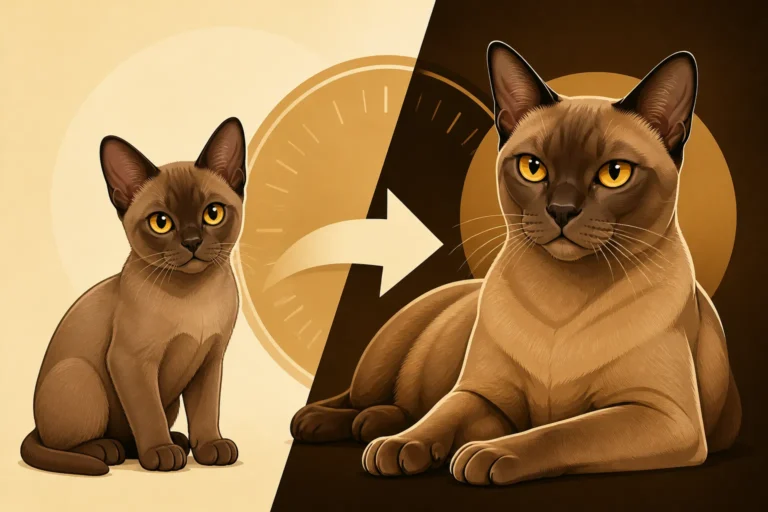
When you compare an early Burmese photograph with a modern show cat, the difference can be startling: the head may look rounder, the muzzle shorter, and the body more compact. That shift did not happen overnight. This guide explains why the Burmese standard was rewritten in the 1980s, what the changes clarified, and why breeders and registries did not all interpret Burmese type in exactly the same way.
Why the Burmese standard changed
A breed standard is a written guide to the appearance and qualities a registry considers desirable. It gives breeders a shared target and helps judges assess cats in the show ring. It is not a description of every Burmese, nor does revising it suddenly change the cats themselves. The standard changes on paper; breeders’ choices over generations shape how the breed looks.
The Burmese had already developed a distinct identity by the time the 1980s revisions came into view. The early breed descended from a small founding population, and its appearance evolved as breeders selected cats that fit their idea of Burmese type. A standard written for an emerging breed could not always capture the finer distinctions that became important as the population and show scene grew.
The original standard had to keep pace with the breed
The Burmese story in the United States began with Wong Mau, a cat brought to San Francisco in the early twentieth century. Early breeding work helped establish the breed, but the cats of that period did not necessarily look exactly like the Burmese seen in modern show rings. Photos and written descriptions from different decades can show gradual changes in head shape, body proportions, and overall presentation. For background, see What the First Burmese Looked Like and When the First Burmese Standard Was Written.
As the breed became established, breeders and judges needed clearer language for assessing it. Terms such as “rounded,” “compact,” or “moderate” can sound straightforward, but they leave room for interpretation. One judge may consider a head sufficiently rounded; another may prefer a more pronounced roundness. When those judgments affect which cats win, breed and registry communities have reason to make the wording more specific.
The 1980s rewrite is often discussed as a milestone in that process, particularly in relation to the American Burmese. It is better understood as a formal clarification and refinement of the desired type than as a moment when the breed was reinvented. Burmese cats had already been changing through selective breeding; the written standard helped define which direction the show community was expected to reward.
Breeders wanted a more recognizable Burmese type
A standard needs to distinguish a breed from other cats, including closely related breeds and cats with similar coloring. A Burmese can be brown, blue, champagne, or platinum in the American standard, but color alone does not establish type. The overall combination of head, eyes, body, coat, and expression is what makes a cat recognizable as Burmese.
Breeders also wanted consistency. If judges used different mental pictures of the ideal Burmese, the results could seem unpredictable to exhibitors. Clearer standards gave judges a common reference point and gave breeders a more defined goal when deciding which cats to pair. The aim was not simply to make every Burmese look identical; it was to describe the qualities that should remain recognizable across individual cats.
That goal became especially important as the American and European Burmese developed along different paths. The standards and the cats they describe are related, but they are not interchangeable. The history of that divergence is explained in How the American and European Burmese Split.
What the rewrite clarified about appearance
The most visible discussions around Burmese type often center on the head. That is understandable: the face has a strong effect on a cat’s expression, and small differences in head shape can make two cats look quite unlike one another. But a standard describes the whole cat, not just its face. Body, proportion, coat, eye color, and balance all contribute to the desired appearance.
| Feature | What a standard helps clarify | Why it matters |
|---|---|---|
| Head shape | The preferred outline and degree of roundness | Helps define the Burmese expression and distinguish type |
| Muzzle | The desired shape and relationship to the rest of the face | Supports the overall head balance rather than standing alone |
| Eyes | Shape, placement, and preferred color | Influences expression and is assessed as part of the head |
| Body | General build, proportion, and substance | Keeps the cat’s outline balanced with its head |
| Coat | Texture, close-lying appearance, and color expectations | Helps describe the breed’s overall presentation |
| Overall balance | How the features work together | Prevents a single exaggerated feature from defining the whole cat |
Head shape became a central point of definition
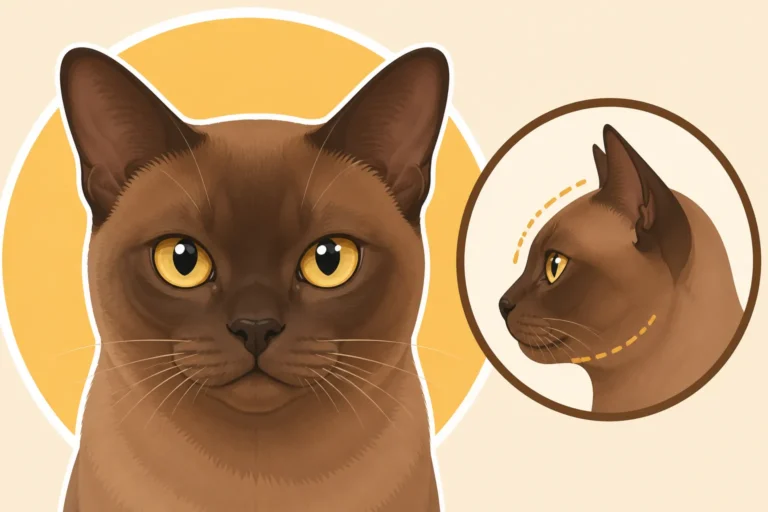
In the American Burmese, the head is described as rounded, with the eyes contributing to a soft, open expression. The muzzle and other facial features are judged in relation to the entire head rather than as isolated parts. The standard is not an invitation to pursue the most extreme version of any one feature. It is a description of a balanced Burmese head. For a closer look at that ideal, see What an American Burmese's Head Should Look Like and How a Burmese's Head Is Judged.
That distinction matters when people compare a show cat with an older photograph. A rounder-looking head may reflect several things at once: the angle of the photograph, the cat’s age, its individual features, and generations of selective breeding. A picture cannot establish that a cat is poorly bred or that a standard has been misapplied. It is one visual record, not a full assessment.
The wording also gives judges a shared vocabulary. “Round” does not mean that every feature should be pushed to an extreme, and “short” or “compact” does not mean that proportion no longer matters. A judge evaluates whether the features fit together in the way the standard describes. That balance is part of what a revision can make easier to discuss.
A standard covers more than the face
The Burmese is often described as a muscular, substantial cat that can feel heavier than its appearance suggests. That body type is part of its character as a breed, but it needs to sit in proportion with the head and limbs. A cat with a desirable head but poor overall balance would not represent the full standard simply because one feature stood out.
The coat also matters. Burmese coats are short and close-lying, with a smooth appearance that complements the body rather than obscuring its outline. Color and eye color contribute to the presentation, too. For example, the standard’s expectations for eye color are part of the breed description, not a decorative afterthought.
This broader view helps explain why a standard rewrite should not be reduced to “the head got rounder.” Head shape may attract the most attention, but the written ideal is a coordinated set of traits. A careful judge considers how those traits work together.
Why the American and European Burmese are not judged identically
The words “Burmese standard” can sound as if there is one universal document used everywhere. In practice, standards are associated with particular registries, and Burmese type has developed differently across regions. The American and European Burmese share ancestry, but their standards describe different preferred appearances. The distinction is not merely a matter of calling the same cat by two names.
A revision in one registry should not automatically be treated as a change adopted by every other registry. The language, show rules, and preferred type can vary. This is why discussions about the 1980s rewrite sometimes become confusing: a person may be referring to a particular registry’s standard, while someone else is thinking of a different Burmese tradition.
The American type emphasizes its own distinct ideal
The American Burmese standard describes an appearance that breeders and judges have shaped over many generations in the United States. It gives particular attention to the breed’s head, expression, and compact, muscular build. When people discuss the 1980s revision, they are often talking about changes that formalized or sharpened expectations for this American show type.
This does not mean every American Burmese looks the same. Standards describe an ideal, while real cats vary. A pet Burmese may have a more moderate head or a different body outline than a show winner and still be unmistakably Burmese. The standard is primarily a judging and breeding reference, not a checklist that determines whether a cat deserves affection or belongs in a home.
The distinction is also useful for prospective owners who see different Burmese cats online and wonder whether one of them is “wrong.” Before drawing conclusions from appearance, it helps to know which registry and type the breeder is working with. What the American Burmese Standard Asks For explains the American standard’s general approach.
The European standard reflects a separate development
European Burmese cats are judged according to a different ideal, shaped by breeding history and the standards used by the registries that recognize them. The European type is often described as more moderate in some features than the American show ideal, though individual cats and standards still need to be assessed on their own terms. What a European Burmese Standard Asks For gives more detail about those expectations.
The divergence did not mean that one type was automatically better or that one was a mistake. It reflected different breeding and judging traditions. Some organizations treat the types as distinct for registration or competition purposes, and breeders generally work within the rules of their chosen registry. For an account of the dispute behind those differences, see Why Britain Rejected the American Burmese Type.
This regional distinction helps put the 1980s revision in context. Rather than representing a global decision about every Burmese, it belonged to a larger history in which breeding communities defined their own preferred type. When readers encounter conflicting descriptions, checking which registry the writer means can resolve much of the apparent contradiction.
What the rewrite meant for breeders and owners
A revised standard influences decisions over time. Breeders may use it when selecting cats for future litters, and judges use it when comparing entries. But a standard does not guarantee that every breeder follows the same priorities or that every cat in a litter will match the show ideal. Genetics, individual variation, and the breeder’s goals all matter.
For owners, the rewrite is useful mainly as historical context. It explains why today’s show Burmese may look different from cats in older books or photographs. It can also help when comparing descriptions from different countries. It does not mean that a Burmese with a more moderate appearance is unhealthy, poorly cared for, or somehow less of a companion.
Standards guide breeding choices without replacing health priorities
A show standard describes desired appearance, but responsible breeding has wider responsibilities. Breeders also need to consider temperament, health, genetic diversity, and the welfare of their cats. A cat’s suitability as a companion cannot be judged by head shape alone, and a breeding decision should not be based on a show result alone.
This is one reason standards are best read as a framework rather than a promise. A breeder may explain how their cats fit a particular registry’s ideal, but prospective owners should also ask about health screening, kitten socialization, and the parents’ history. Those questions are relevant whether a cat is intended for the show ring or a family home.
The standard can also change how people talk about breed quality. If someone says a Burmese is “more correct,” it is reasonable to ask what they mean: correct under which registry’s standard, and in which specific traits? A precise answer is more helpful than a vague comparison based on photographs or personal preference.
Older photographs need to be read with care
Historical images are valuable, but they can mislead if treated as direct, like-for-like comparisons. Camera quality, lighting, pose, and the cat’s age all influence what the image appears to show. A profile photograph may emphasize a muzzle or forehead differently from a front-facing portrait. Even coat color can look different under varied lighting.
It is also easy to mistake a gradual change for a sudden one. Breeding trends develop across generations, and written standards often formalize ideas that breeders have already been discussing. A revision in the 1980s did not make every Burmese cat look different the following year. Instead, it helped create a clearer target for breeders and judges over time.
When comparing a cat to a standard, use the standard written for the correct registry and type. Then consider the whole cat: head, body, coat, color, and balance. That approach is more reliable than deciding from one feature or a single old photograph.
The lasting significance was clearer language
The rewrite matters because breed standards shape how people define and preserve a breed. In the Burmese, clearer language helped describe a particular show ideal at a time when the breed’s appearance and regional differences were attracting attention. It also left a useful record of how breeding communities understood Burmese type.
It did not erase the breed’s earlier history or create a single appearance that all Burmese cats must have. Instead, it made the expectations of a particular standard more explicit. The continuing differences between American and European Burmese standards show why the registry context remains important.
So, when someone asks why the Burmese standard was rewritten in the 1980s, the clearest answer is that breeders and judges needed a more defined description of the type they were selecting and rewarding, especially in the American Burmese. The rewrite helped articulate that ideal. The cats themselves changed through gradual breeding decisions, while the standard put those preferences into words.
Disclaimer
This article is for general informational purposes only and does not constitute professional advice. Laws, prices and regulations vary by location and change over time. Consult a qualified professional for guidance on your specific situation.