How the Tonkinese Was Made From a Burmese
Many people adore the Tonkinese cat, drawn to their striking looks and wonderfully social personalities, but few truly understand the fascinating genetic journey that brought this breed into existence. It's not a tale of independent discovery, but rather an intriguing chapter born directly from the early development of the Burmese cat itself, showcasing how breeders, through careful observation and a little genetic luck, created a beloved new companion. This guide will take you through the captivating history, the genetic underpinnings, and the dedicated efforts that saw the Tonkinese emerge as a distinct and cherished breed, bridging the gap between its Burmese and Siamese ancestors.
The Unexpected Origin of the Tonkinese
The story of the Tonkinese cat doesn't begin with an intention to create a new breed, but rather with the quest to establish the Burmese breed itself. It's a fascinating origin story, deeply intertwined with the genetic experiments of the early 20th century. What began as a scientific endeavor to understand feline coat color genetics ultimately revealed the potential for an entirely new, captivating cat.
Wong Mau: The Catalyst Cat
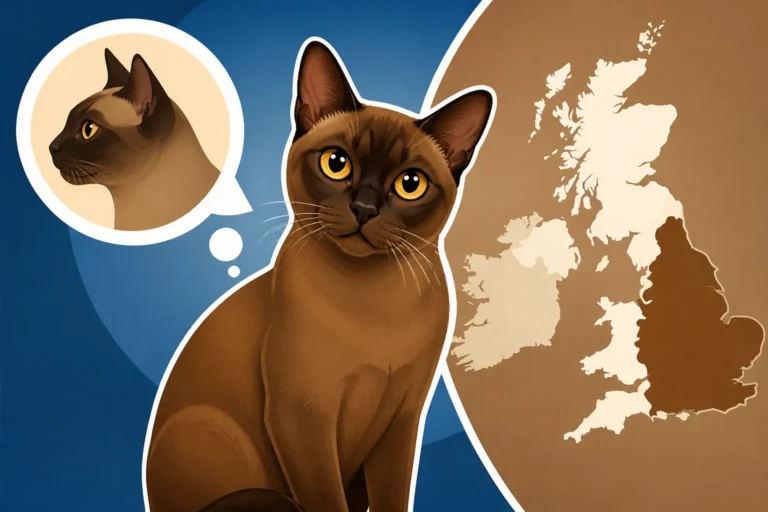
The genesis of the Tonkinese, ironically, lies with a single cat named Wong Mau, who arrived in San Francisco in 1930. This mysterious feline, brought from Burma (now Myanmar) by Dr. Joseph C. Thompson, was the foundation queen of the Burmese breed. Wong Mau wasn't just another pretty face; she possessed a unique coat color – a rich, warm brown that was darker than a Siamese but lighter than a solid black cat. Dr. Thompson, intrigued by her distinctive appearance, embarked on a breeding program to understand and solidify these traits. For a more detailed look into her origins, you might enjoy reading The Burmese Began With One Cat Called Wong Mau.
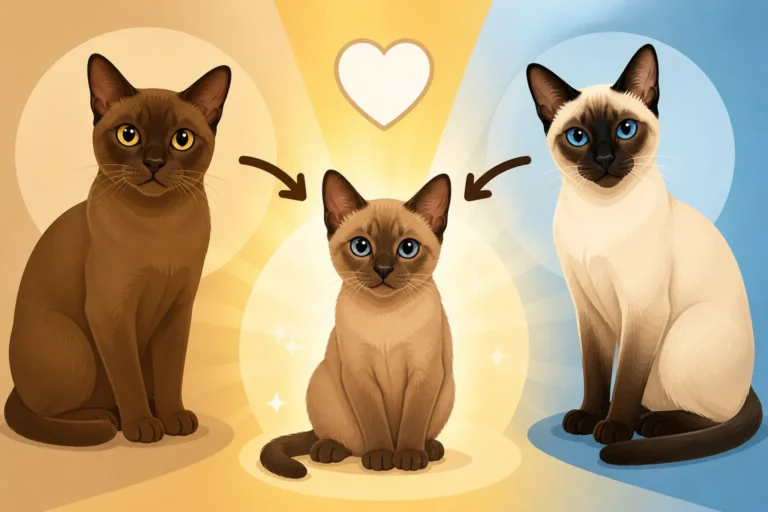
When Dr. Thompson bred Wong Mau, he initially crossed her with a Siamese cat. Why a Siamese? Because at the time, there were no other cats quite like Wong Mau in the West, and the Siamese was the closest available type to help unravel her genetic makeup. This initial cross was crucial, and what happened next was truly eye-opening. The first litter from this pairing revealed something unexpected: not just kittens that looked like Wong Mau or pure Siamese, but also kittens with an intermediate coat pattern and color. These "hybrid" kittens possessed a softer, warmer body color than a Siamese, with points (ears, face, paws, tail) that were less starkly contrasted than a Siamese but more defined than a Burmese. This intermediate type was, in fact, the very first glimpse of what would later become the Tonkinese. Dr Joseph Thompson and the Burmese He Bought in 1930 offers further insight into Dr. Thompson's pivotal role.
Dr. Thompson's Initial Breeding Program
Dr. Thompson's primary goal was to isolate and stabilize Wong Mau's unique "brown" coloration, which he believed represented a distinct genetic trait. To achieve this, he continued to breed Wong Mau back to her own offspring and to other Siamese cats. As the breeding program progressed, the kittens consistently showed three distinct patterns: some were solid brown like Wong Mau (these would become the Burmese), some were pointed like a Siamese, and crucially, some exhibited that intermediate "mink" pattern. This pattern was neither fully pointed nor fully solid, but a beautiful blending of the two.
It was in these early litters that the genetic secret of the Burmese (and by extension, the future Tonkinese) began to unfold. Dr. Thompson meticulously documented his findings, demonstrating that Wong Mau was not a purebred Burmese as we understand it today, but rather carried two distinct color alleles: the gene for Burmese coloration (cb) and the gene for Siamese coloration (cs). When she was bred to a Siamese (which carries two copies of the cs gene), the resulting kittens inherited different combinations. Those inheriting two cb genes would be Burmese, those inheriting two cs genes would be Siamese, and those inheriting one cb and one cs gene would be the intermediate "mink" type – the Tonkinese. This insight into What the First Burmese Litter Told Thompson was groundbreaking. For many years, these intermediate cats were simply considered hybrids or "Tonkanese" (an early, informal term) within the Burmese breeding programs, often used to help maintain genetic diversity or to re-introduce the Burmese color when a pure Burmese line was hard to find. It wasn't until decades later that breeders realized these beautiful cats deserved their own recognition. Some even pondered Whether the First Burmese Was Really a Tonkinese due to this initial mixed genetic makeup.
The Genetic Bridge: Burmese, Siamese, and the Tonkinese
Understanding the Tonkinese means diving a little into the fascinating world of feline genetics, specifically the colorpoint gene. The Tonkinese isn't just a pretty mix; it's a living example of how two distinct genetic traits can combine to create something entirely new and beautiful.
Understanding the Burmese Color Gene
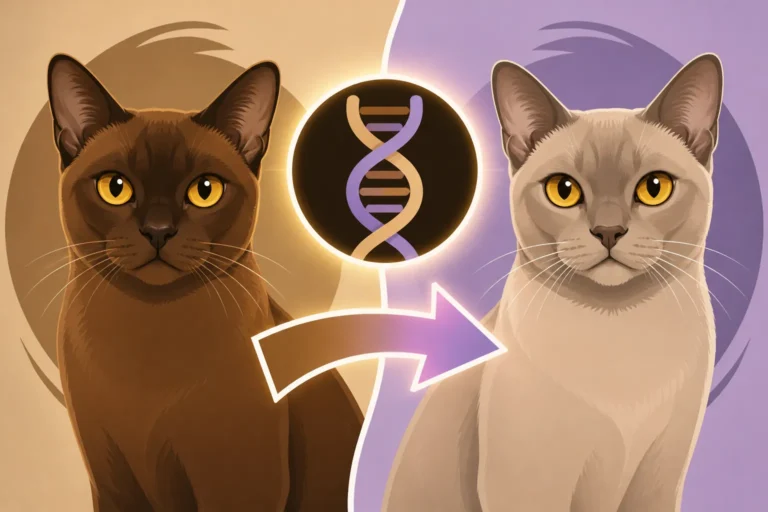
The unique brown color of the Burmese cat, known as sable in the American standard and brown in the European, is due to a specific gene called the Burmese color restriction gene, or cb. This gene causes a partial restriction of pigment development at normal body temperatures, meaning that the cat's extremities (ears, face, paws, tail) appear slightly darker than the warmer core body. However, the restriction isn't as pronounced as in the Siamese. So, while a Burmese might appear solid brown at first glance, a closer look reveals subtle shading, a beautiful depth of color that's truly unique. You can learn more about this by reading The cb Allele Is What Makes a Burmese Brown.
This gene is co-dominant with the Siamese color restriction gene (cs). Co-dominance means that when both genes are present, they both express themselves, rather than one completely masking the other. Imagine it like mixing two paint colors – you get a new color that incorporates aspects of both. This genetic interaction is key to the Tonkinese's appearance. The Burmese's rich, warm brown, combined with its compact, muscular build and extremely affectionate nature, laid a strong foundation for any offspring. If you want to understand the typical appearance, What a Burmese Looks Like Against the Standard gives a good overview.
The Hybrid Vigor of the First Crosses
When Dr. Thompson initially bred Wong Mau to a Siamese, he was essentially creating a first-generation hybrid. The Siamese cat possesses two copies of the cs gene, which results in a much more extreme form of temperature-dependent pigment restriction. Their bodies are very pale, and their points are starkly dark. This is Why a Burmese Is Brown and a Siamese Is Pointed. When a Burmese (carrying cb/cb) is bred to a Siamese (cs/cs), all the resulting kittens will inherit one cb gene from the Burmese parent and one cs gene from the Siamese parent. Their genetic makeup would be cb/cs.
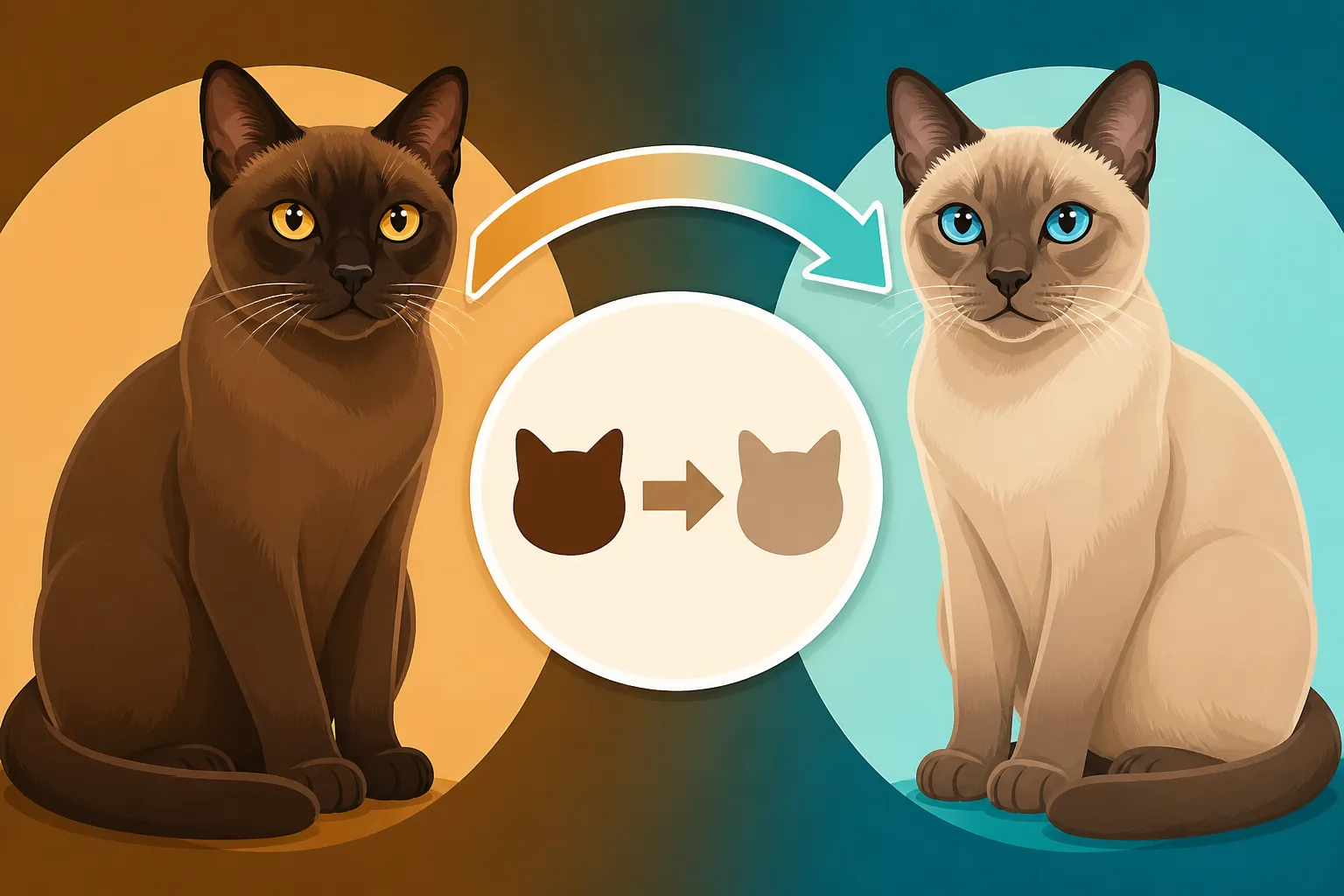
These cb/cs kittens are what we now recognize as Tonkinese. This genetic combination results in a "mink" pattern – a coat color that is distinctly intermediate between the Burmese and Siamese. The body color is richer and warmer than a Siamese, but lighter than a Burmese, with points that are clearly defined but blend more smoothly into the body color compared to the sharp contrast seen in a Siamese. Their eye color, often an aqua blue-green, is another beautiful intermediate trait, distinct from the blue eyes of a Siamese or the gold/green eyes of a Burmese. This initial cross also highlighted What Happens When Burmese and Siamese Genes Meet, showing the predictable genetic outcomes. It's a testament to the scientific approach in early cat breeding that these distinct genetic pathways were so well understood.
The 'Mink' Pattern Emerges
The cb/cs genetic combination is responsible for the captivating "mink" pattern that is the hallmark of the Tonkinese. Unlike the solid appearance of a homozygous Burmese (cb/cb) or the high contrast points of a homozygous Siamese (cs/cs), the Tonkinese displays a more blended, muted point coloration. The body color is a warm, almost luminous shade, and the points are noticeably darker but not sharply defined. Think of it as a subtle gradient rather than a stark contrast.
This unique pattern also often comes with those stunning aqua eyes, a trait almost exclusive to the Tonkinese. It's truly a perfect genetic compromise, capturing the best of both worlds. The term "mink" itself evokes the luxurious, soft, and slightly iridescent quality of their fur. These cats were not just a random occurrence; they consistently appeared in crosses between Burmese and Siamese, demonstrating a predictable genetic outcome. For a long time, these beautiful cats were bred purely as a stage in breeding programs, helping to introduce genetic diversity or refine lines. It took passionate individuals to recognize their inherent beauty and consistent traits as worthy of their own breed status. Understanding Why the Tonkinese Sits Between Burmese and Siamese helps to appreciate this unique genetic expression.
Distinguishing the Tonkinese from its Ancestors
While the Tonkinese owes its existence to the Burmese and Siamese, it has developed its own distinct set of characteristics, setting it apart from its parent breeds in both appearance and personality. This distinctiveness is what ultimately led to its recognition as a unique breed.
The Unique Appearance of a Tonkinese
Physically, the Tonkinese is a beautiful blend, often described as having the best features of both its ancestors. They possess a medium-sized, muscular body that is often heavier than it looks, much like the Burmese, giving them a surprising heft when picked up. Their body is less svelte and angular than a Siamese, but not as compact and cobby as some extreme Burmese types. They have a more moderate head shape, not as round as the American Burmese nor as wedge-shaped as the Siamese. Their ears are medium-sized and set neither too high nor too low.
The most defining visual trait, as we've discussed, is their coat. The "mink" pattern offers a spectrum of colors, including natural mink (a medium brown with darker brown points), blue mink (a blue-gray body with slate blue points), champagne mink (a warm beige with lighter brown points), and platinum mink (a pale silver-gray with darker gray points). Each color variation displays that characteristic subtle contrast. Their fur is short, fine, and incredibly soft, feeling like velvet to the touch. Their eyes are truly captivating, typically a luminous aqua, a shade of blue-green that is rarely seen in other breeds. This aqua eye color is a strong indicator of the cb/cs genetic makeup and helps differentiate them immediately. A good way to visualize the differences is to compare How to Tell a Burmese From a Tonkinese.
Temperament: A Blend of Both Worlds
When it comes to personality, the Tonkinese is often said to be the perfect "middle ground" between the boisterous, demanding Siamese and the gentle, velcro-like Burmese. They are incredibly affectionate and people-oriented, thriving on human interaction and often following their favorite people from room to room. Like the Burmese, they are known for their profound loyalty and desire to be involved in whatever you're doing. They love to cuddle under the covers and demand attention, but perhaps with a little less vocal insistence than a Siamese.
However, they also possess a playful, mischievous streak, inherited from both sides of their family tree. Tonkinese cats are intelligent, curious, and love to play games, often engaging in fetch or learning tricks with ease. They maintain a kitten-like playfulness well into adulthood, keeping their families entertained with their antics. They are also known for their surprisingly strong voices, often described as a throaty "Tonkinese rumble" rather than a harsh meow, capable of holding a conversation. This balanced temperament makes them wonderfully adaptable companions for families with children, other cats, and even cat-friendly dogs. Providing enrichment toys and cat trees, perhaps from a reputable retailer like Chewy, can keep these intelligent cats mentally stimulated and happy. They truly are the best of both worlds, possessing the warmth and devotion of the Burmese alongside the playful intelligence of the Siamese.
Establishing the Tonkinese as a Separate Breed
Despite their early appearance in breeding programs, it took dedicated efforts from passionate breeders to elevate the Tonkinese from a mere hybrid to a recognized and celebrated breed in its own right. This process involved careful selection, advocacy, and navigating the sometimes-strict rules of cat registries.
Early Recognition Challenges and Triumphs
For many years, the Tonkinese, or the cb/cs cats as they were genetically known, were primarily used in Burmese breeding programs. Breeders would cross a Burmese with a Siamese to produce these mink-colored kittens, often with the intent to then breed those mink cats back to pure Burmese to refresh bloodlines or to introduce desired traits. The challenge was that many cat associations at the time had strict definitions of "purebred" and were hesitant to recognize a breed that was explicitly a hybrid of two already established breeds. There was also a lingering debate from the early days of the Burmese regarding Why the Founding Burmese Produced Two Breeds, with the Tonkinese being the second, albeit initially unacknowledged, outcome.
However, the undeniable charm, consistent appearance, and wonderful temperament of the mink cats captivated a growing number of enthusiasts. Breeders like Jane Barletta in North America and others in Canada and Europe began to see the potential for a new, distinct breed. They recognized that the Tonkinese wasn't just an intermediate step but a stable, unique entity. They started forming breed clubs and working diligently to establish a breeding standard that would differentiate the Tonkinese from both the Burmese and the Siamese. This was a slow process, involving consistent breeding for specific traits and presenting these cats to registry judges. The tireless efforts eventually paid off, leading to initial recognition in the 1970s and 80s from major cat associations.
The Dedication of Breed Developers
The journey to full breed recognition for the Tonkinese was a true labor of love, requiring immense dedication and a clear vision from its early proponents. These breeders weren't just crossing cats; they were meticulously tracking pedigrees, documenting genetic outcomes, and working to ensure that the Tonkinese consistently reproduced its unique characteristics. They focused on refining the "mink" pattern, ensuring the correct aqua eye color, and developing a specific body type that was neither too cobby nor too svelte, aiming for that athletic, muscular feel that is now characteristic of the breed.
One of the significant decisions was to establish a breeding program that would allow for three distinct genetic pairings: Burmese x Burmese (producing pure Burmese), Siamese x Siamese (producing pure Siamese), and Burmese x Siamese (producing Tonkinese). Crucially, the Tonkinese could also be bred to another Tonkinese, which would result in a litter that could include all three types: Burmese, Siamese, and Tonkinese, due to the co-dominant nature of the cb and cs genes. This approach, while complex, ensured genetic diversity and solidified the Tonkinese's place as a truly distinct breed rather than just a first-generation cross. Many breeders today continue to work with these guidelines, carefully planning pairings to produce healthy, typey Tonkinese cats. Resources available through places like Chewy or specific breed clubs can help new owners understand the dietary and enrichment needs specific to the breed. The success of the Tonkinese is a testament to these early pioneers who saw beyond the traditional definitions and championed a truly unique feline companion. For further reading, it's interesting to compare this journey with How the Bombay Was Made From a Burmese, another distinct breed also descended from the Burmese, showcasing the versatile genetics of the foundational cats.
Living with a Tonkinese: A Legacy of Companionship
Bringing a Tonkinese into your home means embracing a whirlwind of affection, playfulness, and unwavering companionship. Their unique heritage has blessed them with a combination of traits that makes them truly special family members.
Meeting the Tonkinese's Needs
A Tonkinese thrives on interaction and connection. These aren't cats content to simply coexist in the background; they want to be part of your life, involved in your activities, and sharing your space. Their strong desire for companionship means they do best in homes where they aren't left alone for long periods. If you have a busy household or work outside the home, considering a pair of Tonkinese (or another cat-friendly companion) is often recommended. This way, they can keep each other company, fulfilling their social needs even when their human family is away. Just like their Burmese ancestors, they have a tendency to get lonely and anxious if isolated.
Their playful nature means they need plenty of mental and physical stimulation. Interactive toys, regular play sessions with their humans, and even puzzle feeders can help keep their intelligent minds engaged. They are often willing to learn tricks, walk on a leash, or play fetch, making them highly interactive pets. When it comes to nutrition, a high-quality diet is important for their muscular build and energy levels. Many Tonkinese, like Burmese, can have a hearty appetite, so monitoring their food intake and choosing appropriate foods (perhaps exploring the variety of brands and types on Chewy) is crucial to maintain a healthy weight. Their short, soft coat is low-maintenance, requiring only occasional brushing to keep it glossy and free of loose hairs.
Why the Tonkinese Has Such Enduring Appeal
The Tonkinese cat has cemented its place in the hearts of cat lovers around the world because it truly offers a harmonious blend of the best traits from its illustrious ancestors. They possess the deep affection and devotion of the Burmese, often described as "lap barnacles" or "shoulder riders," combined with the intelligence, curiosity, and playful spirit of the Siamese. Their moderate voice is a pleasant compromise between the gentle purr of a Burmese and the vocal exuberance of a Siamese.
Moreover, their distinctive "mink" coat and mesmerizing aqua eyes are simply beautiful, providing a unique aesthetic that sets them apart. They are robust, generally healthy cats with a good lifespan, provided they receive proper care and attention. Their adaptability and gentle nature make them excellent companions for a wide range of living situations, from bustling family homes to quieter environments, as long as they are given ample love and attention. The story of the Tonkinese is a wonderful testament to genetic science, dedicated breeders, and the sheer joy that these remarkable cats bring into our lives, proving that sometimes, the best discoveries are made when you're looking for something else entirely.
Breed Trait Comparison: Burmese, Tonkinese, and Siamese
To truly appreciate the Tonkinese, it's helpful to see how its characteristics stack up against its founding breeds. This table highlights some key differences and similarities.
| Trait | Burmese (cb/cb) | Tonkinese (cb/cs) | Siamese (cs/cs) |
|---|---|---|---|
| Body Type | Stocky, compact, muscular; "brick wrapped in silk" | Medium, muscular, athletic; intermediate | Svelte, elegant, long, lean, tubular |
| Head Shape | Round, broad, medium muzzle | Moderate wedge, gentle contours; intermediate | Long, tapering wedge |
| Coat Pattern | Solid (sable, blue, champagne, platinum), subtle shading at points | Mink (body lighter than points, blended contrast) | Pointed (pale body, dark, sharply defined points) |
| Eye Color | Gold to green | Aqua (blue-green) | Deep sapphire blue |
| Vocalization | Soft, raspy rumble; often quiet | Conversational, "Tonkinese rumble"; moderate volume | Loud, demanding "Meezer" voice; very vocal |
| Temperament | Extremely affectionate, docile, loyal, "velcro cat" | Affectionate, playful, intelligent, interactive; balanced | Active, demanding, intelligent, outgoing, can be loud |
This comparison clearly illustrates How a Burmese Differs From a Tonkinese and how the Tonkinese truly sits as a distinct bridge between its two parent breeds, inheriting unique qualities from each while forging its own identity.
Disclaimer
This article is for general informational purposes only and does not constitute professional advice. Laws, prices and regulations vary by location and change over time. Consult a qualified professional for guidance on your specific situation.