How to Tell a Burmese From a Tonkinese
A Burmese and a Tonkinese can look remarkably alike: both are affectionate, short-coated cats with muscular bodies and expressive eyes. The confusion is understandable, especially when you’re looking at kitten photos or an adult without pedigree papers. This guide explains the differences in build, head shape, coat pattern, eye color, and documentation—and shows where appearance alone can’t settle the question.
Start with the biggest difference
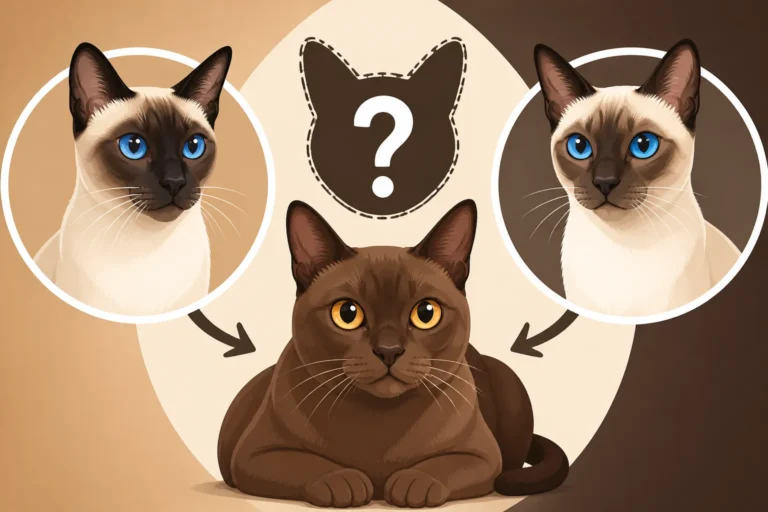
A Tonkinese has Burmese and Siamese ancestry
The Tonkinese developed from Burmese and Siamese cats, so it naturally sits between the two in appearance. Many Tonkinese have the Burmese cat’s solid, muscular feel combined with a more moderate, wedge-shaped head and the color pattern associated with Siamese cats. That blend is why a quick glance can leave you unsure which breed you’re seeing.
The Burmese, by contrast, is a distinct breed with its own standards and type. A Burmese may look compact and rounded, but it is not simply a Tonkinese with a darker coat or a Burmese-Siamese cross. Breed identity comes from pedigree and breeding history, not just a resemblance to one side of the family tree.
This connection also explains some of the confusing language around color. The Burmese color gene affects how pigment appears across the coat, while the Tonkinese’s coat patterns reflect different combinations of color-point genetics. For a closer look at the background, see Why the Tonkinese Sits Between Burmese and Siamese and What Happens When Burmese and Siamese Genes Meet.
Their build often gives you a useful first clue
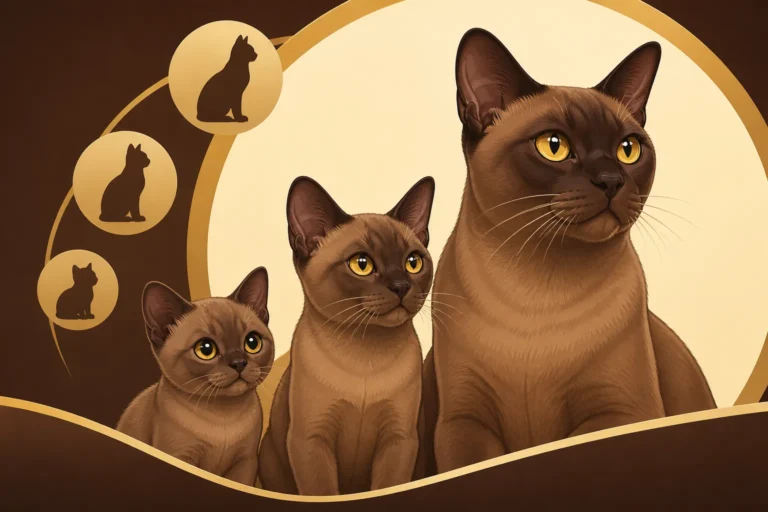
A Burmese is famously solid for its size. Pick one up, and it may feel heavier than its compact outline suggests—a quality often described as a “brick wrapped in silk.” Its body is generally muscular, with a broad chest and sturdy legs. The coat is short and close to the body, so there is little fluff to disguise its shape.
A Tonkinese is also athletic and muscular, but it typically looks more medium-built and less compact. Its outline may appear longer or more balanced, with a body that feels firm without giving the same especially dense impression. Individual cats vary, of course: a lean Burmese, a sturdy Tonkinese, age, sex, and body condition can all blur the visual distinction.
If your first clue is weight, treat it as a clue rather than a verdict. A cat’s size alone cannot confirm its breed, and an overweight Tonkinese may feel heavier than expected while a slender Burmese may look less compact. The Burmese’s characteristic body type is discussed in What a Burmese's Body Type Is Called.
Compare head shape, eyes, and coat
Head shape can help, but the two Burmese types matter
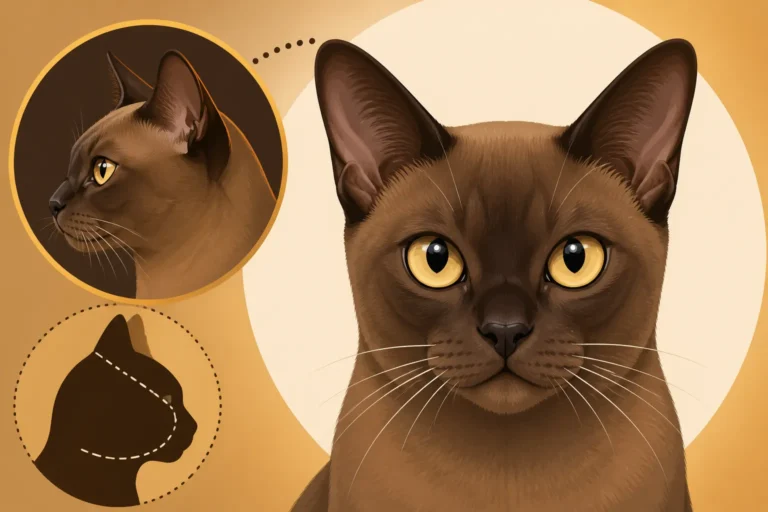
Burmese head shape varies between the American and European types, so there is no single outline to use as a universal test. The American Burmese is generally known for a rounder head and shorter muzzle. The European Burmese is typically more moderate, with a softer wedge-shaped outline. If you are comparing a Tonkinese with a European-type Burmese, the difference may be subtler than it would be with a round-headed American Burmese.
Tonkinese cats usually have a modified wedge-shaped head, with gently rounded contours rather than the very rounded look associated with the American Burmese. Their muzzle and cheek lines can look more moderate, too. Still, photographs can be deceptive: camera angle, facial expression, age, and even grooming can make a head appear rounder or narrower.
When studying a cat in person, look at the whole head rather than deciding by the nose or ears alone. Notice the width between the eyes, the shape of the cheeks, and how the muzzle fits into the face. For breed-standard details, compare What an American Burmese's Head Should Look Like with What a European Burmese's Head Should Look Like.
Coat pattern is often the clearest visible difference
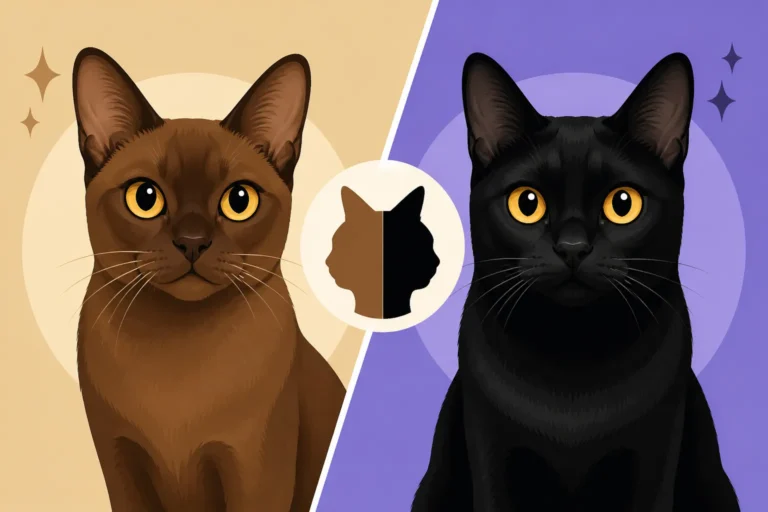
The coat can be one of the most helpful clues. Burmese cats are known for a close-lying coat with a relatively even, rich color across the body. The coat may be darker at cooler areas such as the face, ears, legs, and tail, but the overall impression is usually of a solid, shaded color rather than distinct points.
Tonkinese cats can have three recognized pattern types: solid, mink, and pointed. In a pointed Tonkinese, the face, ears, legs, and tail are noticeably darker than the body, much like the familiar Siamese pattern. A mink Tonkinese has a more subtle contrast, while a solid-pattern Tonkinese may look closer to a Burmese at first glance. That overlap is a common reason people mistake one breed for the other.
Color names can add another layer of confusion. A breeder or registry may use terms such as natural, champagne, blue, or platinum for Tonkinese colors, while Burmese color names vary by type and registry. Don’t rely on a color label in an online listing without checking what pattern it describes. The Burmese’s shading is explained in Why a Burmese Is Darker at the Extremities, and How to Tell a Burmese From a Tonkinese is a useful related comparison.
| Feature | Burmese | Tonkinese |
|---|---|---|
| General build | Compact, muscular, often surprisingly heavy for its size | Medium-built, athletic, often appearing more balanced or elongated |
| Head shape | American type is usually rounder; European type is more moderate | Usually a modified wedge with softly rounded contours |
| Coat pattern | Typically an even, shaded appearance | May be solid, mink, or pointed, with varying contrast |
| Eye color | Usually yellow to gold shades, depending on type and standard | Can vary with coat pattern, including blue, aqua, or greenish shades |
| Best proof of breed | Reliable pedigree and breeder records | Reliable pedigree and breeder records |
Eye color adds context, not certainty
Eye color can support what you’re seeing in the coat, but it is not a stand-alone breed test. Burmese eyes are generally in yellow-to-gold shades, though the exact wording and acceptable range depend on the breed type and registry. A Tonkinese may have blue eyes in a pointed pattern, aqua eyes in a mink pattern, or greenish to yellow-green eyes in a solid pattern.
Lighting makes this harder than it sounds. Indoor bulbs can make eyes look warmer or cooler, and phone cameras often shift color. A kitten’s eye color may also change as it matures, so one early photo is a poor basis for a firm identification. If a cat has blue or aqua eyes alongside visible point contrast, that combination may suggest Tonkinese, but it still does not prove ancestry.
Look at eye color alongside the coat pattern and head shape. A Burmese with gold-toned eyes and a fairly even coat may fit the breed’s typical appearance, while a Tonkinese with aqua eyes and a mink pattern may show a more mixed set of clues. For more detail on Burmese eye expectations, see Which Eye Color a Burmese Should Have.
Use records when appearance is not enough
Pedigree documents are more reliable than photos
If you are buying a kitten from a breeder, ask which breed and type the kitten is registered as, and request the pedigree or registration information that supports that description. For a Burmese, ask whether the breeder describes the cat as American or European type. For a Tonkinese, ask which coat pattern and color terminology the breeder is using.
A responsible breeder should be able to explain the kitten’s parents and provide clear paperwork rather than relying on a vague phrase such as “Burmese-looking.” If a seller advertises a cat as a purebred Burmese or Tonkinese but cannot explain its registration or lineage, treat the claim cautiously. A resemblance in a listing photo is not documentation.
If you’re adopting an adult cat, the shelter or rescue may have only an estimated breed label. That is common and does not mean anyone has done anything wrong; without pedigree records, many cats are best described as mixed-breed or Burmese-type rather than confirmed purebred. A vet can assess health and physical traits, but a visual exam alone generally cannot establish a pedigree.
DNA tests should not replace a documented history
People often hope a DNA test will deliver a simple answer. Genetic testing can provide information about ancestry or particular inherited traits, depending on the test, but it does not necessarily confirm that a cat meets a breed registry’s definition of Burmese or Tonkinese. A breed label and a cat’s physical resemblance are not the same thing as a documented pedigree.
If you are curious about an adopted cat, consider what you need to know. If the question is simply whether the cat looks more Burmese-like or Tonkinese-like, careful observation may be enough for everyday conversation. If the answer matters for registration, breeding, or a purchase decision, ask for records from the breeder or registry instead of treating appearance or a consumer test as definitive.
For a pet household, the cat’s personality, health care, and fit with your routine matter much more than having the perfect label. If you are preparing for a new cat, a retailer such as Chewy can be one option for browsing everyday basics like food bowls, litter, and carriers; those supplies are useful regardless of whether the cat is Burmese or Tonkinese. The breed label itself should come from reliable records, not a shopping listing.
Make a careful identification without overreading the clues
Follow a simple comparison process
When you are trying to tell a Burmese from a Tonkinese, work through the clues in an orderly way rather than fixating on one feature. Start with the overall build: does the cat look especially compact and dense, or more medium-built and elongated? Then look at the head, keeping in mind that American and European Burmese types differ.
Next, inspect the coat in natural light. Look for distinct points, a softer mink contrast, or a more even shaded appearance. Then consider eye color in combination with the pattern. If the clues point in different directions, that does not necessarily mean someone has misidentified the cat; the breeds share ancestry, and individual variation is real.
Finally, check whatever records are available. A useful order is:
- Ask for the registered breed and, if relevant, the Burmese type.
- Request pedigree or registration records from the breeder.
- Compare the cat’s build, head, coat pattern, and eyes as supporting clues.
- If records are unavailable, describe the cat cautiously rather than claiming certainty.
Remember that daily care does not depend on the label
Burmese and Tonkinese cats are both often people-oriented and active, but individual temperament varies. Don’t assume a cat will behave a certain way just because of its breed name. Spend time with the cat, ask about its habits, and consider whether your household can provide the attention, play, and companionship it needs. Which Household a Burmese Fits offers more context on matching a Burmese to a home.
If you’re setting up for either breed, focus on practical needs: a safe carrier, scratching surfaces, comfortable resting places, engaging toys, and a feeding routine suited to the individual cat. Chewy is one place people may browse for general cat supplies, but product choices should follow your cat’s needs and your veterinarian’s advice—not assumptions about breed. If you’re comparing food or accessories online, check the item details and make sure they fit the cat you actually have.
The most reliable answer comes from combining evidence without asking any single clue to do too much. A compact, gold-eyed cat with an even coat may look strongly Burmese; a cat with a modified wedge-shaped head and a mink or pointed coat may look more Tonkinese. But when there are no trustworthy records, the honest conclusion may be “Burmese-type,” “Tonkinese-type,” or simply “a cat with traits of both.” If you are looking for everyday supplies after bringing a cat home, Chewy may help you browse options, while a breeder’s paperwork or adoption records are the right place to look for identity.
Disclaimer
This article is for general informational purposes only and does not constitute professional advice. Laws, prices and regulations vary by location and change over time. Consult a qualified professional for guidance on your specific situation.