Why an American Burmese’s Muzzle Is Shorter
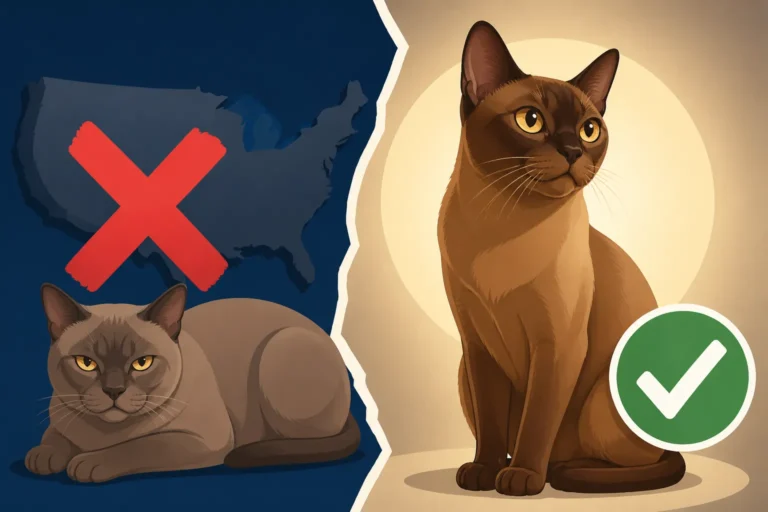
An American Burmese’s muzzle looks shorter because generations of selective breeding favored a compact, rounded head with a broad, clearly defined muzzle. That feature is part of the American Burmese type, not a sign that every individual cat has the same face or that the breed is flat-faced. Here’s how the American and European looks differ, what breeders and judges assess, and what the shape does—and does not—mean for health.
What makes an American Burmese muzzle look short
A compact head changes the proportions
The muzzle is only one part of the face. Its apparent length depends on how it sits within the head as a whole: the width of the cheeks, the curve of the skull, the position of the eyes and the transition from forehead to nose all affect what you notice when you look at a Burmese.
In the American Burmese, the desired head shape is generally rounded and compact, with a short nose and a broad muzzle. Because the cheeks and lower face have substantial width, the distance from the eyes to the nose can appear especially short. The effect is not simply “a small nose”; it is a set of facial proportions that make the face look full and rounded.
That can be surprising if you are used to seeing other cats with longer, more tapered faces. A Burmese may look as if its features are gathered toward the center of its head, especially when viewed from the front. From the side, the short nose and rounded forehead help create the breed’s characteristic profile. For a fuller look at the whole facial outline, see What an American Burmese's Head Should Look Like.
Selective breeding shaped the American type
Breed standards describe the appearance breeders work toward over generations. They do not mean that one person set out to create a short muzzle in isolation. Breeders select cats whose overall features fit the preferred type, then make careful mating choices to preserve those traits while maintaining sound structure and health.
Over time, American Burmese lines developed a more rounded, compact look than the lines that became known as European Burmese. That difference is most visible in the head, but it is not limited to the muzzle: the skull, cheeks, eyes and overall expression contribute to each type’s appearance. The history behind that divergence is explained in How the American and European Burmese Split.
It is also worth remembering that a standard describes a goal, not a guarantee that every cat will look identical. Two American Burmese can differ in how broad their muzzles seem, just as two cats from the same family may have different expressions. Age, sex, body condition, coat color, viewing angle and individual inheritance all affect what a face looks like in a photograph or in person.
How the American and European Burmese faces compare
The European Burmese has a more tapered outline
European Burmese cats are generally described as having a more moderate, less rounded head shape than the American type. Their face tends to look more wedge-shaped, and the muzzle may appear longer because the overall outline is less compact. The difference is one of type and proportion, rather than a simple distinction between “short-nosed” and “long-nosed” cats.
If you place photographs of the two types side by side, the European Burmese may appear to have a more noticeable taper from the cheekbones toward the muzzle. The American Burmese, by comparison, often looks rounder across the face. For a closer description of that outline, see What a European Burmese's Head Should Look Like.
These are broad tendencies, not a reliable way to identify every cat from a single snapshot. Camera angle can make a muzzle look shorter or longer, and a cat’s expression changes the apparent shape of its face. A head-on photo, for example, may emphasize cheek width, while a profile view can make the nose and forehead easier to assess.
| Feature | American Burmese type | European Burmese type |
|---|---|---|
| Overall head impression | Rounded and compact | More moderate and tapered |
| Muzzle appearance | Often looks short and broad | Often appears longer within a wedge-shaped outline |
| Facial proportions | Full cheeks and a rounded outline are prominent | The face generally narrows more toward the muzzle |
| What the difference means | A distinct breed type shaped by selection and standards | A distinct breed type shaped by a different development path |
| What it does not prove | That every American Burmese has an identical face | That every European Burmese has a long or narrow muzzle |
Standards assess the face as a whole
A show judge does not assess a Burmese by measuring only the muzzle. The head is considered in relation to the rest of the cat, including the skull shape, cheek fullness, eye placement, nose and overall balance. A feature that seems prominent on its own may look quite different when viewed as part of the whole head.
This matters because a short muzzle can be described casually as though it were a single, isolated trait. In practice, the desired appearance comes from a combination of features. A broad muzzle on a rounded head creates a different impression from the same muzzle on a narrower, more tapered face. The judging context is explored in How a Burmese's Head Is Judged.
The standards and registration systems can also affect how people talk about Burmese type. If you are looking at a breeder’s listing or pedigree, ask which type the cat is and which registry is relevant, rather than relying on a photo alone. The distinctions between the types are discussed in Whether the Two Burmese Types Are Separate Breeds and How CFA Registers a European Burmese.
What the shorter muzzle does and does not mean
It does not make an American Burmese a flat-faced cat
“Short muzzle” can sound alarming because people often associate a shortened face with extreme flat-faced breeds. Those descriptions should not be treated as interchangeable. The American Burmese is recognized for a rounded head and short, broad muzzle, but that does not automatically mean an individual has a severely flattened face or is experiencing breathing problems.
A breed’s appearance is not a substitute for checking a cat’s actual health. If a Burmese has noisy or labored breathing, persistent nasal discharge, difficulty eating, or other concerning symptoms, a veterinarian should assess the cat. Those signs should not be dismissed as normal just because the cat has a short-looking face.
When choosing a kitten, focus on the full picture: comfortable breathing at rest, normal activity, a clean face and eyes, and veterinary records. Ask the breeder how they prioritize health and temperament alongside appearance. A responsible conversation should not revolve only around whether a kitten’s muzzle looks especially short or whether its head seems especially round.
A shorter muzzle does not identify a cat’s type by itself
A short-looking nose can be a clue, but it is not enough to identify a cat as American Burmese. The rest of the head and body matter, as do the cat’s pedigree and registration. A mixed-breed cat may have a rounded face, and a Burmese from a particular line may not match the most exaggerated version of the type shown in an online photo.
If you are comparing Burmese with related breeds, remember that facial resemblance can be misleading. The Tonkinese, for example, has its own appearance and breed history, even though it is associated with Burmese and Siamese ancestry. How a Burmese Differs From a Tonkinese offers a useful comparison beyond the muzzle alone.
For prospective owners, the practical question is not just “Does this cat have a short muzzle?” It is “Do I understand the type I am considering, and can the breeder explain the cat’s background clearly?” Look for consistent information across the breeder’s description, pedigree, health records and the appearance of adult relatives. A kitten’s face can change as it matures, so avoid making a decision based only on a very young kitten’s proportions.
How to assess an American Burmese’s muzzle responsibly
Look at several angles and the entire head
When viewing a cat, try to see more than one clear angle. A front view helps show cheek width and the shape of the muzzle; a side view gives a better sense of the profile and the relationship between the forehead, nose and chin. If you are considering a kitten, seeing the parents or adult relatives can help you understand how features may develop, though no family resemblance is a guarantee.
Photos can distort proportions. A close-up taken with a phone camera may make the center of the face look larger or the muzzle look shorter than it does in person. Lighting, posture and expression also matter. If a breeder uses only tightly cropped face photos, ask for ordinary pictures or video that show the cat’s full head and body.
It may help to compare images against the relevant type’s standard rather than against a single online example. What a Burmese Looks Like Against the Standard can help you think about the cat as a whole rather than reducing the breed to one facial feature.
Ask questions that connect appearance with welfare
A good breeder should be comfortable explaining whether their cats are American or European type, how they make breeding decisions, and what health checks they perform. Ask to see the relevant paperwork and clarify which registry the pedigree uses. If the answer is vague or the seller treats a particular facial shape as proof of quality without discussing health, take time to investigate before committing.
You can also ask how adult cats in the line breathe, eat and maintain their weight. These questions are sensible even when a cat’s muzzle does not appear unusually short. They keep the conversation grounded in the individual animal’s wellbeing rather than in appearance alone.
Ultimately, the American Burmese’s shorter-looking muzzle is best understood as part of a rounded, compact head type developed through selective breeding. It is a recognizable distinction from the more tapered European Burmese outline, but it is only one feature among many. A healthy, well-cared-for cat matters more than how closely its face matches an idealized photograph.
Disclaimer
This article is for general informational purposes only and does not constitute professional advice. Laws, prices and regulations vary by location and change over time. Consult a qualified professional for guidance on your specific situation.