Why a European Burmese Kitten Is Usually Sold Abroad
It can be incredibly disheartening when you fall in love with the look and temperament of a European Burmese cat, only to find that securing a kitten within your home country feels like searching for a needle in a haystack. Many prospective owners get excited by the distinct appearance of the European type, imagining one joining their family, but quickly encounter a wall of limited availability. This guide aims to demystify why European Burmese kittens are primarily sold abroad, explaining the intricate historical, breeding, and logistical reasons behind their scarcity in certain regions.
The Historical Divergence of the Burmese Breed
To truly understand why European Burmese kittens are so often sold within their continent of origin, we need to rewind the clock and look at how the breed itself developed. What many new enthusiasts don't realize is that the "Burmese" isn't just one monolithic breed; it encompasses two distinct types that have evolved separately over decades, driven by different breed standards and geographic isolation.
Post-War Breeding Programs and Standards
The very foundation of the Burmese breed began in the United States with a single cat named Wong Mau. The Burmese Began With One Cat Called Wong Mau. From this remarkable cat, American breeders carefully established the breed. However, as the Burmese gained popularity and spread to other parts of the world, particularly post-World War II, different breeding programs emerged. In Britain, for example, breeders began to develop their lines with slightly different ideals for head shape, body type, and overall conformation. These differing visions led to the formal recognition of two distinct types: the American Burmese and the European Burmese (often just called "Burmese" in Europe).
Adding to this complexity, there were moments of significant upheaval in the breed's early history, such as when the CFA (Cat Fanciers' Association) suspended Burmese registration in 1947 due to concerns about hybrid crosses. CFA Suspended the Burmese in 1947 and Took It Back. While CFA eventually reinstated the breed, this period allowed the British lines to solidify their separate trajectory, focusing on their own interpretation of the ideal Burmese. The result was a clear split in how the breed was developed and perceived across the Atlantic. How the American and European Burmese Split.
Geographic Isolation and Gene Pools
Think of it like two separate islands forming from a single landmass. Once separated, the populations on each island evolve independently. This is essentially what happened with the Burmese. The ocean, coupled with different breeding goals, created two distinct gene pools. Breeders in Europe focused on perpetuating the characteristics they valued, often exchanging breeding stock only with other European breeders. This meant that the genetic traits defining the European type became concentrated within that geographic region.
For instance, the genetic diversity within the European Burmese lines became quite specific, leading to a smaller overall gene pool compared to its American counterpart in some areas. Why the European Burmese Gene Pool Is Smaller. This isn't necessarily a bad thing, but it means that the characteristics that make a European Burmese unique are strongly entrenched within those lines. Importing a cat from one continent to another for breeding purposes involves considerable expense, time, and logistical challenges, naturally discouraging extensive cross-continental breeding, especially once the two types had diverged significantly. Breeders tend to work within their established networks, and these networks are typically geographically bound.
Understanding the Distinct Breed Standards
The core reason for the regional sales patterns isn't just history; it's also about what breeders are aiming for. The American and European Burmese are recognized as separate entities by many major cat registries, each with its own detailed description of the ideal cat. This means a breeder dedicated to the European type is working to produce kittens that fit that specific mold.
Key Physical Differences Between Types
When you see a European Burmese, you'll notice it has a distinct look compared to its American cousin. The European Burmese generally features a more wedge-shaped head, a longer muzzle, and ears that are often set a bit higher and are more pointed. Their bodies tend to be more svelte and elegant, giving them a slightly less compact appearance (see What a Burmese Looks Like Against the Standard). They still possess that wonderful "brick wrapped in silk" density but with a refined elegance.
In contrast, the American Burmese typically has a noticeably rounder head, a shorter, broader muzzle, and eyes that are rounder and set further apart. Their body is more cobby and compact. What an American Burmese's Head Should Look Like. Breeders in North America are working to perfect these traits, while European breeders focus on their own standard. This adherence to specific standards means that a European breeder isn't just producing "a Burmese cat"; they are producing a European Burmese cat, bred precisely to meet those distinct criteria. What a European Burmese's Head Should Look Like. Mixing these types would dilute the very traits they've worked so hard to establish.
Registry Recognition and Breeding Ethics
The breed clubs and registries play a huge role in maintaining these distinctions. Organizations like the GCCF (Governing Council of the Cat Fancy) in the UK or FIFE (Fédération Internationale Féline) in Europe explicitly recognize the European Burmese as its own type, with distinct standards. In North America, while TICA (The International Cat Association) recognizes both as different types, CFA maintains a single standard that is essentially the American Burmese. Which Registries Separate the Two Burmese Types. This divergence in official recognition reinforces the separation.
From a breeding ethics perspective, most reputable breeders of either type strongly advise against crossing American and European Burmese. Why the Two Burmese Types Are Not Crossed. The goal is to preserve the integrity of each line. A European Burmese breeder invests years in developing their specific lines to consistently produce kittens that embody the European standard. Introducing American genetics could undo generations of careful breeding, leading to kittens that don't conform well to either standard. This commitment to type preservation is a primary reason why European Burmese breeders prefer to sell their kittens within a community that understands and values these distinctions, often within Europe itself.
Practicalities of Breeding and Export
Beyond history and breed standards, there are very tangible, practical reasons why European Burmese kittens are usually sold abroad rather than being widely available internationally. These come down to logistics, cost, and the specialized nature of breeding.
The Economics of International Breeding
Breeding cats is already an expensive endeavor, even when operating locally. When you start talking about international breeding, the costs skyrocket. For a North American breeder to establish a European Burmese line, they would need to import breeding stock directly from Europe. This isn't just buying a kitten; it involves significant expenditures on:
- Purchase price: European Burmese kittens with breeding rights can be quite costly.
- Travel expenses: Airfare for the cat, potentially for the breeder to accompany it or a dedicated pet transport service. What Importing European Burmese Lines Costs.
- Veterinary checks and certifications: Extensive health screenings, vaccinations, and official documentation required for international travel.
- Quarantine: Depending on the destination country, a quarantine period might be necessary, incurring daily boarding fees.
- Registration fees: Registering an imported cat with local registries can add further costs.
- Time and stress: The logistical headache and emotional toll on both the animal and the human involved are considerable. For example, What Importing a Burmese From Britain Involves highlights many of these complexities.
Given these hurdles, it’s understandable why only a very small number of dedicated breeders outside of Europe would undertake such an expensive and complicated process. This naturally limits the number of European Burmese available in other markets, making them a rarity in places like the United States or Canada.
Limited Local Demand and Breeder Focus
Even if a handful of European Burmese found their way to other continents, the existing market might not be large enough to sustain many breeders. In North America, the American Burmese is the dominant type, widely available and deeply loved. The demand for the distinct European type, while growing, remains a niche interest.
This means that breeders committed to the European standard often focus their efforts on their established European clientele, where there's a recognized appreciation and consistent demand for their specific type. They build relationships with other breeders and pet owners within this community. How Many European Burmese Breeders Work in America indicates just how few breeders there are working with these lines outside of Europe. Their efforts are concentrated on maintaining their lines and finding suitable homes within their immediate sphere, where the nuanced differences of the European Burmese are understood and sought after. This isn't to say they wouldn't sell internationally, but the primary sales channels and network are often within Europe itself.
Finding a European Burmese Kitten (If You're Abroad)
So, what if your heart is truly set on a European Burmese, and you live outside of Europe? It's not impossible, but it requires dedication, patience, and a willingness to navigate international processes.
Connecting with Specialized Breeders
Your first step will be to connect directly with breeders in Europe who specialize in the European Burmese type. Start by looking at breed club websites for countries like the UK, France, Germany, or the Netherlands, which are strongholds for the European Burmese. These sites often list registered breeders. You might also find independent breeder websites or groups on social media platforms that focus specifically on this type.
When you find potential breeders, be prepared to introduce yourself thoroughly. They'll want to know about your home environment, your experience with cats, and why you're interested in their specific lines. Reputable breeders are extremely selective about where their kittens go and will appreciate your genuine interest. Don't be shy about asking for health clearances, pedigree information, and references. It's crucial to ensure the breeder is transparent about genetic testing for conditions common in Burmese, such as hypokalemia or diabetes predisposition. Which Diseases a Burmese Breeder Must Declare is a good starting point for understanding what information a responsible breeder should provide.
The Realities of Importing a Kitten
If you find a breeder willing to sell you a kitten internationally, be ready for a significant undertaking. Importing a pet is a complex process with many steps and costs.
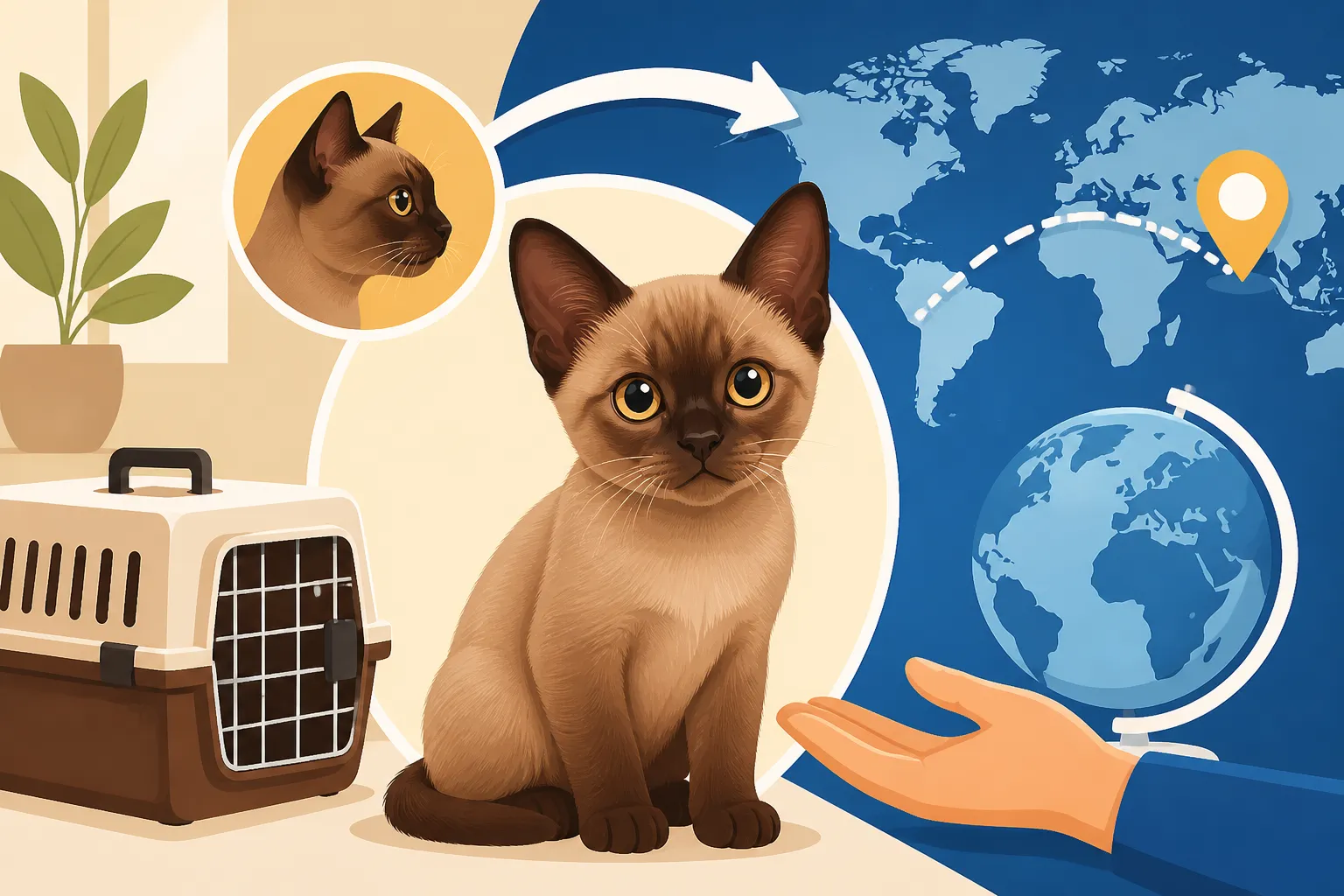
First, research the import regulations for your specific country. This includes vaccination requirements, necessary health certificates, and any quarantine periods. These rules can change, so always check with your country's agriculture or pet import authority. The cost of a kitten will be just one part of your budget; you'll also need to factor in international air travel for the kitten. Whether a Burmese Should Travel in the Cabin or the Hold can give you insights into the considerations for feline air travel.
Consider using a specialized pet transport service. While more expensive, these services handle all the logistics, paperwork, and ensure the animal's welfare during transit. They can be invaluable in navigating customs and ensuring a smooth journey for your new family member.
Here's a quick overview of what you might expect when considering an international adoption of a European Burmese kitten:
| Aspect | American Burmese (Local) | European Burmese (Imported) |
|---|---|---|
| Availability | Relatively high, many breeders | Very limited, often requires international sourcing |
| Cost of Kitten | Standard breeder prices for your region | May be higher due to demand/rarity, plus export fees |
| Travel Costs | Local transport or short car ride | International airfare, potential customs fees |
| Health Certs | Standard domestic vet checks | Extensive international vet checks, export certificates |
| Quarantine | Typically none | Possible, depending on destination country |
| Timeframe | Can be weeks to a few months | Can be several months, often longer due to logistics |
| Logistics | Relatively simple, direct communication with local breeder | Complex, may involve pet transport agencies and multiple authorities |
| Stress on Kitten | Minimal | Potentially higher due to longer travel and new environment |
Remember to factor in insurance for your imported kitten. Providers like Healthy Paws can offer peace of mind, but be sure to check their policies regarding pre-existing conditions or any waiting periods. When it comes to daily care, high-quality food can be shipped to your door, ensuring your kitten gets the best nutrition regardless of its origin.
Ultimately, while challenging, bringing a European Burmese kitten into your non-European home is a dream that can be realized with diligent research, patience, and a healthy budget.
Disclaimer
This article is for general informational purposes only and does not constitute professional advice. Laws, prices and regulations vary by location and change over time. Consult a qualified professional for guidance on your specific situation.