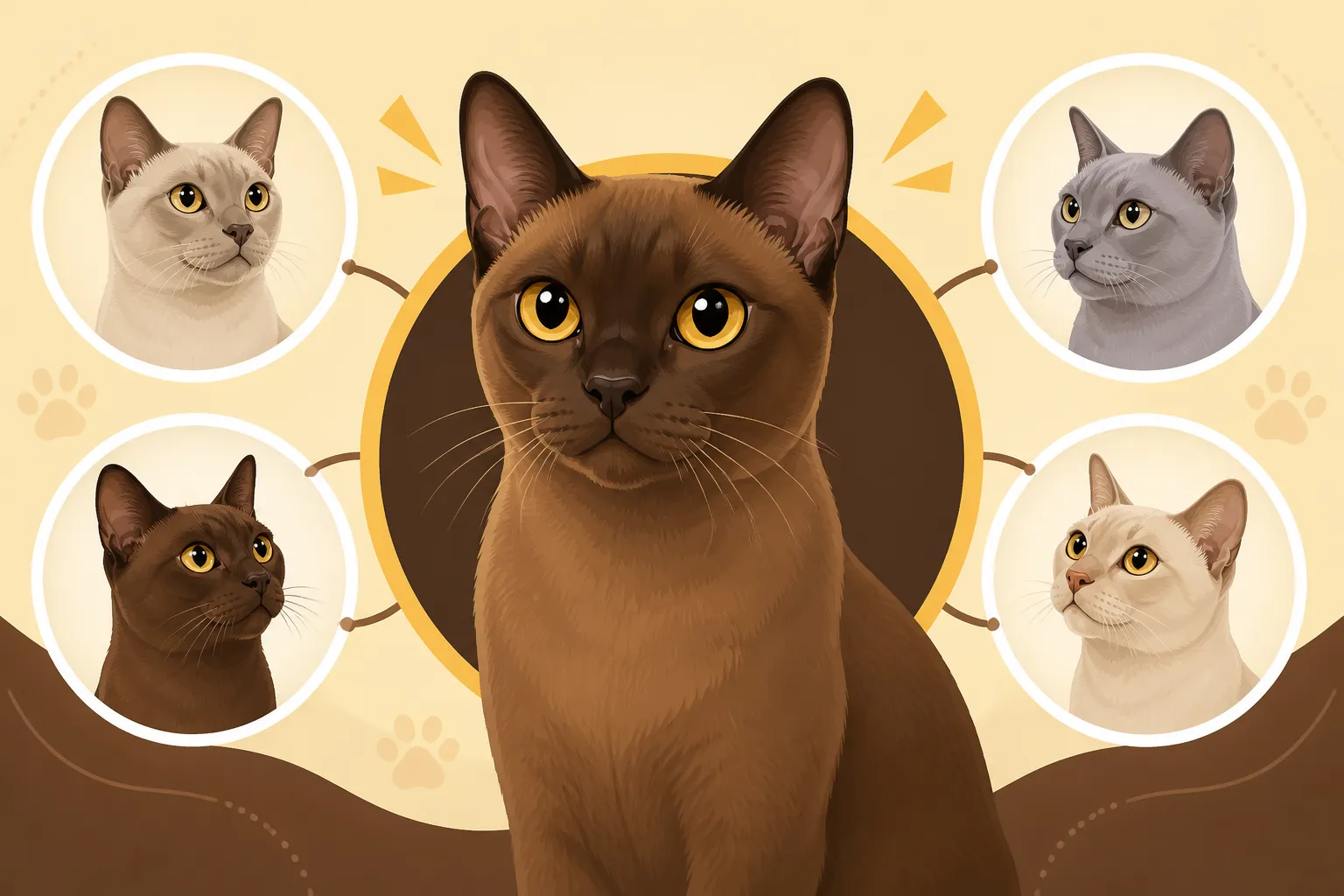
Which Other Breeds Carry the Burmese Color Gene
A cat can carry the Burmese color allele without looking Burmese, and two cats from related breeds can have very different coats because they inherited different versions of the same color gene. This guide explains which breeds may carry the Burmese allele, how it differs from Siamese colorpoint, and why breed ancestry alone cannot confirm a cat’s genetic makeup.
What the Burmese color gene actually is
The Burmese allele is one version of a color gene
The phrase “Burmese color gene” is commonly used for the cb allele, a version of the tyrosinase gene that affects how pigment develops in a cat’s coat. It is more precise to call it an allele rather than a separate gene. The allele influences pigment production in a temperature-sensitive way, so coat color can be deeper on cooler parts of the body and paler on warmer areas.
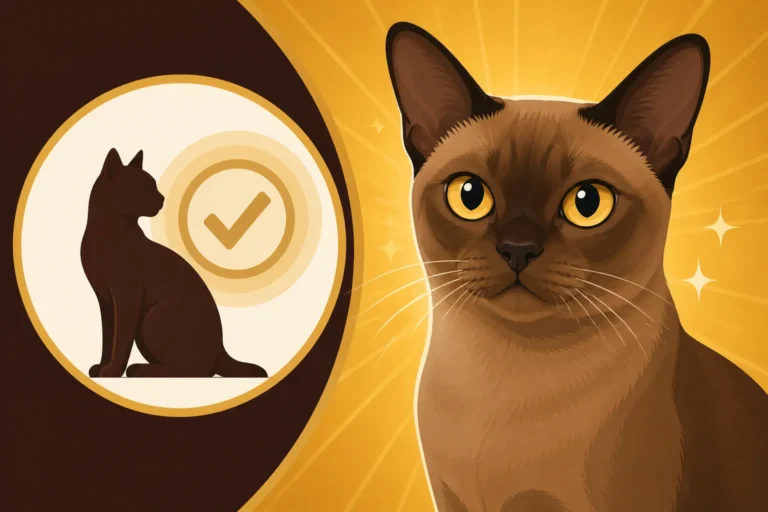
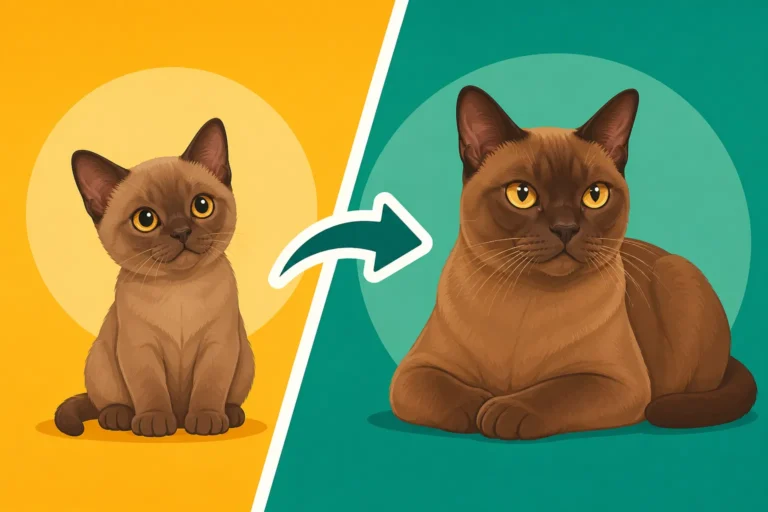
In a Burmese cat, two copies of the Burmese allele—one inherited from each parent—usually produce the characteristic solid, shaded sepia appearance. The exact shade varies, and a kitten’s coat can deepen as it matures. For a fuller explanation of the color effect, see What the cb Allele Does to a Burmese's Color and What Two Copies of cb Produce in a Burmese.
A cat with just one copy of cb may look fully colored if it also has a copy of the dominant full-color allele, often written as C. That cat can still pass cb to its kittens. In other words, a Burmese-looking coat is not the only clue that a cat might carry the allele—and a cat that looks nothing like a Burmese could still have it.
Alleles at the same gene can produce different patterns
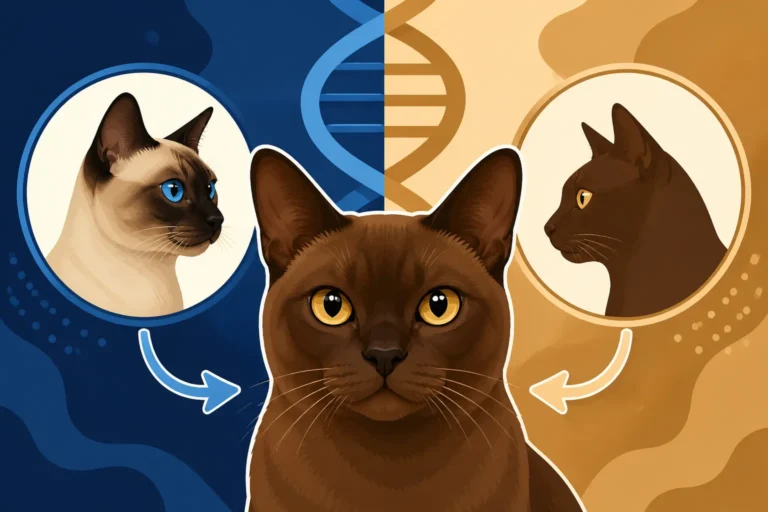
The Siamese colorpoint pattern involves another allele at the same gene, commonly written cs. It is also temperature-sensitive, but it produces the familiar contrast of a pale body and darker points on the face, ears, paws, and tail. The Burmese cb and Siamese cs alleles are related variations at the same gene, but they are not interchangeable.
When a kitten inherits one cb allele and one cs allele, the result is often called a mink pattern, associated with the Tonkinese. The coat typically has more contrast than a Burmese coat but less than a traditional Siamese colorpoint. The pairing explains why Burmese and Siamese ancestry can meet in a breed without every kitten looking like either parent. What Happens When Burmese and Siamese Genes Meet and What a Burmese Bred to a Siamese Produces explore that inheritance in more detail.
| Inherited combination | Common color description | What it means |
|---|---|---|
| cb/cb | Burmese sepia | Two Burmese alleles are present |
| cb/cs | Mink | One Burmese allele and one Siamese colorpoint allele are present |
| cs/cs | Siamese colorpoint | Two Siamese colorpoint alleles are present |
| C/cb | Usually full color | The cat may carry cb without showing Burmese shading |
| C/cs | Usually full color | The cat may carry cs without showing Siamese points |
These descriptions are useful general patterns, not a substitute for a pedigree or genetic test. Other color genes can affect the final appearance, and terminology differs among registries and breeding communities.
Breeds that may carry the Burmese allele
Tonkinese cats carry Burmese and Siamese color ancestry
The Tonkinese is the clearest example of a breed associated with both Burmese and Siamese color alleles. Its characteristic mink appearance is commonly linked to inheriting cb from one parent and cs from the other. That combination gives the coat an intermediate contrast, although individual cats can vary in shade and pattern.
The Tonkinese developed through Burmese and Siamese breeding, and the relationship between the breeds is part of its history. Still, not every Tonkinese should be assumed to have an identical genetic background based on appearance alone. A cat’s actual alleles depend on its parents and family line. For a look at the breed’s origins, read How the Tonkinese Was Made From a Burmese.
The distinction matters if someone is trying to predict kitten colors. A mink-colored Tonkinese may pass either cb or cs to a kitten, while a cat with a different genotype may pass a different allele. The other parent’s genes matter just as much, so coat color cannot be reliably predicted from one parent’s breed label alone.
Bombay cats may inherit cb through Burmese ancestry
The Bombay was developed using Burmese cats and black American Shorthair cats. Because of that history, some Bombay lines may carry the Burmese allele even though the breed is known for its sleek black coat. A black cat can carry a recessive color allele without displaying it; its visible coat does not prove that cb is absent.
That does not mean every Bombay carries cb, or that every black cat with Burmese ancestry will pass it on. It depends on whether the allele remained in that particular line and whether the cat inherited it. If a Bombay has a full-color allele paired with cb, the black coat may conceal the carrier status. The breed’s development is described in How the Bombay Was Made From a Burmese.
This is a good example of why appearance and ancestry should not be treated as the same thing. A breed may have Burmese ancestry without every member carrying the cb allele, and an individual cat may carry the allele while showing no obvious Burmese shading.
Burmese-derived Asian breeds can have varied color genetics
In Britain, cats developed from Burmese lines and other breeds became part of the wider Asian group, which includes cats with a range of coat types and patterns. Because Burmese ancestry may occur in some family lines, cb may also be present in some individuals. But “Asian” is not a guarantee that a particular cat has the allele. The pedigree and specific breeding history are what matter.
The Burmilla is another breed with Burmese ancestry, originating from a Burmese and a Chinchilla Persian. That history makes the possibility of Burmese alleles relevant to certain lines, but it does not establish that every Burmilla carries cb. A breed’s origin tells you where to ask questions; it does not confirm the genotype of an individual cat. See How the Burmilla Was Made From a Burmese for more on that breed’s beginnings.
Breed populations can also change over time as breeders select for different coat colors and patterns. An allele found in an early foundation cat may become uncommon or disappear from some lines, while remaining in others. That is why broad statements such as “all cats of this breed carry the Burmese gene” are usually too strong without population-wide testing.
Breeds that are often confused with carriers
Siamese cats have a related allele, not the Burmese allele
Siamese cats are relevant to this discussion because their colorpoint pattern involves the cs allele at the same gene. But a Siamese is not automatically a carrier of the Burmese cb allele. Sharing a gene location does not mean sharing the same allele: cb and cs are distinct versions with different effects on coat color.
The difference becomes especially visible when the alleles meet in a Tonkinese-type combination. A cat with cb/cs has a different color pattern from a cat with cs/cs, even though both alleles are temperature-sensitive. This is why “Burmese-type gene” and “Siamese gene” should not be used as if they mean the same thing. How to Tell a Burmese From a Tonkinese can help explain the visible differences between the breeds.
Burmese ancestry does not prove a cat carries cb
A cat may have a Burmese somewhere in its family tree and still not inherit cb. Each kitten receives one allele at this gene from each parent, and which allele is passed on depends on the parents’ own genetic combinations. A distant ancestor’s coat color cannot tell you exactly what a descendant inherited.
The reverse is also true: a cat that does not look Burmese may carry cb. For example, a cat with a dominant full-color allele and one cb copy may have a coat that does not reveal the carrier status. This is why visual identification is unreliable when the question is whether an individual cat can pass the Burmese allele to kittens.
Breed labels can add another layer of confusion. The American and European Burmese developed along different paths and are described by different standards in some registries. A cat’s registration and pedigree can clarify its breed background, but neither a breed name nor a coat description alone guarantees a specific genotype. How the American and European Burmese Split and Why the British Burmese Went a Different Way offer useful background on those distinctions.
How to find out whether an individual cat carries cb
Start with reliable pedigree information
If you are considering a kitten from a breeder, ask about the parents’ registered breed, pedigree, and any available color-genetics information. Ask the breeder to explain what is known about cb in the specific line, rather than relying on a general statement about the breed. A clear answer should distinguish between confirmed test results, known parentage, and an assumption based on appearance.
For a cat from a shelter or rescue, the history may be incomplete. A Burmese-like coat can be a clue to appearance, but it does not prove that a cat is a purebred Burmese or has two cb copies. Likewise, a solid black or brown coat does not rule out a hidden carrier allele. When ancestry is unknown, avoid treating a visual guess as a genetic result.
Pedigree details are most useful when they trace the relevant ancestry across multiple generations. If the question concerns potential kittens, ask about both parents: a single parent’s breed or color cannot determine what the litter will inherit. Understanding What the First Burmese Litter Told Thompson can also provide historical context for how early Burmese and Siamese breeding shaped the modern color genetics.
Use genetic testing when the answer matters
A genetic test may be appropriate when a breeder needs to understand coat-color inheritance or when a cat’s genotype is important for a planned mating. Before ordering a test, confirm with the laboratory that its panel tests the specific TYR variant associated with the Burmese cb allele. A test for general breed ancestry is not necessarily the same as a test for a particular color allele.
A result should be interpreted in context. Knowing that a cat carries cb does not, by itself, identify the cat’s breed, prove its pedigree, or predict every detail of a kitten’s coat. It tells you about one genetic factor. Other inherited color alleles and modifiers can influence what the coat looks like.
If you are not breeding and simply want to understand your pet’s coat, testing may not be necessary. A cat can be a wonderful companion regardless of whether its color comes from Burmese ancestry, another breed history, or a mix of influences. The practical takeaway is simple: Tonkinese and some Burmese-derived lines are the most relevant places to look for cb, but only an individual cat’s genetics can confirm whether it carries the allele.
Disclaimer
This article is for general informational purposes only and does not constitute professional advice. Laws, prices and regulations vary by location and change over time. Consult a qualified professional for guidance on your specific situation.