What an American Burmese’s Head Should Look Like
A Burmese may look round at a glance, but the American Burmese head has a particular balance of broad curves, full cheeks, a short muzzle, and large round eyes. That can be tricky to judge in kitten photos, where age, angle, and expression change the impression. This guide explains the features to look for and how to compare them fairly.
The overall shape of an American Burmese head
A rounded head with no sharp planes
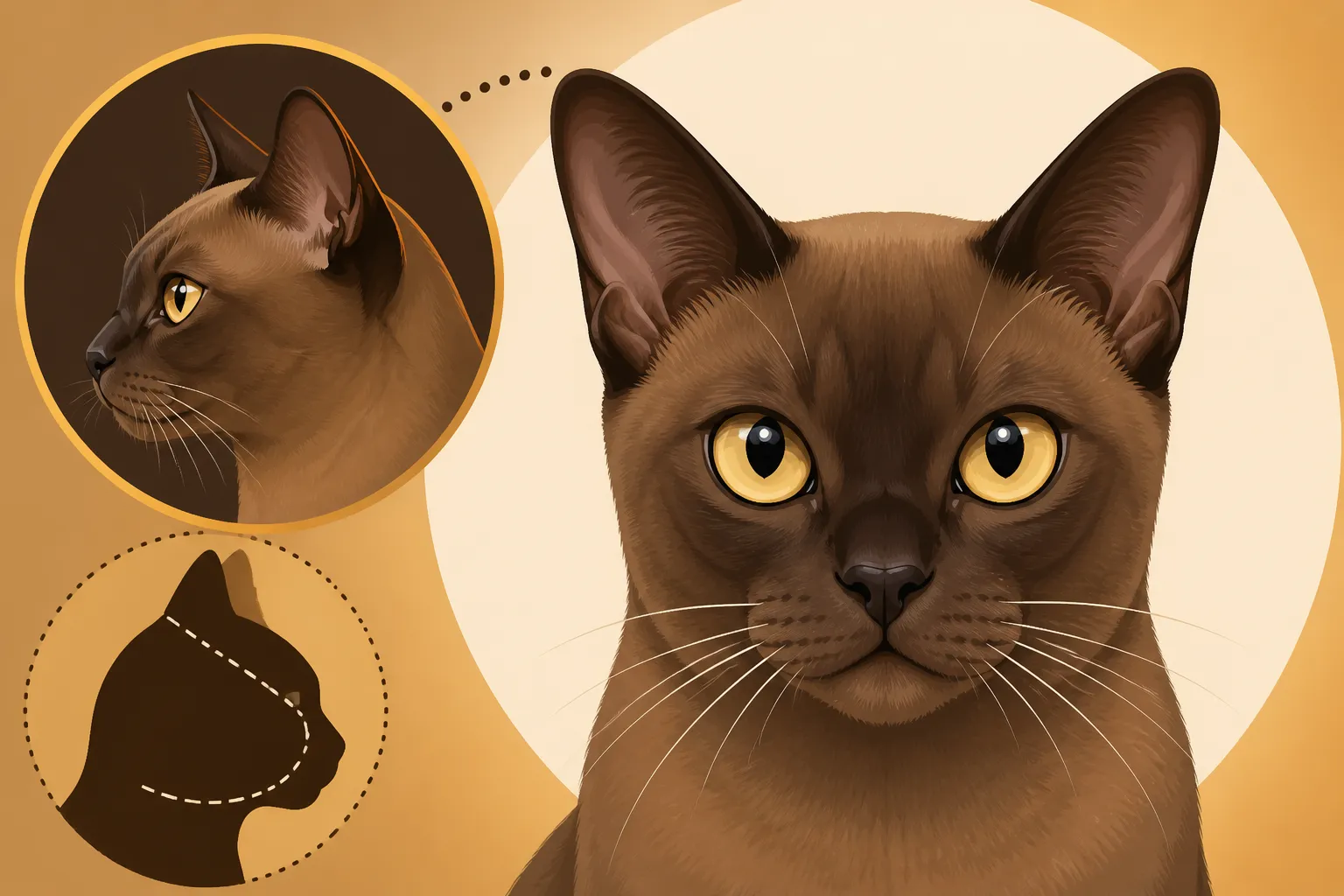
The American Burmese head is meant to look rounded and full rather than long, wedge-shaped, or sharply angular. Look at the whole outline: the forehead, cheeks, and muzzle should flow into one another in soft curves. A strong example can appear almost circular from the front, but it should still have definition and a balanced expression—not a featureless ball shape.
Photos can be misleading. A close-up taken with a phone camera may make the muzzle look larger or the head look narrower than it is. A cat looking slightly downward may seem to have a flatter forehead, while a side angle can exaggerate the nose. When possible, compare front and profile views, and look at the cat in a relaxed, natural posture.
The head is judged as part of the overall Burmese type, not as a collection of isolated features. A broad head paired with a fine, elongated muzzle may look less balanced than a head where the width, cheek fullness, and muzzle shape work together. For a broader overview of judging, see How a Burmese's Head Is Judged.
Full cheeks and a short, broad muzzle
The cheeks should look full, adding to the breed’s rounded appearance. The muzzle is short and broad, with a gentle transition from the cheek area toward the nose. It should not look long and narrow, nor should it appear pinched or pointed. The aim is a compact, pleasing shape that keeps the face soft and substantial.
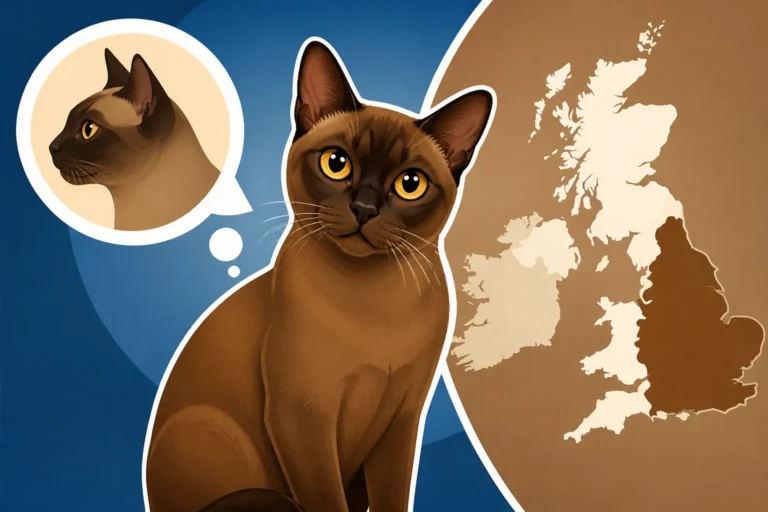
The American Burmese is often described as having a shorter muzzle than the European Burmese. That difference is about the overall type, not a reason to treat every small variation as a fault. Age, sex, body condition, and family lines can all affect how full a cat’s face appears. A kitten’s cheeks may not yet have the same mature look as an adult’s.
If you are comparing the two types, use a consistent angle and look at the head as a whole rather than focusing only on the nose. Why an American Burmese's Muzzle Is Shorter explains that characteristic in more detail, while What a European Burmese's Head Should Look Like offers a useful comparison.
A firm chin and a balanced profile
From the side, the profile should look compact and balanced, with a short nose and a defined transition around the nose. The chin should be firm and fit the face rather than receding noticeably or jutting forward. The idea is not to find one dramatic profile feature; it is to see whether the forehead, nose, muzzle, and chin form a harmonious line.
A side-on picture is especially useful when assessing a kitten or adult, but it should not be treated as a complete verdict. The cat may be stretching, turning, or holding its mouth in an unusual position. A breeder or judge will consider multiple views and the cat’s overall structure, not one frozen moment.
For the wider context of proportion and type, What an American Burmese Standard Asks For is a helpful companion topic. It’s also worth keeping in mind that the head should complement the breed’s compact, muscular body rather than look delicate or disconnected from it.
Eyes and ears that complete the expression
Large, round eyes set well apart
The American Burmese is known for large, round eyes that contribute strongly to its open, alert expression. They should look round rather than oval or slanted, and they are generally set far enough apart to suit the broad head. The eyes are a major part of the expression, but they should be considered alongside the cheeks and muzzle rather than judged alone.
Eye color is typically in the yellow-to-gold range. The precise shade can vary, and lighting can make it hard to assess in a photograph. A warm indoor bulb, a bright window, or phone-camera processing can all shift the apparent color. For a fair comparison, view the cat in natural, indirect light if you can.
If you are unsure whether an eye looks round enough, compare photographs taken at eye level rather than from above. How Round a Burmese's Eyes Should Be and How a Burmese's Eye Color Is Judged cover those traits more closely. Remember that a squint, watery eye, or sudden change in appearance is a health question, not a breed-standard feature; ask a veterinarian about persistent or new symptoms.
Medium ears with rounded tips
The ears should be medium in size, broad at the base, and rounded at the tips. They should sit in a way that complements the width and shape of the head. Ears that look very large, sharply pointed, or unusually high-set can change the face’s overall impression, even if the other features seem close to the desired type.
In pictures, ear position can change dramatically with mood. A cat listening to a sound may turn its ears outward, while a relaxed cat may hold them more forward. This is why a single photo is not enough to assess ear set. Look for several images, or observe the cat when it is calm and facing forward.
The ears should not overwhelm the eyes or make the head appear narrow. A useful comparison is to look at the outline from the front and then at a three-quarter angle. That gives you a better sense of how the ears fit into the rounded head shape.
| Feature | What to look for | What can mislead you |
|---|---|---|
| Head outline | Broad, rounded contours | Camera angle or a tilted head |
| Cheeks | Fullness that supports the rounded face | Age and individual maturity |
| Muzzle | Short, broad, and balanced | A close-up lens that enlarges the nose |
| Chin | Firm and in proportion to the muzzle | A cat holding its head at an odd angle |
| Eyes | Large, round, and well spaced | Lighting, squinting, or image editing |
| Ears | Medium, broad at the base, rounded at the tips | Ears turned toward a sound |
How to assess a Burmese head fairly
Use several views instead of one flattering photo
When you are looking at a cat online, try to find a front-facing view, a side profile, and a relaxed three-quarter view. These angles answer different questions. The front view helps you judge width, eye spacing, and the general roundness of the face. The profile gives you a clearer look at the muzzle and chin. A three-quarter view helps connect those features into one overall impression.
Kitten photographs deserve extra caution. Young cats are still growing, and their faces may change as they mature. Fur, posture, and expression can also make a young Burmese look more or less rounded than it will later. Ask for recent, unfiltered photographs if you need a clearer comparison, and do not treat a single attractive pose as proof of adult structure.
It helps to compare cats of a similar age and type. American and European Burmese are not simply different labels for the same appearance; their standards and typical head shapes differ. How the American and European Burmese Split gives useful background, and How to Tell a Burmese From a Tonkinese can help when another breed’s head shape is part of the comparison.
Separate breed type from health and grooming concerns
A breed-standard description is not a health diagnosis. Eye discharge, persistent squinting, facial swelling, difficulty eating, or a sudden change in the way a cat holds its head should not be explained away as “just how the face looks.” Those changes call for veterinary attention, especially if they appear suddenly or come with reduced appetite or discomfort.
Routine care should also be kept separate from judging. If a veterinarian recommends gently cleaning around the eyes, use a soft, clean pad and follow that advice rather than scrubbing or applying unapproved products. Some owners find basic pet-care supplies through retailers such as Chewy, but product choice should follow the veterinarian’s guidance. Chewy is a place to check for simple supplies, not a substitute for an exam if the eye itself looks irritated.
For an ordinary healthy cat, the head’s appearance is best assessed when the cat is comfortable, clean, and not squinting or resisting handling. A relaxed expression makes it easier to see the natural shape. If you are preparing for a show or evaluating a pedigree cat, refer to the relevant registry’s standard and ask an experienced breeder or judge to explain how they assess the features together.
Keep the head in proportion with the whole cat
The Burmese is compact and muscular, often feeling heavier than its outline suggests. A head that looks rounded and broad should still make sense with the cat’s body and overall proportions. What a Burmese's Body Type Is Called explains the compact build that helps give the breed its characteristic presence.
This is another reason not to judge from a cropped headshot alone. A tight crop can hide whether the cat has the sturdy build that complements its head, and a low camera angle can make the face seem more massive. When comparing cats, look at full-body images as well as close-ups, and take note of posture, maturity, and condition.
If you are choosing a kitten, ask the breeder which Burmese type the kitten belongs to and which standard they are following. The type should be clear in the pedigree and the breeder’s explanation. A clear answer is more useful than trying to infer everything from a photograph, especially when the kitten is still growing.
Common mistakes when judging the American Burmese head
Mistaking roundness for exaggeration
“Round” does not mean every feature should be pushed to an extreme. A face can be broad without looking distorted, and the muzzle can be short without appearing compressed. The best impression comes from the relationship between the head, cheeks, eyes, nose, and chin. If one feature dominates, pause before deciding that the cat represents the type well.
Breed descriptions can also lead people to over-focus on a phrase such as “full cheeks” or “large eyes.” Those traits matter, but they do not replace the overall assessment. Think in terms of balance: do the eyes suit the width of the head, does the muzzle fit the cheeks, and does the profile look coherent?
Comparing different ages, angles, or Burmese types
A kitten and a mature adult are not fair visual comparisons. Neither are two cats photographed from different distances or under different lighting. Before drawing conclusions, try to match age, angle, and photo quality as closely as possible. If that is not possible, treat your impression as tentative rather than definitive.
The same care applies when comparing American and European Burmese. Their differences are meaningful, and each should be viewed against the appropriate standard. A feature that seems less typical in one type may be more consistent with another. For more background on the split, revisit How the American and European Burmese Split and compare the relevant type-specific descriptions.
Treating a photo as a final judgment
Online photographs are useful for an initial impression, but they cannot show everything. A photo may be edited, taken at an unhelpful angle, or selected to emphasize a particular feature. If you are making a serious decision about a kitten, ask questions about the cat’s type, maturity, pedigree, and the breeder’s interpretation of the standard.
A calm conversation is often more informative than a string of close-ups. Ask the breeder to describe what they see in the kitten’s head now and what they expect to change as it matures. If you are assessing a show prospect, consult an experienced judge or breed mentor familiar with the applicable registry standard.
Disclaimer
This article is for general informational purposes only and does not constitute professional advice. Laws, prices and regulations vary by location and change over time. Consult a qualified professional for guidance on your specific situation.