Which Color Codes Appear on a Burmese Pedigree
A Burmese pedigree can show a color as a word, a short letter code, or a combination of both, depending on the registry that issued it. That can make a kitten’s paperwork feel harder to read than it should be. This guide explains the common Burmese color codes, what they usually mean, and how to check them without mistaking a color label for a health or breed guarantee.
Why Burmese pedigree color codes vary
A pedigree is a record of a cat’s registered identity and ancestry, not a universal code sheet. The same Burmese color may be written differently by different registries, and a code used in one system may not translate neatly into another. Before decoding a letter, identify which organization issued the paperwork.
Check the registry before interpreting the code
Look near the top of the pedigree or registration certificate for the registry’s name. The document may use a full organization name, an abbreviation, or a logo. This detail matters because cat registries do not all use the same breed labels, color names, or shorthand.
Some European systems use an alphanumeric format in which a breed abbreviation is followed by a color code. In the EMS system, for example, BUR is commonly used for Burmese, while a lowercase letter can identify a color. Other registries may print the color as a word, use a different abbreviation, or record the cat under a different breed designation.
So if you find a code that looks like BUR n, do not assume that every registry would write the same cat’s color in the same way. Read the code using the issuing registry’s key or ask the breeder to explain the notation on that specific document. You can also compare the pedigree with How a Burmese's Color Is Registered to understand why registration practices matter.
A color code is not the same as a registration number
Pedigrees often place several kinds of information close together: a cat’s registered name, registration number, date of birth, sex, breed, color, and parentage. It is easy to confuse a short color code with part of an identification number, especially if the layout is cramped or the certificate has been scanned.
A registration number identifies the cat in the registry’s records. A color code describes the registered coat color. Neither one is a DNA test result, a health-screening result, or proof that a cat has a particular temperament. If the certificate includes health or genetic information, it should be clearly labeled and supported by the relevant test documentation.
For example, a pedigree might identify a cat as a Burmese and list its color as blue. That tells you how the registry recorded the cat’s appearance; it does not, by itself, tell you whether the cat was screened for an inherited condition. Those are separate questions to ask the breeder.
Common Burmese color names and codes
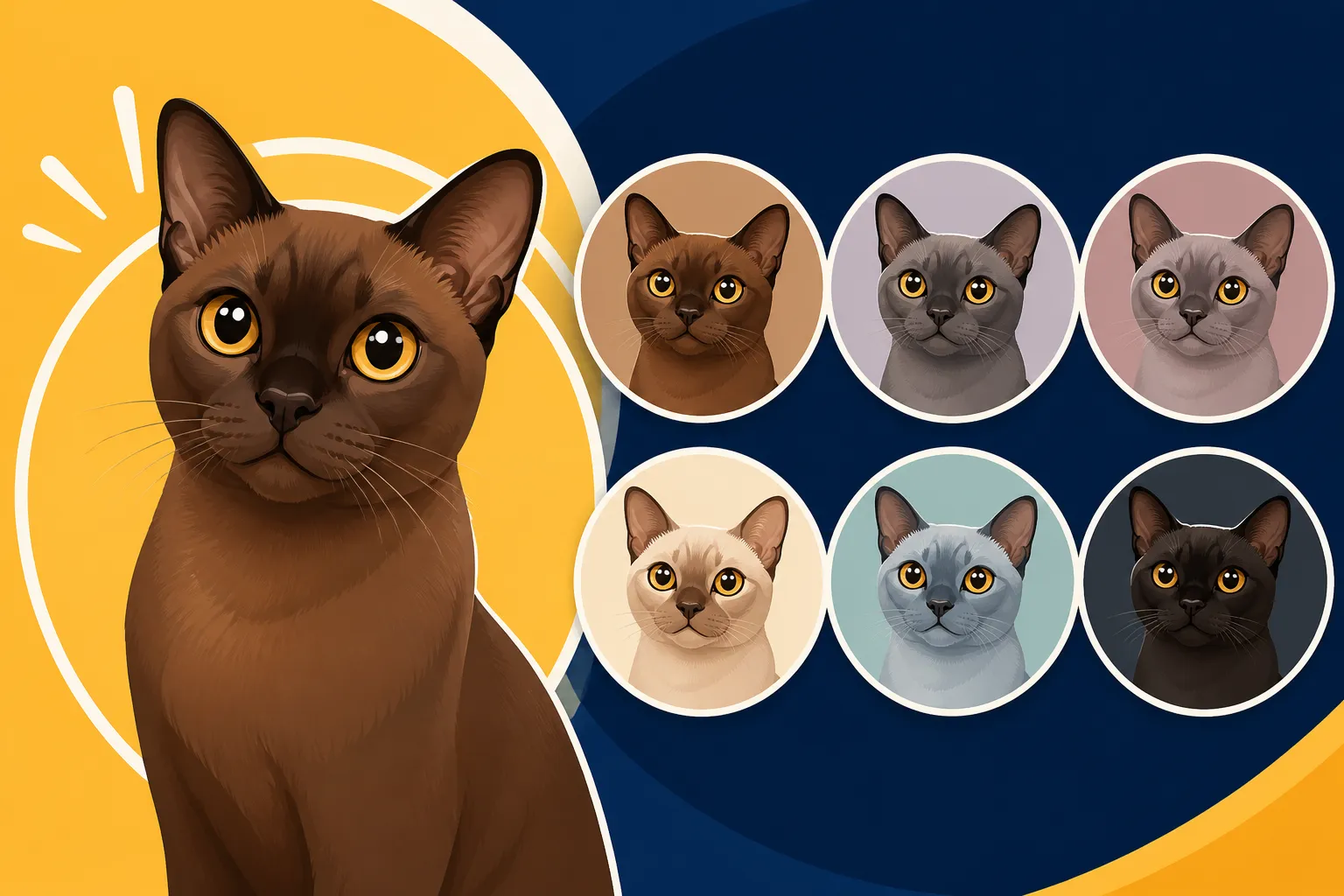
The most familiar Burmese colors depend partly on which Burmese type and registry you are looking at. American Burmese are commonly associated with four colors: sable, champagne, blue, and platinum. European Burmese registries may recognize a broader range, including red, cream, and tortoiseshell varieties. The standards and accepted color lists are not identical, so a code should always be read in context.
Common EMS color codes
In EMS-style notation, the color is generally represented by a letter after the breed abbreviation. The following are common Burmese color associations in that system:
| EMS-style code | Common color name | Notes |
|---|---|---|
| BUR n | Brown | Often called sable in American Burmese contexts |
| BUR a | Blue | A diluted version of brown-based coloring |
| BUR b | Chocolate | Often called champagne in American Burmese contexts |
| BUR c | Lilac | Often called platinum in American Burmese contexts |
| BUR d | Red | Recognized in some European Burmese systems |
| BUR e | Cream | Recognized in some European Burmese systems |
| BUR f | Black tortie | A tortoiseshell combination |
| BUR g | Blue tortie | Blue combined with red-toned patches |
| BUR h | Chocolate tortie | Chocolate combined with red-toned patches |
| BUR j | Lilac tortie | Lilac combined with cream-toned patches |
These are useful reference points, not a promise that every pedigree will use the same wording or format. A registry may use a different breed abbreviation, show the color in plain language, or include additional notation. If a document lists a color you do not recognize, ask for the registry’s official color key rather than guessing from one letter.
Color names can also shift between traditions. For instance, the word brown in one system may refer to a color commonly called sable in another. The genetic relationship is more useful than the label alone, which is why The Four Colors a Burmese Comes In and The cb Allele Is What Makes a Burmese Brown can help clarify the background behind those names.
American and European color labels do not always match
American Burmese descriptions often use the terms sable, champagne, blue, and platinum. In many European contexts, related colors may be described as brown, chocolate, blue, and lilac. These pairs are commonly used as corresponding names, but the wording on a pedigree still depends on the registry and its rules.
It is tempting to see two different names and conclude that the cats must be different colors or even different breeds. Usually, the first step is simply to check which color vocabulary the registry uses. For a broader explanation of the color lists, see Which Colors CFA Accepts in a Burmese and Which Colors the European Burmese Standard Adds.
The distinction between American and European Burmese is not just a matter of color terminology. The types have developed under different standards and registration practices. If a pedigree uses a color name you have not seen before, check the breed type and registry as well as the color itself. How the American and European Burmese Split provides context for why paperwork and terminology may differ.
How to read the color entry on a pedigree
Once you have identified the registry, look for the section labeled color, coat, or variety. The entry may be written in words, as a code, or as both. Compare the color entry for the cat with the entries for its parents, but remember that a kitten’s appearance and its registered color do not tell the whole story about inherited genes.
Read the full entry, not one letter in isolation
A code often makes sense only as part of a complete notation. In an EMS-style entry, the breed abbreviation points to the breed, while the following letter indicates color. Other letters or numbers may be used for pattern or additional registry details. Do not treat one letter pulled out of a longer code as a universal Burmese color label.
If the pedigree lists a color name rather than a code, that is perfectly normal. Some paperwork is designed for breeders and registry staff, while other documents are easier for pet owners to read. The absence of a familiar code does not automatically mean the pedigree is incomplete or suspicious.
When anything is unclear, ask the breeder for three specific details: the name of the registry, the registry’s written color designation, and an explanation of how that designation maps to the cat’s visible color. A responsible breeder should be able to point to the paperwork and explain the terminology without pressuring you to accept a guess.
Compare the kitten with its parents carefully
A kitten’s coat can change as it grows, and Burmese coloring is influenced by temperature-sensitive pigmentation. The coat may deepen or shift in appearance over time, particularly at cooler areas of the body. That means a young kitten may not look exactly like the adult cat pictured in a breed guide.
This is one reason a photograph alone is a poor way to confirm a registered color. Lighting, camera settings, age, and the kitten’s coat development can all affect how a shade appears. A warm indoor photo may make a blue coat look darker; a bright window can make a pale coat seem almost cream.
The color entry should be interpreted alongside the registry’s description and the cat’s age, not as a demand that the kitten match a particular online image. For more on how Burmese color develops, see How a Burmese's Color Deepens Where It Is Cool and How a Burmese's Color Gene Reacts to Temperature.
What a pedigree color code can and cannot tell you
A color code is useful, but it answers a narrow question: how the registry recorded the cat’s coat color. It does not establish everything a new owner may want to know about a Burmese, from ancestry to health history. Keeping those categories separate helps you ask clearer questions and avoid reading too much into one line of paperwork.
Use the pedigree as one part of the record
A pedigree can help confirm registered ancestry and show how a cat is identified within a registry. It may also make it easier to understand whether a breeder is working with American or European Burmese lines, depending on the registry and the details recorded. But a pedigree is not a complete medical file.
Ask separately for veterinary records, any relevant screening results, vaccination information, and the terms of the purchase or adoption agreement. If the breeder says a color or health status is “guaranteed,” ask what document supports that statement. A coat-color entry should never be treated as a substitute for a test certificate.
It can help to keep the pedigree with other records in a folder or secure digital file. If you use Chewy for regular food orders, your order history may also help you remember when you changed a food or treat. That history is useful for your household notes, but it does not verify the cat’s pedigree or replace records from the breeder or registry.
Keep color, genetics, and appearance distinct
A color name describes what the coat looks like or how it is registered. A genetic test, where relevant, examines a specific inherited trait. Appearance can be influenced by age and environmental conditions, while a pedigree records information according to the registry’s rules. These are related ideas, but they are not interchangeable.
For example, seeing a chocolate-toned kitten does not let you determine its complete genetic makeup from appearance alone. Likewise, knowing the registered color does not prove which alleles the cat carries. If you are interested in how a Burmese color is inherited, ask the breeder what testing or parentage records are available and what those records actually establish.
For everyday care, focus on the cat in front of you rather than trying to infer its needs from the color code. Record weight, diet, veterinary visits, and any changes in coat or appetite. If you keep household notes in the same place as your Chewy receipts, you can track product changes alongside observations—but treat those notes as personal records, not formal medical evidence.
Questions to ask when a Burmese color code is unclear
It is completely reasonable to ask for an explanation before signing paperwork or taking a kitten home. A clear answer should identify the registry and explain the notation in plain language. If the explanation keeps changing, or the breeder cannot show the original registration information, pause and ask for clarification before relying on the code.
A helpful checklist:
- Which registry issued this pedigree? Find the name or abbreviation on the document.
- What does this exact color entry mean in that registry? Ask for the written color name as well as the code.
- Is the cat registered as an American or European Burmese? The type may affect the standards and terminology you encounter.
- Does the color name differ from the everyday name I know? Ask whether, for example, the registry’s wording corresponds to a familiar American term.
- Are health tests documented separately? Request the actual test records rather than relying on the color entry.
- Can I keep a copy of the registration paperwork? Keep it with veterinary and ownership records.
A Chewy order history can help you track routine supplies after your cat comes home, but keep registry documents and breeder-provided test records in a separate, clearly labeled folder. If you use Chewy for food, note the product name and the date of any change in your care log. This simple habit makes it easier to explain a diet change to your veterinarian without confusing purchase records with pedigree information.
The main rule is simple: identify the registry first, then decode the entry using that registry’s conventions. Burmese color terminology can vary, and the same shade may be described by different names in different systems. A little context turns a confusing string of letters into a useful piece of your cat’s record.
Disclaimer
This article is for general informational purposes only and does not constitute professional advice. Laws, prices and regulations vary by location and change over time. Consult a qualified professional for guidance on your specific situation.