Why the Tonkinese Is Half Burmese
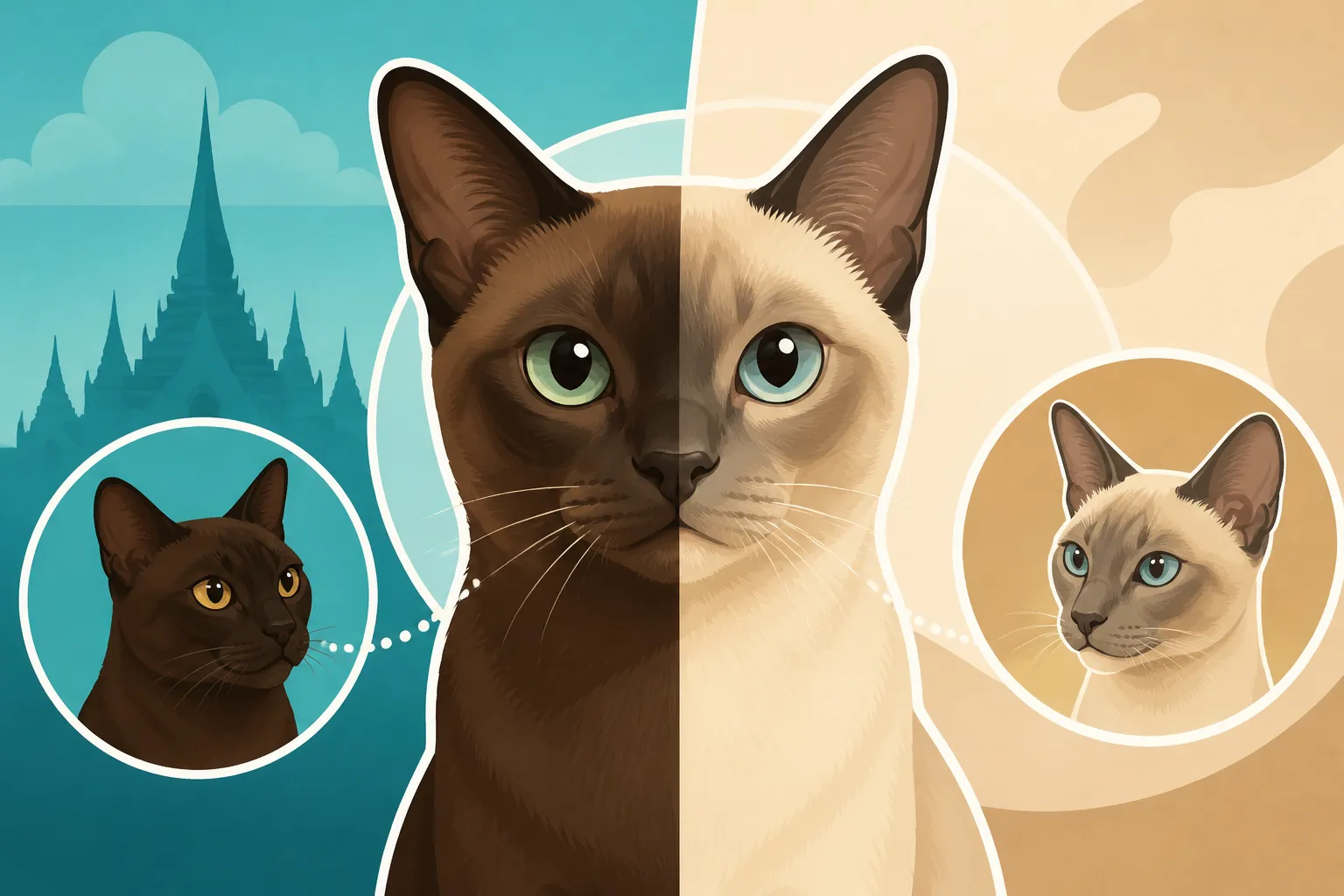
A Tonkinese is often described as “half Burmese,” which sounds like every cat carries an exact 50 percent share of Burmese ancestry. The history is a little more nuanced: breeders deliberately combined Burmese and Siamese cats to develop the Tonkinese, but its defining look and modern pedigree aren’t a simple genetic halfway calculation.
Why the Tonkinese Is Called Half Burmese
The breed was developed from Burmese and Siamese cats
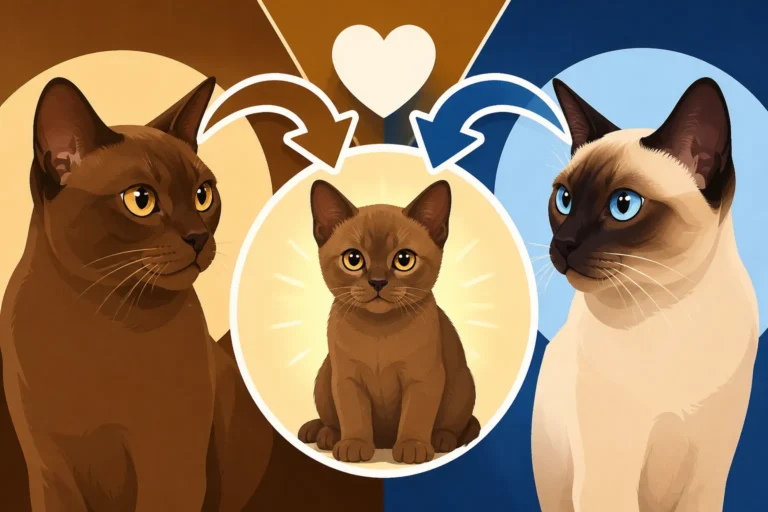
The Tonkinese was developed through planned matings between Burmese and Siamese cats. Breeders wanted a cat that brought together qualities associated with both: the Burmese’s compact, muscular build and rich coat coloring, alongside the Siamese’s more contrasting points and distinctive coloring. The aim was not simply to create a Burmese with a different coat, but to establish a recognizable breed of its own.
The idea of combining these two types was not entirely new. Early Burmese breeding history also involved Siamese ancestry, and some of those crosses produced cats that looked intermediate between the two. But the Tonkinese developed through later, deliberate breeding programs that selected for a consistent combination of physical traits and color patterns. For more on the earlier relationship between the breeds, see What Happens When Burmese and Siamese Genes Meet.
That history is why “half Burmese” is a useful shorthand: it points to one of the Tonkinese’s founding breeds. But it shouldn’t be read as a guarantee that any individual Tonkinese has exactly half its DNA from a Burmese and half from a Siamese. Breed ancestry is established through pedigrees and breeding history, not by dividing a cat’s appearance into equal shares.
“Half” describes ancestry, not a guaranteed genetic percentage
A Tonkinese may have Burmese and Siamese ancestors in its pedigree, but the exact contribution from each ancestor depends on the cat’s family tree. Genes are inherited in combinations, and a kitten doesn’t receive a perfectly equal bundle of visible traits from each side. Even littermates can differ in appearance despite having the same parents.
The word “half” is especially easy to misunderstand because it can sound like a precise DNA-test result. In everyday breed descriptions, it usually means that Burmese and Siamese cats were used to create the breed. It does not mean that every Tonkinese is a first-generation Burmese-Siamese cross, or that a simple appearance check can reveal an exact ancestry percentage.
Modern Tonkinese breeding also aims to produce Tonkinese cats, rather than repeatedly recreating the breed from scratch. A kitten’s registered breed and type depend on its documented ancestry and the rules of the relevant registry. If you’re comparing the two breeds’ backgrounds, How a Burmese Differs From a Tonkinese explains why related ancestry doesn’t make them interchangeable.
The Tonkinese became a distinct breed
A breed can begin with crosses between two established types and still become a separate breed over time. As breeders select cats with a particular combination of features, those features become more consistent across generations. The Tonkinese is recognized for its own blend of body type, coat pattern, and eye color—not merely for being a Burmese-Siamese mix.
That distinction matters if you’re choosing a kitten. Two cats may share Burmese ancestry and still have different breed identities, temperaments, and physical characteristics. A breeder’s pedigree and registration information tell you more than a casual label such as “half Burmese.” For the broader story of how the breed took shape, see How the Tonkinese Was Made From a Burmese and Why the Tonkinese Sits Between Burmese and Siamese.
How Burmese and Siamese Genetics Shape the Tonkinese
Coat color comes from a shared temperature-sensitive gene
One of the most interesting connections between Burmese, Siamese, and Tonkinese cats is the gene involved in their coat color. These breeds are associated with forms of a temperature-sensitive color pattern: pigment develops more strongly in cooler parts of the body, such as the face, ears, paws, and tail. That is why a cat may have darker extremities than its torso.
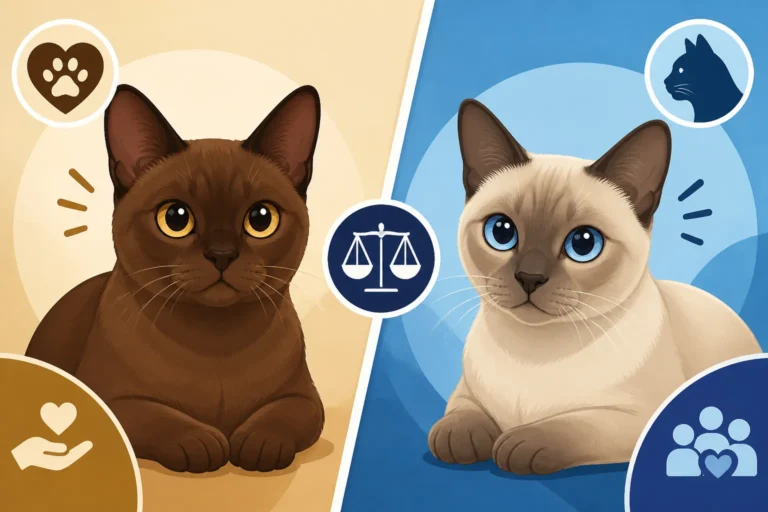
The Burmese and Siamese versions of this pattern are often described with the symbols cb and cs. A typical Burmese pattern is associated with two Burmese-type copies, while a typical Siamese pointed pattern is associated with two Siamese-type copies. Tonkinese mink coloring is commonly associated with one copy of each. This genetic combination helps explain why mink Tonkinese coloring often looks intermediate: more contrast than a Burmese sepia coat, but less contrast than the sharply pointed Siamese pattern.
That explanation is useful, but it is not a complete visual identification test. Coat shade, age, temperature, and individual variation affect how a cat looks. A kitten’s color may also deepen as it matures. To understand the Burmese side of this color inheritance, see The cb Allele Is What Makes a Burmese Brown and Why a Burmese Is Darker at the Extremities.
The three common patterns help show the difference
Tonkinese cats are commonly described as having three coat patterns: mink, pointed, and solid or sepia. Mink is the pattern most people associate with the breed because it often shows a moderate contrast between the body and the darker points. Pointed cats typically have stronger contrast, while sepia cats tend to have a more even, shaded appearance.
These patterns can make the relationship to the Burmese and Siamese easier to picture, but they are not a simple set of labels for “half this” and “half that.” The genes involved influence coat color and pattern; they do not turn a cat into a precise visual average of its parents. Tonkinese eye colors also vary with pattern, with aqua often associated with mink cats, while pointed and sepia cats may have different eye-color ranges.
| Breed or pattern | Common color appearance | What it suggests |
|---|---|---|
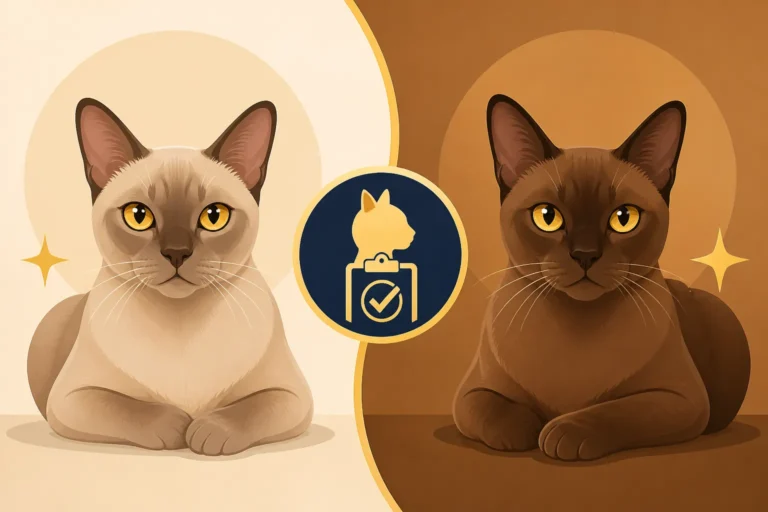
| Burmese sepia | More even, shaded coat with darker areas | Burmese-type color expression |
| Siamese pointed | Strong contrast between pale body and dark points | Siamese-type color expression |
| Tonkinese mink | Intermediate contrast between body and points | A combination of Burmese- and Siamese-type color alleles |
Think of this table as a helpful visual guide, not a way to confirm a cat’s breed. Coat pattern can suggest how certain color genes are expressed, but documented pedigree is what supports a breed designation.
A Tonkinese isn’t simply a color between two breeds
The Tonkinese is often called an “in-between” cat because its coat pattern can appear intermediate. But that phrase can undersell the breed. Tonkinese cats have their own recognized type, and their appearance is influenced by more than one color gene. Their body shape, head, coat texture, and eye color all contribute to the overall look.
A buyer might see a mink kitten and assume it is automatically a Tonkinese, or see a brown cat and assume it is a Burmese. Neither conclusion is reliable from color alone. Similar-looking coats can appear in cats with different backgrounds, and colors can shift as a kitten grows. If you’re interested in the Burmese’s color development, Why a Burmese Kitten Darkens as It Grows offers useful context.
How the Tonkinese Differs From a Burmese
Their bodies and overall appearance are not identical
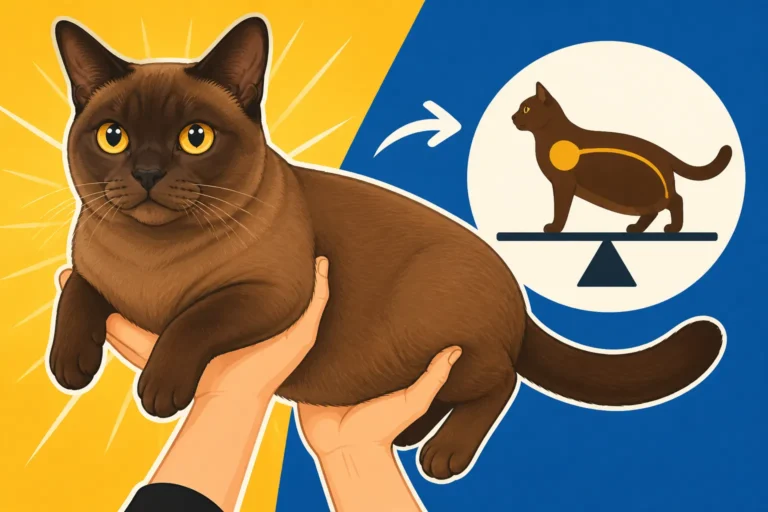
Burmese cats are known for a surprisingly solid, muscular feel beneath a short, close-lying coat. They can feel heavier than their size suggests, which is why the breed is sometimes described as a “brick wrapped in silk.” Tonkinese cats are also athletic and muscular, but their proportions and breed standard are distinct. The two breeds may share traits without having the same body type.
Their heads and facial features are another area where the breeds shouldn’t be treated as interchangeable. Burmese standards differ by type, and Tonkinese cats have their own standard as well. A photograph can flatten these differences, especially when the cats have similar coat shades. Seeing a cat move and comparing its full build is often more informative than focusing on its color alone.
If you’re trying to identify a cat from a listing or family photo, check the pedigree and registration details rather than relying on a single feature. The guides How to Tell a Burmese From a Tonkinese and What a Burmese Looks Like Against the Standard can help you understand what breed-specific traits to look for.
Coat pattern is a clue, not proof of breed
A Tonkinese mink coat may look like a middle ground between a Burmese and a Siamese, but appearance alone cannot establish ancestry. Lighting can change how dark a coat seems, and the coat may shift with age. A kitten photographed in bright daylight may look noticeably different from the same cat indoors or after its coat has matured.
When you’re considering a kitten, ask the breeder which registry records the cat, what its pedigree shows, and how the breeder describes its pattern. A responsible breeder should be able to explain those details plainly instead of relying on a vague phrase like “half Burmese.” If supplies are part of your new-cat planning, Chewy can help you compare basics such as litter, food bowls, and carriers; breed identification, though, should come from the cat’s records and knowledgeable breeder.
Shared ancestry doesn’t mean identical personality
Burmese and Tonkinese cats are both often described as social, people-oriented breeds, but no breed label can predict every individual cat’s behavior. A cat’s early socialization, health, household routine, and past experiences all matter. One Tonkinese may be a constant companion, while another may be more independent; the same variation exists among Burmese cats.
It’s also worth thinking about the practical needs behind the affectionate reputation. A highly social cat may need daily play, attention, and company, not just a full food bowl and a sunny windowsill. Before bringing one home, consider how much time people are actually in the house and how the cat will cope when routines change. You can explore the Burmese side of that question in Whether a Burmese Is the Right Cat for You.
For a new kitten, plan for a quiet adjustment period, a secure carrier, scratching surfaces, and food that matches the kitten’s current diet at first. If you’re comparing everyday supplies, Chewy can be one place to review options, but ask the breeder what the kitten already eats and use your veterinarian’s advice when changing diets.
What “Half Burmese” Means When Choosing a Tonkinese
Ask what the breeder means by the phrase
If a breeder advertises a kitten as “half Burmese,” ask whether they mean the Tonkinese breed’s historical Burmese ancestry or that the kitten is a direct cross between a Burmese and a Siamese. Those descriptions are not the same. The first refers to the breed’s origins; the second describes a particular mating and may have different implications for registration and how the kittens are represented.
Request the kitten’s pedigree and registration information, and ask which breed name will appear on its paperwork. A clear answer should connect the kitten’s parentage to the breeder’s claims. If the explanation keeps changing, or if the seller can’t show basic records, treat that as a reason to pause and ask more questions.
You can also ask how the breeder describes the kitten’s coat pattern and expected adult appearance. A knowledgeable breeder should be comfortable explaining that color can change and that visual traits don’t provide a mathematical ancestry breakdown. For background on the Burmese’s own development, Which Siamese the First Burmese Was Bred To and What Thompson's Program Proved About the Burmese provide helpful historical context.
Use pedigree and health information, not a DNA guess
A consumer DNA test is not a substitute for documented pedigree when you’re trying to confirm a registered breed. Genetic tests can examine particular inherited traits or health variants, but those results do not necessarily establish a cat’s full breed history. If ancestry matters to you, request breeder documentation and verify that the details are consistent.
It’s equally sensible to ask about health screening and the health history of the kitten’s parents. Ask what veterinary care the kitten has received, whether the breeder provides health records, and what ongoing support is available after you bring the cat home. Keep copies of the paperwork in one place so you can share it with your veterinarian.
When you bring a Tonkinese home, focus on the individual cat rather than expecting it to behave exactly like a Burmese or Siamese. Set up a predictable feeding and play routine, provide places to climb and rest, and introduce new rooms gradually. If you need to gather everyday care supplies, Chewy may be useful for comparing products, while your veterinarian can help tailor food and health decisions to your cat.
The simplest accurate way to understand the phrase is this: the Tonkinese was developed using Burmese and Siamese ancestry, and its appearance can reflect traits associated with both. “Half Burmese” explains part of the breed’s history, but it is not a precise percentage claim or a substitute for the Tonkinese’s own identity, pedigree, and individual characteristics.
Disclaimer
This article is for general informational purposes only and does not constitute professional advice. Laws, prices and regulations vary by location and change over time. Consult a qualified professional for guidance on your specific situation.